Kalshi vs. Polymarket September 2026: Comparing Top Prediction Markets

Kalshi vs. Polymarket US isn’t a one-size-fits-all choice. If you’re in the U.S. and trying to figure out which one actually fits how you want to trade, this guide is here to help.
We’ll start our Kalshi vs. Polymarket US comparison with the key details: how to legally use each platform, how contracts work, and what the latest Kalshi and Polymarket promo code offers look like.
There's plenty on the board to use both welcome offers. NFL Week 2 opens Thursday, September 17, with the Lions vs. Bills game, and runs through Giants vs. Rams on Monday night; college football Week 3 kicks off Saturday with Lane Kiffin's return to Ole Miss vs. LSU; and MLB plays nightly until the regular season ends September 27.
When ready, feel free to click either of our links above (or any others found throughout this page) to claim the Polymarket or Kalshi promo code offers. Traders can even claim each offer once, meaning you can start things off with a bonus regardless of platform.
🗝️ Kalshi vs. Polymarket Key Takeaways for September 2026
| 🏆 Category | 🟢 Kalshi | 🔵 Polymarket |
|---|---|---|
| ⭐ Promo Code | ACTION55 | ACTION |
| 🤑 Welcome Bonus | Trade $25, Get $55! | Deposit $10, Get a $50 Trading Bonus! |
| 📝 Full Terms and Conditions | Certain limitations apply. The offer is available to new users only, subject to the terms and conditions. 18+ only. Restrictions and eligibility requirements apply. Event contract trading involves significant risk and is not appropriate for everyone. Please carefully consider if it is appropriate for you in light of your personal financial circumstances. Kalshi products are not available in all jurisdictions. See kalshi.com/regulatory for more information. Not available in AZ, IL, MA, MD, MI, MT, NV, OH, and WA. | 18+ Only. Restrictions and eligibility requirements apply. Not available in all jurisdictions. Trading is risky. 100% loss can occur. See polymarket.com/tos for more information. The Polymarket US App serves as an independent software provider and affiliate of Polymarket US and Polymarket Clearing, the CFTC-regulated exchange and clearing organization. |
| 🏆 Best Fit For | Traders who want more categories, browser access, and lots of funding options. | Traders who prefer an app-first experience and the lowest taker fees, with maker rebates on resting orders. |
| 🌎 Legal Status | Kalshi has held designated contract market status since November 2020. | QCX LLC, doing business as "Polymarket US", received designated contract market status in July 2025. |
| 🪙 Platform Type | A federally-regulated exchange with its own order books, market rules, and settlement procedures. | A federally-regulated, dollar-based product that operates separately from Polymarket International. |
| 💳 Payment Methods | ACH, credit cards, cryptocurrency, digital wallets and wire transfers. | ACH bank transfers, debit cards, wire transfers, and Apple Pay through the U.S. app. |
| 📊 Available Markets | Huge market coverage with sports, politics, culture, crypto, commodities, climate, economics, finance, technology, and other event contracts. | Sports, politics, and other U.S. event markets. Availability changes, and the U.S. menu is separate from Polymarket International. |
| 📈 Crypto Perpetual Futures | Yes. BTCPERP started on June 3, 2026. Ethereum and XRP were added later that month, and now there are 13 different cryptocurrencies included in Kalshi's contracts. | No |
| 💰 Trading Fees | Taker fees peak at $1.75 per 100 contracts at 50¢ and fall toward either extreme. Makers pay a reduced fee. Certain markets use different multipliers. Schedule dated 7 July 2026. | Taker fees peak at $1.50 per 100 contracts at 50¢ and fall toward either extreme. Makers receive a rebate. Active traders above $250,000 in monthly volume earn taker rebates of 10–50%. Schedule effective 1 July 2026. |
| 📖 Order Books | Liquidity varies by contract. Check the bid, ask, and available size. | Polymarket has deeper liquidity in global and political markets, though it varies by contract and shouldn't be inferred from Polymarket International volume. |
| 💸 Payout Structure | A standard winning binary contract settles at $1, while the losing side settles at $0, subject to the listed market rules. | A winning U.S. binary contract settles at $1 and the losing side at $0, subject to the contract terms. |
In short: Polymarket US costs less to trade, running about 14% cheaper on taker fees at 50 cents; Kalshi charges roughly 17% more on the same order and pays makers a rebate where Kalshi charges them. Kalshi counters with wider market coverage, more funding methods, desktop and app access, and crypto perpetual futures that Polymarket US doesn't offer at all.
State Note: The state exclusion list above reflects the current offer terms as of September 2026. It shouldn't be treated as a permanent legal map for every prediction market or event contract. Platform access, market availability, and state requirements can change.
🤔 Why Compare Kalshi and Polymarket?
The prediction market industry has more names than it did a year ago, but choosing between the two biggest comes down to a few things that actually affect you:
✅ What you'll pay in trading fees
✅ whether the specific market you want is even listed
✅ and how your contract settles once the event is over.
A big welcome offer won't rescue a trade you misread.
Each platform excels in different areas while leaving something to be desired in other areas. By doing side-by-side comparisons of the top prediction markets, you can both find the platform that fits your needs the best and maximize any available promo code offers.
After all, a big bonus doesn’t mean much if you can’t use it where you live, or if the contract you want to trade isn’t structured or priced in a way that fits your approach.
As such, you should always check your eligibility based on your location. Both Kalshi and Polymarket US operate as federally regulated designated contract markets under the Commodity Futures Trading Commission (CFTC), but both of the current promo code offers aren’t always available in every state.
💰 Kalshi vs. Polymarket Promo Code Offers Explained
When doing a side-by-side comparison of top prediction markets like Kalshi vs. Polymarket, it's important to fully understand both welcome bonuses. Before clicking any of our exclusive links and redeeming either the Kalshi or Polymarket promo code offer, remember that all new traders must meet the following requirements:
- Must have never previously held an account with the platform.
- Must be a valid US citizen who is at least 18 years old and living in a state where prediction markets are legal.
- As of September 2026, restricted states include Arizona, Illinois, Massachusetts, Maryland, Michigan, Montana, Nevada, Ohio, and Washington.
Look to the table and explanation below for a full breakdown of Polymarket and Kalshi's wagering requirements.
| 📝 Term or Condition | 🟢 Kalshi | 🔵 Polymarket |
|---|---|---|
| 💰 Qualifying Deposit | $10 | $10 |
| 🔃 Qualifying Trade | $25 | n/a |
| 🤑 Full Bonus Amount | $55 | $50 |
Once eligibility is settled, comparing them is easy enough. Kalshi asks you to complete $25 in qualifying trades and pays a flat $55 in bonus credits. Polymarket US asks for a first deposit of at least $10 and adds a $50 trading bonus with no trade required. Both bonuses are fixed amounts now, so there's no randomness on either side.
On the numbers alone, Polymarket has the the easier requirement, while Kalshi gets you a little bit more in bonus credits. At Polymarket you get $50 for a $10 deposit with no trade required, while Kalshi requires $25 in cumulative trades to unlock $55.
Note: The Kalshi welcome offer is similar to the Kalshi referral program, which also varies the amount you receive for referring friends.
🫵 Kalshi vs. Polymarket: Which Best Fits Your Trading Style?
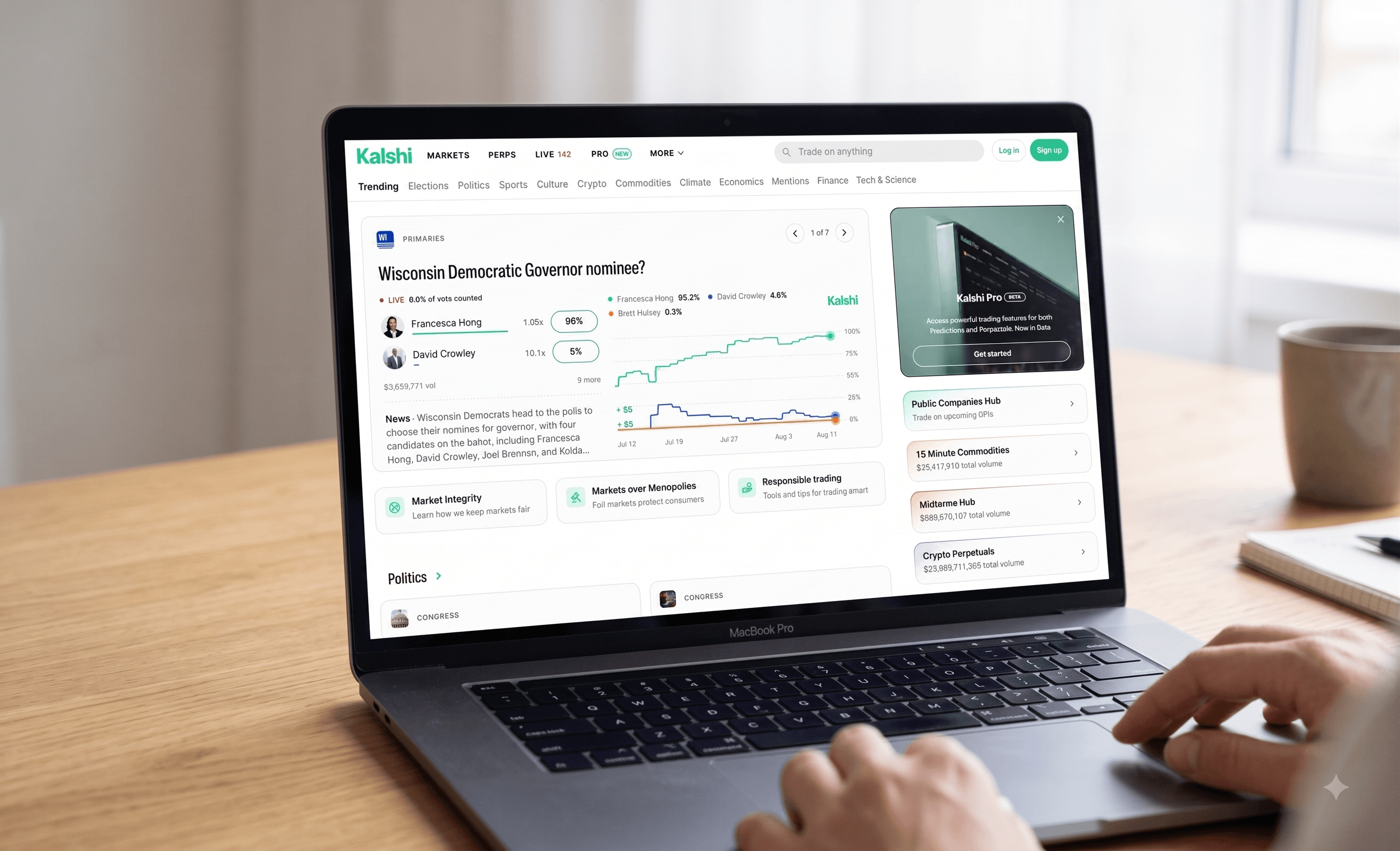
Kalshi suits traders who like to compare different contracts on a larger screen before putting any money in. Polymarket US suits traders making quicker decisions from a phone. Trading style, not the welcome offer, should drive the choice.
💻 Kalshi's interface sits somewhere between a brokerage account and a live event board. You can browse active markets, follow sports contracts and monitor your positions from the same account, and the desktop site gives you room to keep several contracts open at once and see how prices stack up.
📱 Polymarket US keeps more of the experience inside its app. It's built for quick checks and fast entries without moving through multiple tabs or windows, which suits traders who mainly check markets and place orders from their phones.
Picture a Saturday with a full NFL slate: that's the difference between lining up angles before first pitch and reacting the moment lineups drop. Either way, when both platforms list the same outcome, check both before placing the order. One may show the lower price while the other offers tighter spreads or better liquidity near it.
How Prediction Markets Work: Event Contracts and Order Books
A prediction market lets you trade a contract on whether something happens. If it does, the contract settles at $1. If it doesn't, it's worth $0. A sportsbook hands you a fixed price and takes the other side of your action. Kalshi and Polymarket US don't work that way. They run exchanges, where traders post buy and sell orders against each other and those orders set the price. That's the line between betting against the house and trading against other people.
Say a contract on the Chiefs is trading at 60 cents. That's the market pricing the outcome at roughly 60%, and it moves as new orders come in and fresh news lands. A single game also breaks into more than one contract (an outright winner, a spread, a total, player props), each with its own price and its own settlement.
Here's where the comparison starts to bite. The same game can be built one way on Kalshi and another on Polymarket US, from how the question is worded to what counts as the official result. Two contracts that look identical can pay out on different terms. So when you line the two up, price and crowd size are only part of it. What each contract actually promises, and how it settles, can differ from one platform to the other, and that's worth reading before you put money on either.
How to Compare a Contract Before You Trade
Check four things before you place an order:
- The bid ask spread
- How many contracts sit at that price
- Which order type you're using
- The market rules for settlement
Here's what each one does to your entry price.
1. The bid ask spread
The spread is the gap between the highest bid and the lowest ask. Narrow is good.
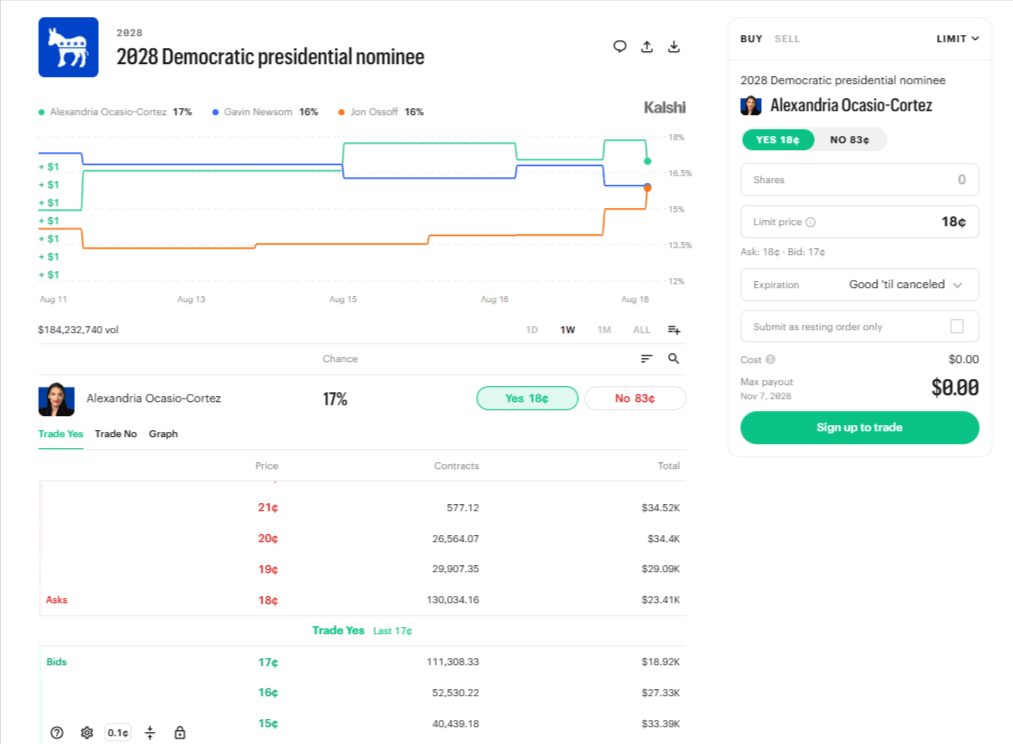
On Kalshi's 2028 Democratic presidential nominee market on 18 August 2026, the Alexandria Ocasio-Cortez contract had bids at 17 cents and asks at 18 — a one-cent spread, so you could buy and sell again without giving much back.
A wide gap means you pay up to get in and take less to get out.
2. How many contracts sit at that price
The price on screen tells you what the next contract costs. It doesn't tell you how many you can buy at it.
Take Kalshi's 2028 Democratic presidential nominee market on 18 August 2026. The Alexandria Ocasio-Cortez contract showed YES at 18 cents, with 130,034 contracts available at that price. Order 20 or order 20,000 — you pay 18 cents either way. That's strong liquidity, and the one-cent bid ask spread means you can get back out cheaply.
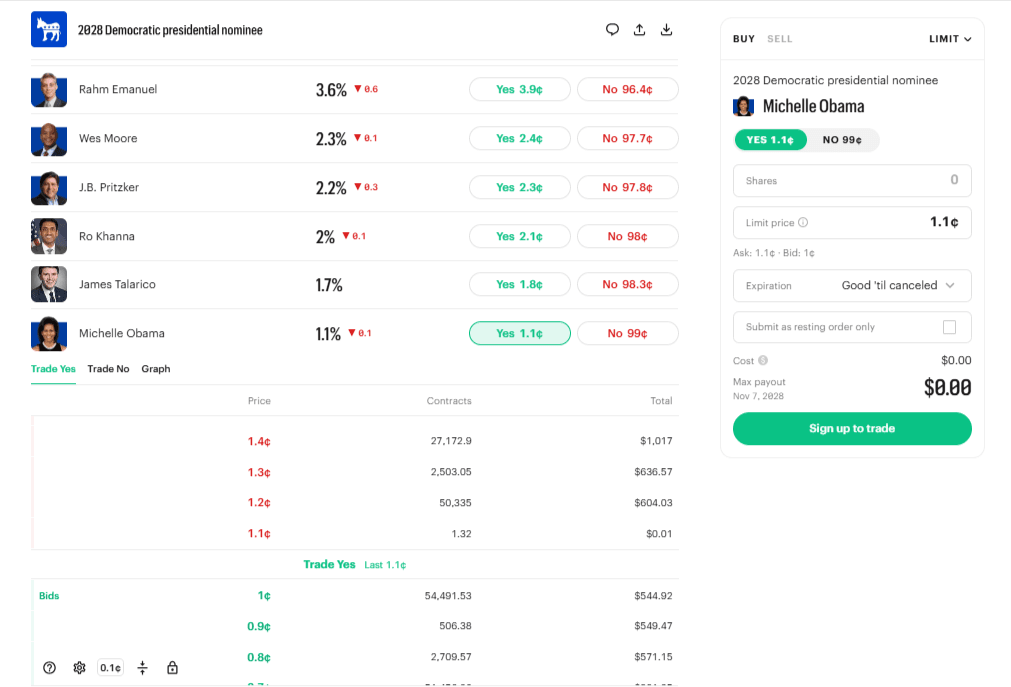
Now scroll down the same page. The Michelle Obama contract showed YES at 1.1 cents, but only one contract was available there. Everyone else was asking 1.2. Buy 20 and you get one at 1.1 and nineteen at 1.2 — almost 9% more than the price you clicked.
Same market, same moment, two very different books. Check the market depth behind a price before you order.
3. Which order type you're using
Both Kalshi and Polymarket US run on order books. Think of it as a live list of offers from other traders showing who’s willing to buy, who’s willing to sell, at what price, and for how many contracts.
When you place a market order, you’re agreeing to take whatever prices are currently available. From there, it fills right away, starting with the best price and moving down the list if your order is larger than what’s offered at that level.
A limit order works differently. You choose the exact price you’re willing to pay (or accept), and your order sits in the book until another trader matches it. This order type gives you more control over the price, with the downside being there’s no guarantee it will fill.
4. The market rules for settlement
Know what the contract actually covers, how it resolves, and when. Wording differs between platforms even when the game is the same, and that difference decides who gets paid.
Trading Fees on Kalshi vs. Polymarket: What You Actually Pay
Both exchanges build trading fees on the same idea: you pay most where the outcome is least certain.
On Kalshi and Polymarket US alike, taker fees follow the same formula: coefficient x contracts x price x (1 − price). So the cost peaks at 50 cents and shrinks toward either end. Only the coefficient differs, and so does what happens when you're the one providing liquidity.
Here's what each platform's published schedule charges on a 100-contract order. Kalshi's is dated 7 July 2026; Polymarket US's took effect 1 July 2026.
| Contract price | Kalshi taker | Polymarket US taker | Kalshi maker | Polymarket US maker |
|---|---|---|---|---|
| 10¢ | $0.63 | $0.54 | −$0.16 | +$0.11 |
| 30¢ | $1.47 | $1.26 | −$0.37 | +$0.26 |
| 50¢ | $1.75 | $1.50 | −$0.44 | +$0.31 |
| 70¢ | $1.47 | $1.26 | −$0.37 | +$0.26 |
| 90¢ | $0.63 | $0.54 | −$0.16 | +$0.11 |
Look at the last two columns, because that's the real difference. Kalshi charges its makers a reduced fee. Polymarket US pays its makers a rebate.
Rest an order at 50 cents on Kalshi and you're down 44 cents per hundred; do the same on Polymarket US and you're up 31. On taker fees alone, Kalshi costs about 17% more at every price on this curve.
High volume traders get another break. Polymarket US rebates 10% of taker fees above $250,000 in monthly volume, 25% above $1 million, and 50% above $10 million, paid weekly. Active traders clearing size can cut their real cost that way.
As always, check the live fee page before you fund your account on either.
Kalshi's Crypto Perpetual Futures
One of the clearest product differences in the Kalshi vs. Polymarket debate is crypto perpetual futures, which only Kalshi offers.
Unlike event contracts, perpetuals never expire, so there's no end date and no $1 or $0 payout. You hold them as long as you like, and the price tracks the crypto it's based on.
The risk works differently too. You put up collateral instead of buying a contract outright, and it sits in a separate account from your Kalshi trading balance. If the position moves against you and that collateral runs low, Kalshi closes it for you. You also have to apply before you can trade them at all.
Kalshi launched the first regulated Bitcoin perpetual futures contract in the US on June 3, 2026, after CFTC approval. Since then, they have added contracts for Ethereum and XRP, with a total of 13 crypto assets covered. The leverage is lower than offshore options, and the trading apps use isolated margins only.
So: if you want leveraged crypto in the same place you trade events, only Kalshi has it.
💳 Funding Kalshi and Polymarket US Accounts
Both platforms hold your balance in dollars, but the funding methods look very different.
| Funding method | 🟢 Kalshi | 🔵 Polymarket US |
|---|---|---|
| ACH bank transfer | ✅ | ✅ |
| Debit card | ✅ | ✅ |
| Wire transfer | ✅ | ✅ |
| Cryptocurrency | ✅ | ❌ |
| Apple Pay / Google Pay | ✅ | ❌ |
| PayPal / Venmo | ✅ US only, not in every state | ❌ |
| Cash App | ✅ Deposits only | ❌ |
Note: Cash App can only be used for deposits, and PayPal or Venmo may not appear in every state. The USDC wallet process on Polymarket International doesn't apply to the regulated U.S. exchange. Processing times, fees, and withdrawal holds can also differ by method, so check those details before funding the account.
🏈 Kalshi vs. Polymarket: Politics and Sports Markets
Political and sports markets don’t move the same way. In sports, prices can change within minutes as lineups get posted, a starter is scratched, or weather changes. Political markets tend to move more slowly. They can stay open for months and react to things like new polls, court rulings, debates, or legislative votes.
It’s also common for news to move the price before anything is officially decided. A network might call a race, a candidate might concede, or early results might come in, but the contract won’t settle until the exchange has the official outcome it requires.
Kalshi and Polymarket U.S. both offer political markets, but the wording of the question makes a huge difference. “Which party wins the most House seats?” isn't the same as “Which party controls the House on a specific date.” Recounts, delayed certifications, or changes after the election can lead to different results depending on how the contract is written.
Active Sports Markets: Read the Contract First
Sports contracts look simple until the wording starts to look tricky. One game can split into a handful of separate markets, like the regulation result, the match winner, the series winner, the total, player props, and each settles on its own terms.
Take a knockout soccer game that's level after 90 minutes and gets decided in extra time. A contract on a team to win in regulation loses, because it only counts the first 90. A contract on that same team to win the match cashes, because it includes extra time and penalties. Same game, same team, opposite result.
Now put Kalshi and Polymarket US next to each other. They can list what looks like the same game and still define it differently, from what counts toward the result to when the market settles. Before you buy on either, run through a few things:
- Time covered: regulation only, or overtime, extra time, and penalties too?
- Schedule changes: what happens if the game is postponed, shortened, or called?
- Result source: which league or governing body decides the official outcome?
- Corrections: can a later stat change or official review move the settlement?
Those answers live on the contract page, and they can differ between the two platforms even when the matchup is identical. You can be right about the team and still wrong about the contract, if it doesn't cover what you thought it did.
What You Can Trade This Week: MLB and NFL
Both Kalshi and Polymarket US carry markets on games happening right now, so here's what's worth a look this week.
Football is the main draw. NFL Week 2 opens Thursday with the Lions at the Bills, runs 14 games across Sunday's windows, and closes with the Giants at the Rams on Monday night. Season-long NFL markets: division winners, win totals, conference and Super Bowl LXI futures sit alongside the weekly game contracts on both platforms, and Week 1 already moved them: Seattle beat New England 13-10 in the opener, and the 49ers routed the Rams 27-7 in Melbourne.
College football Week 3 lands Saturday, headlined by LSU at Ole Miss, with Florida State at Alabama and Michigan State at Notre Dame. Texas's Week 2 beatdown of No. 1 Ohio State reshuffled the championship futures board. Baseball is into the final fortnight of its regular season, so division and wild-card races are moving nightly ahead of the September 29 postseason.
Races like these move more than the nightly game markets: a team's division and pennant contracts can reprice with every result. What's listed differs between Kalshi and Polymarket US, so compare both before you commit to a price.
US Sports Markets Available to Use Your Bonus Credits
Below, you'll find some sports markets available to use your bonus credits:
| 📅 Date & Time (EDT) | 🏟️ Matchup | 📺 TV Channel |
|---|---|---|
| Thursday, Sept 17 (WNBA Returns) | ||
| 8:15 PM | 🏈 Lions at Bills (NFL, TNF; first game at new Highmark Stadium) | Prime Video |
| 10:00 PM | 🏀 Aces at Storm (WNBA) | USA Network / CNBC |
| Friday, Sept 18 | ||
| 7:30 PM | 🏀 Fever at Tempo (WNBA) | ION |
| 8:00 PM | 🏈 Houston at Texas Tech (CFB; defending Big 12 champs) | FOX |
| 10:00 PM | 🏀 Fire at Valkyries (WNBA) | ION |
| Saturday, Sept 19 (CFB Week 3) | ||
| 12:00 PM | 🏈 Arizona State vs. Kansas - Union Jack Classic, London (CFB) | FS1 |
| 1:00 PM | 🏀 Mercury at Wings (WNBA) | CBS / Paramount+ |
| 3:30 PM | 🏈 Florida State at Alabama (CFB) | ABC |
| 7:30 PM | 🏈 LSU at Ole Miss (CFB) | ABC |
| Sunday, Sept 20 (NFL Week 2 Sunday) | ||
| Afternoon, TBC | 🏈 Saints at Ravens (NFL) | CBS |
| Afternoon, TBC | 🏈 Commanders at Cowboys (NFL) | FOX |
| Afternoon, TBC | 🏈 Raiders at Chargers (NFL) | CBS |
| 8:20 PM | 🏈 Colts at Chiefs (NFL, SNF) | NBC / Peacock |
| Monday, Sept 21 | ||
| 8:15 PM | 🏈 Giants at Rams (NFL, MNF) | ESPN / ABC |
| Tuesday, Sept 22 | ||
| TBC | 🏀 WNBA final-week games - matchups TBC | League partners |
Where Can You Find the Contract Rules?
Both publish their market rules on the contract page.
Polymarket US settles from a three-tier source hierarchy: the governing body first, then official scorecards and referee reports, then wire services like the AP, Reuters and ESPN.
Kalshi lists settlement timing and its verification source on each contract, so you can see how the market resolves before you buy.
Polymarket US counts overtime, extra innings and shootouts by default on game-level sports contracts, except in soccer league matches, which settle on the result at 90 minutes plus stoppage.
Cancellations and pre-event withdrawals settle at last fair market price. The price when the announcement lands, not the last trade before trading closes.
Trading Responsibly on Kalshi and Polymarket
An event contract puts real money at risk, and a losing one is worth nothing once it settles. Both Kalshi and Polymarket US build in ways to keep that in check with deposit caps, cooldown periods, and self-exclusion, all inside your account settings on each platform. Kalshi also funds the National Council on Problem Gambling's trader health work and offers confidential support through Birches Health.
A few responsible trading habits go a long way on either exchange:
- Size the position before you enter. Your way out is an order book, not a cash-out button, and thin depth won't always let you leave at the price on screen.
- Don't average down to claw back a loss. That just piles more risk onto a single yes-or-no outcome.
- Read the market rules before you look at the price. Most bad surprises come from the contract, not the number.
If trading has stopped feeling like a choice, the National Council on Problem Gambling runs the National Problem Gambling Helpline at 1-800-MY-RESET, available 24/7 by call or text. Its longstanding national line, 1-800-522-4700, is also still in service.
💭 Final Thoughts on Kalshi vs. Polymarket
Overall, the Kalshi vs. Polymarket debate has shown us that both are popular options for a reason. Ultimately, the best prediction markets platform for you comes down to what you value most.
Both the Polymarket and Kalshi promo code offers carry decent value, with the Kalshi welcome bonus offering the highest overall value. The Polymarket welcome bonus, while valuable, has a much lower ceiling but a very reasonable barrier of entry.
When it comes to the platform itself, Kalshi carries the wider board and offers more ways to fund an account, with access across web and mobile. Meanwhile, Polymarket US is strictly app-based and operates separately from Polymarket International, meaning its available markets, fees, funding methods, and trading activity differ from what you see on the international platform.
Neither exchange has the best price or liquidity on every contract. So, before trading, check the available size, order book, and settlement terms for the market in front of you. Those details can affect the value of a trade far more than the difference between the two welcome bonuses.
At the end of the day, holding an account with multiple of the best prediction markets is a good way to make sure you're always getting the best price. It's also a great way to take advantage of as many promo code offers as possible.
Feeling ready? Click either of our exclusive Polymarket or Kalshi promo code offers through the banners below, and good luck!
❓ Kalshi vs Polymarket FAQs
📚 Kalshi Vs. Polymarket Additional Resources
Looking to learn more about Kalshi or Polymarket! Feel free to visit any of our resource pages below!

