Plus500 Promo Code for $20 Bonus in September 2026

Plus500 is now live! This app has a prediction market product, following the ever-so-popular industry trend. It also has a focus on futures trading, which I haven't seen so pronounced at competitors.
We're still waiting on a Plus500 promo code to drop, but the welcome offer is a $20 bonus when you trade $10 as of September 28, 2026.
Check out my review of Plus500, where I discuss the welcome bonus and other features that make this prediction market app stand out from the crowd.
👇 While You Wait for Plus500's Promo Code, Check Out:

- Huge Variety of Trending Topics
- Low Trading Fees
- Fastest Payouts


Promo Code

- Live P&L Tracking
- Clean Design and Easy to Use App
- Leading Prediction Market in The US

Promo Code

- Peer-to-Peer Sports Prediction Market
- Low Fees on Winning Trades
- Lucrative Rewards Program

Promo Code

- Wide-Variety of Real World Events
- Top-Tier Mobile App
- Generous Welcome Offer

- Highly Rated Mobile App
- 'Prophet Boosts' Feature
- Rewarding Refer-a-Friend Bonus


Promo Code
🔍 TL;DR
- No promo code has been announced yet for Plus500 prediction markets, but the welcome offer is get $20 when you trade $10.
- Plus500 launched event-based prediction markets in early February 2026, through a partnership that routes clearing through Kalshi Klear LLC.
- Contracts are usually Yes/No, priced in cents (32¢ ≈ 32%), and settle to $1 or $0 at resolution.
- Plus500 lists a $0.01 per contract (per side) commission for this prediction markets platform, and notes exchange/NFA fees may apply.
Quick Facts
| ⭐ Plus500 Promo Code | Pending |
| 💰 Plus500 Signup Bonus | Trade $10, Get $20 |
| 📅 Launch Date | Feb. 3, 2026 |
| 💸 Commission | $0.02 per contract |
| 📱 How It Works | Yes/No contracts, settle $1 or $0 |
| 👨⚖️ Regulation | CFTC |
| ✅ Last Verified by Action Network On | September 28, 2026 |
🗝️ Key Takeaways of the Plus500 Promo Code
No Plus500 promo code is available yet, but stay tuned for a code from Action Network.
Right now, the welcome bonus for Plus500's prediction market platform is: Trade $10, Get $20.
Key terms of this bonus include:
- Limited to the first 5,000 customers
- Valid until Oct 31, 2026
- First-time depositors who trade at least $10 in Prediction Market contracts get a $20 trading bonus
- The bonus may take up to 7 days to hit your account
- Any winnings from your bonus are eligible for withdrawal
See how the Plus500 welcome offer compares to the best prediction market bonuses.
Plus500 Futures “First Deposit Bonus”
Most of our readers are concerned with Plus500's prediction market product.
But, Plus500 also has a futures trading product that offers another signup bonus — a first deposit bonus rather than a trade-and-get.
See below to determine your reward:
| Minimum Deposit | Bonus Amount |
|---|---|
| $500 | $20 |
| $1,000 | $50 |
| $5,000 | $100 |
| $10,000 | $200 |
Here are the bonus details Plus500 lists on its futures bonus terms page:
- All unused bonus balances expire after 90 days (Invite A Friend can differ).
- Plus500 may offer additional bonus promotions based on certain pre defined criteria, at its discretion.
- Plus500 reserves the right to amend withdraw or restrict a bonus promotion, and says it is the sole arbiter of requirements, terms, and associated issues.
Treat a deposit bonus as trading credit with conditions, not “extra cash” you can automatically pull out. Before you make an initial deposit, read the terms carefully, especially anything tied to your bonus balance and when the offer is active (aka the offer valid window), so you’re not surprised later.
🤔 What Are Plus500 Prediction Markets?
Plus500 is an Israel-based fintech with a long-running global trading business. In the U.S., its offering has been more futures-focused, though it has since expanded into prediction markets.
On this prediction markets platform, you’re trading contracts tied to real-world outcomes. Most of these are framed around economic or geopolitical events (and other financial events) that eventually resolve to a clear result. Instead of making bets at the best online sportsbooks, you’re taking a position in a market price, and you can adjust that position over time based on how the market moves.
This rollout puts Plus500 on the consumer side of prediction markets, alongside other platforms (like Kalshi) trying to make event contracts easier for everyday users to access. Reuters, for example, reported the category logged $47 billion in global trading volume in 2025, which helps explain why more companies are offering prediction-market access beyond professional trading desks.
Plus500 Prediction Markets vs. Futures
While prediction markets tend to be more popular among our readers, Plus500 also offers trading on futures.
Here's a quick breakdown of prediction markets vs futures at Plus500:
| Prediction Markets | Futures | |
|---|---|---|
| What you're trading | Outcomes of future events | Prices of underlying assets |
| What you trade on | Yes/no or multi-outcome questions (elections, sports, economic data) | Commodities, indices, currencies, rates, etc. |
| Price range | Typically $0–$1 (or 0–100%), reflecting probability | Reflects asset's market price, no fixed cap |
| Settlement | Binary — resolves to Yes/No based on real-world outcome | Contract settles or closes based on price movement |
| Expiration | Tied to the event's resolution date | Fixed contract expiry (monthly, quarterly, etc.) |
| Leverage | Generally none — you risk your position size | Often leveraged/margin-based |
| Profit driver | Correct prediction of outcome | Price movement direction and magnitude |
| Regulatory framing | CFTC-regulated in the US as "contracts" | CFTC-regulated as derivatives/futures contracts |
| Trader type | Better suited for beginners and risk-adverse traders | Ideal for riskier traders, those who want hedging opportunities |
⚙️ How Plus500 Prediction Markets Work
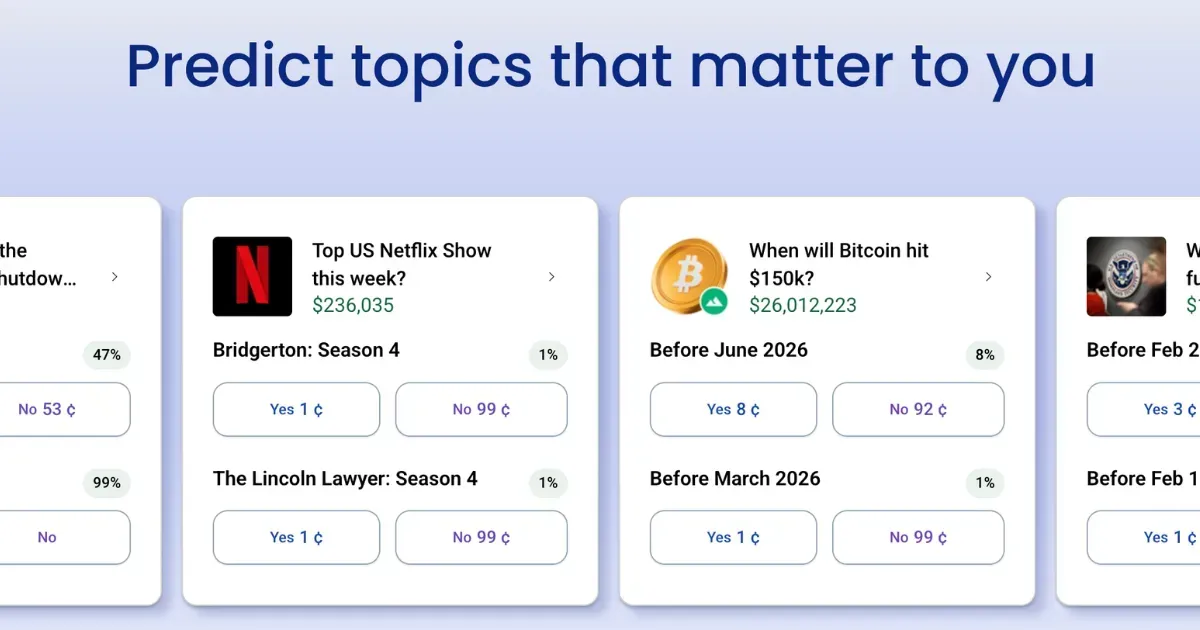
Yes/No Contracts and Prices in Cents
Like at other prediction market apps, event contracts are framed as a yes/no question about a specific event. You pick a side by buying contracts, and you can sell later if you want to change your position before settlement.
A 32¢ price is the market implying about a 32% chance at that moment. Not a guarantee, just where buyers and sellers are meeting. When more money leans one way, prices usually follow. When there's more demand for “Yes,” the “Yes” price rises and “No” falls, and vice versa.
If you’ve watched a Kansas City Chiefs line move the second injury news hits, you already understand how this works. This is still a market reacting to new information, just expressed through contract prices instead of point spreads.
Settlement and Payouts
At settlement, the contract resolves to a fixed outcome:
- If it resolves in your favor, it settles at $1.
- If it resolves against you, it settles at $0.
So if you bought “Yes” at 60¢ and the event resolves “Yes,” you’re up 40¢ per contract before any fees. Same math the other way around if you bought “No,” you’re just taking the other side of the market. Your max loss is what you pay (60¢), and your max win is what’s left to $1 (40¢), before fees. If you sell before settlement, your profit or loss is just the difference between your entry price and exit price.
How Small Can You Start?
Plus500 lets users trade as little as $1 on their prediction markets. Practically, that means starting with a small number of low-priced contracts so you can watch how prices move, how your position shows up on the platform, and what the full "lifecycle" looks like from entry to settlement.
💵 Fees at Plus500
For Plus500 prediction markets, fees are competitive with other exchanges.
For event contracts, a small commission of $0.01 per contract applies, and the exchange charges an additional feel of $0.01. So, fees total $0.02.
Pro tip to avoid withdrawal fees at Plus500: Plan to withdraw once per calendar month. You get your first withdrawal of each calendar month fee, but if you choose to make additional withdrawals for the month, you'll incur a 1.75% fee. The fee is relatively small but can add up if you're withdrawing large sums of money.
Withdrawal minimums are $1, max is $150.
Plus500’s Commission
Plus500 lists a prediction markets contract commission of $0.01 per contract (per side). “Per side” means that if you buy and later sell to close or trim your position, that’s two sides, two commissions.
Additional Fees
Plus500 also says that exchange and NFA fees may apply. Think of it as a possible extra line item attached to the market itself, not just the Plus500 side of the ticket.
For Example:
- A trader buys $100 in “Yes” contracts at 60¢ (about 166 contracts).
- The event resolves “Yes.” Winning contracts settle at $1, so the gross payout is about $167, roughly $67 in profits before fees.
- The $.02 per contract equals $3.34, which cuts into your $67 profit. So you'd walk away up $63.66.
Long story short, be mindful about how you think about trades. Before you enter, ask yourself: “Am I likely holding to settlement, or am I probably trading out?” Your total cost changes depending on how many times you touch the order button.
👨⚖️ Is Plus500 Regulated?
Yes! Plus500's prediction market features regulated event contracts, with clearing routed through Kalshi Klear LLC.
Kalshi Klear LLC is registered with the CFTC as a Derivatives Clearing Organization (DCO). In practical terms, the clearinghouse is the back-end system that tracks which accounts hold which contracts and processes settlement when an event is resolved.
That structure gives you rule-defined settlement, but it doesn’t remove trading risk. Prices can still move quickly, especially around fast-moving events, and a market can still be wrong in the end.
💰 Taxes at Plus500
Plus500 notes that profits or losses may be subject to U.S. tax reporting. Always consult a qualified tax advisor if you’re using a trading platform.
👣 How to Sign Up at Plus500
- Create an account and accept the platform terms.
- Complete identity verification (KYC). Here, you can expect the standard stuff you’ve seen on other regulated accounts like your country of residence, phone number, name, date of birth, address, Social Security number (for U.S. accounts), etc.
- Fund your account using one of the approved payment methods, then choose a market and place your first position.
Funding Your Account
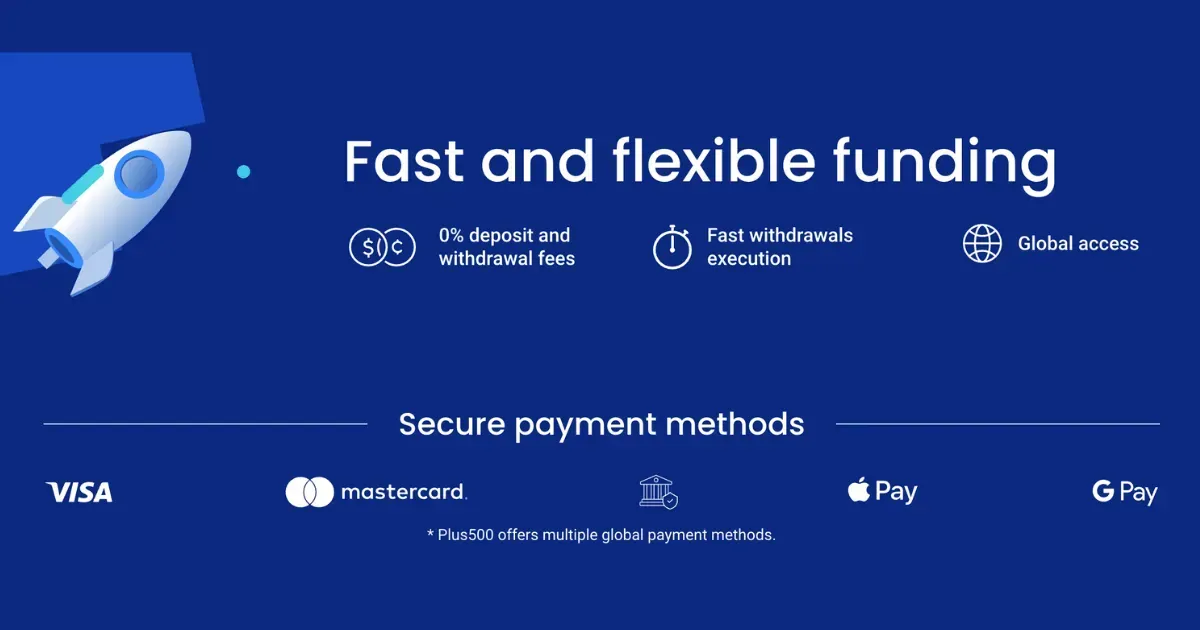
When it comes to deposit methods, Plus500 highlights options like cards and mobile wallets, plus bank transfer. My go-to deposit method at Plus500 is Apple Pay, but Google Pay, bank transfers, and VISA and Mastercard debit transactions are also support. Plus500 does not accept credit card or prepaid card deposits.
Pro-Tip for Beginners
If you’re new to event based trading, don’t start with a market that’s weeks out. Pick something that settles soon. You’ll learn more by watching one full cycle: entry, price movement, position tracking, and settlement, than you will staring at the market page all night.
Additionally, you should always prioritize responsible trading.
⚔️ Plus500 vs. Kalshi
You place the trade inside Plus500’s platform, but the event contracts you’re trading are tied into Kalshi’s infrastructure, including Kalshi Klear, which handles clearing. Think of it as one login on your side, with Kalshi handling the exchange side in the background.
When Does Going Directly to Kalshi Make Sense?
- You want access to a specific market you can’t find on Plus500.
- You prefer the Kalshi exchange interface. If you already trade on the Kalshi exchange and like how it’s laid out, you might rather keep everything in one place there.
If you already use Plus500 for futures, keeping these contracts on the same platform is the practical upside. One login, one funding setup, and one place to track your position.
If you want to try out Kalshi as well, be sure to sign up via the Kalshi promo code.
❓ Plus500 Promo Code FAQs
