


The Senate’s failure to advance the CLARITY Act is a major setback for the U.S. crypto industry, but it also leaves a major policy fight unresolved: whether federally regulated prediction markets can offer sports-related contracts without following state and tribal gaming rules.
The Senate voted 49–50 against invoking cloture on the motion to proceed to H.R. 3633, formally known as the Digital Asset Market Clarity Act. Because cloture required 60 votes, the Senate could not even begin formal debate or consider amendments to the bill.
The decision comes in the wake of a massive NFL betting weekend, in which prediction markets played a major role. 
What Happened in the Senate?
The vote was not a final vote on whether to pass the CLARITY Act. Instead, senators were deciding whether to move the bill onto the Senate floor for debate.
In the Senate, a cloture vote is commonly used to end procedural delay and allow a measure to move forward. For this vote, supporters needed 60 senators. They received 49.
All 49 “yes” votes reportedly came from Republicans. Four Republicans—Susan Collins of Maine, Josh Hawley of Missouri, Jerry Moran of Kansas, and Thom Tillis of North Carolina—voted no, alongside nearly all Democratic senators and the chamber’s two independents. Senator Chris Coons of Delaware did not vote. Tillis subsequently entered a motion to reconsider, a procedural step that may preserve a limited opportunity to revisit the question later.
The practical result is straightforward: the Senate did not begin debating the bill, did not vote on amendments, and did not hold a final passage vote. While the legislation is not technically dead, the path forward before the November midterm elections appears narrow.
What the CLARITY Act Would Do
The CLARITY Act is mainly a cryptocurrency market-structure proposal. Its central purpose is to create clearer federal rules for digital assets and reduce the long-running uncertainty over whether a crypto asset should be regulated as a security or a commodity.
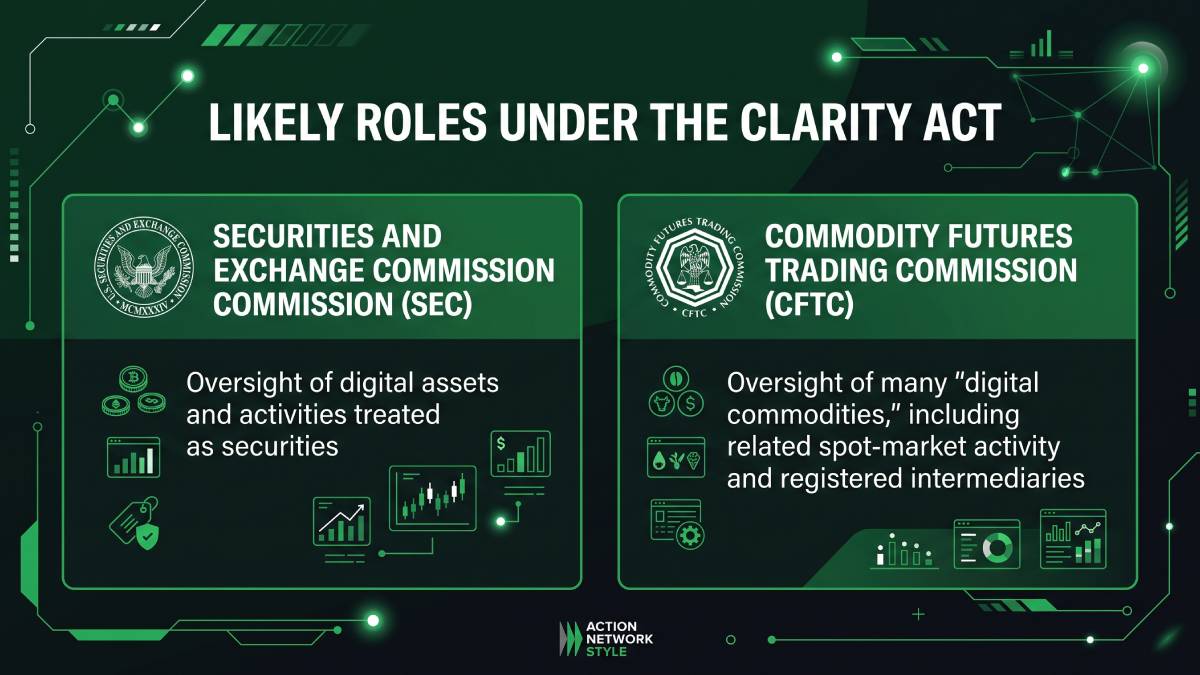
The bill would divide major responsibilities between two federal agencies:
Under the CLARITY Act, the Securities and Exchange Commission would generally oversee digital assets and related activities that qualify as securities. The Commodity Futures Trading Commission would generally regulate many assets classified as “digital commodities,” as well as certain related spot-market activities and registered intermediaries, such as trading platforms and brokers.
The Senate draft also included a regulatory structure for digital-commodity exchanges, brokers, and dealers. These entities could face requirements related to customer-asset segregation, conflicts of interest, recordkeeping, and protections in the event of bankruptcy.
The final Senate version also addressed decentralized finance, or DeFi. It sought to distinguish between genuinely decentralized software and platforms that still have meaningful human control.
A protocol with a controlling party, transaction-censoring ability, upgrade keys, or the power to pause the system could face registration and compliance obligations. Simply publishing code, running a node, or providing an oracle would not automatically make someone a regulated operator.
Ethics and Stablecoin Disputes
The bill’s sponsors tried to win more Democratic support by adding tougher ethics and stablecoin provisions shortly before the vote.
The revised text included stronger restrictions intended to prevent public officials from profiting from their own cryptocurrency ventures. It also gave state attorneys general a role in enforcing certain ethics rules. These provisions were designed to respond to criticism surrounding elected officials and crypto-related financial interests.
Banking groups also raised concerns that stablecoin rewards or yield programs could pull deposits away from traditional banks, making it harder for those banks to lend to households, farms, and small businesses. The final draft reportedly gave the Treasury secretary authority to intervene if payment stablecoins contributed to serious deposit outflows.
Those changes did not produce the bipartisan support needed to clear the 60-vote threshold.

Why Prediction Markets Became an Issue
Although the CLARITY Act is fundamentally a crypto bill, prediction markets became an important part of the political debate surrounding it.
Prediction markets allow people to buy and sell contracts tied to future outcomes. A contract might concern an election, an economic release, a court ruling, or a sports event. Platforms such as Kalshi and Polymarket have drawn increased attention as event-contract trading expands.
Tribal gaming organizations, commercial casino operators, state gaming regulators, and some labor groups argue that sports-event contracts can look and function like sports betting. Their concern is that a platform regulated by the CFTC could offer sports-related markets nationwide while avoiding state licensing rules, tribal-state gaming compacts, tribal sovereignty protections, and rules under the Indian Gaming Regulatory Act, or IGRA.
It was a topic of discussion at the IGA Tradeshow.
These groups pushed Congress to add clearer protections to the CLARITY Act. Their preferred changes generally included:
- A direct prohibition or restriction on sports-event and casino-style contracts offered through federally regulated prediction-market platforms.
- Language stating that the law would not override IGRA, tribal-state compacts, tribal gaming law, or state gaming authority.
- A clear statement that federal commodities law cannot be used to bypass state or tribal regulation of gambling-like activity.
The final Senate draft did narrow certain DeFi provisions so that they applied to digital-commodity spot and cash transactions rather than automatically covering event contracts. That distinction mattered because it reduced the chance that broad crypto language could unintentionally shelter prediction-market activity. Still, tribal and commercial gaming interests said the bill did not go far enough.

What Happens Next?
The failed cloture vote means there is no new federal market-structure law for crypto or prediction markets—for now.
For the crypto industry, that leaves major questions unresolved. Companies still must operate under the existing and sometimes overlapping authority of the SEC, CFTC, Treasury Department, state regulators, and courts. The lack of a comprehensive statute continues to create uncertainty about registration, token classification, exchange operations, and consumer protections.
For tribal governments and gaming stakeholders, the outcome prevents the CLARITY Act from advancing without the stronger protections they wanted. However, it does not settle the underlying dispute over whether sports-event contracts are financial products, gambling products, or both. The issue is likely to continue through CFTC policy, litigation involving states and tribes, regulatory enforcement, and future congressional proposals.
The Senate vote was therefore more than a crypto-industry defeat. It also paused—without resolving—a growing national conflict over who gets to regulate prediction markets when those markets resemble sports wagering.


