


The opening week of the NFL season delivered more than close games and highlight-reel plays. It also triggered a major jump in activity across NFL prediction markets, with football-related contracts helping push platforms such as Kalshi to record trading levels.
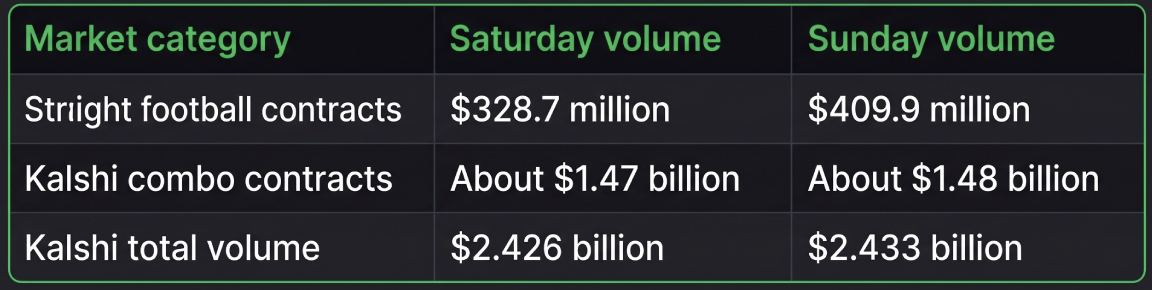
Kalshi posted $2.426 billion in total contract volume on Saturday, followed by a new daily record of $2.433 billion on Sunday. Much of that trading came from football markets and multi-leg “combo” contracts, which work in a way that resembles parlay-style NFL betting.
The numbers show that interest in NFL prediction markets is growing quickly. A recent study found 84% of U.S. NFL bettors have heard of prediction markets, and 60% plan to trade event contracts this season.
But they also show why readers should look carefully at how prediction-market volume is measured before comparing it directly with traditional sportsbook betting handle.
College and NFL Football Powers the Surge
Football was the largest driver behind the opening-week surge. It's ironic because the NFL has actually pushed back on prediction markets in the past.
From the Wednesday NFL season opener through Sunday, Kalshi recorded more than $617 million in NFL market trading. On Sunday alone, the platform handled $388.1 million in direct NFL trading volume when combo contracts were excluded. That represented roughly 76% of the tracked NFL prediction-market volume across operators that day.
For the full week of September 7 through September 13, tracked NFL prediction markets generated at least $1.035 billion in volume. Kalshi accounted for about $983.36 million of that amount, according to DeFiRate’s tracking data. That total included $537.48 million in direct NFL contracts and $445.88 million in NFL-only combo contracts.
This big increase suggests that football is becoming one of the most important sports for event-contract exchanges. NFL games create frequent, high-interest opportunities for traders, ranging from basic winner markets to point spreads, totals, player performance questions, and season-long futures.
What Are NFL Prediction Markets?
NFL prediction markets allow users to buy and sell contracts tied to specific football outcomes.
A contract might ask whether a team will win, whether a game will go over or under a listed total, whether a player will reach a statistical milestone, or which club will win the Super Bowl.
Unlike conventional NFL betting, where a bettor generally places a wager against a sportsbook at listed odds, prediction-market participants trade contracts with other market participants. Contract prices can reflect the market’s implied view of an outcome’s likelihood.
For example, if a “Yes” contract on a team winning is priced at 60 cents, the market is broadly signaling an implied probability near 60%, before accounting for trading costs and market structure. If that outcome happens, the contract may settle at $1; if it does not, it may settle at $0.
Kalshi describes itself as a regulated event-contract exchange where users trade contracts tied to real-world outcomes. Its NFL offerings have included game winners, spreads, totals, player markets, futures, and multi-leg Combos. Prediction markets are mainly regulated by the Commodity Futures Trading Commission (CFTC).
Combo Contracts Drove Much of the Volume
The biggest reason Kalshi’s overall daily volume rose above $2.4 billion was the popularity of combo contracts.
These multi-leg products contributed about $1.47 billion in volume on Saturday and roughly $1.48 billion on Sunday—more than half of the platform’s total activity on both days.
Straight football contracts also attracted significant activity:
One particularly active NFL market involved the Cowboys-Giants Sunday Night Football matchup. The game-winner market generated $56.3 million in trading volume, while the point-spread market added another $16.3 million.
A five-leg NFL player-performance combo also produced $36.44 million in weekly volume, illustrating the demand for more complex contracts among football traders.
Why Volume Needs Context
Large volume numbers can make NFL prediction markets appear directly comparable to traditional sportsbook handle. However, the two measures are not identical.
On platforms such as Kalshi, reported volume can count both sides of a transaction: the buyer or “taker” and the seller or “maker.” In multi-leg contracts, especially those with long odds, market makers may contribute substantial notional volume. That means headline trading volume can be larger than the amount of consumer money truly at risk.
A closer, though still imperfect, measure is taker-side volume. Kalshi’s taker-side volume was reported at $555.7 million on Saturday and $596.7 million on Sunday. Those are substantial totals, but they remain below the platform’s July 11 record of $640.3 million in taker-side activity.
This does not make the record weekend less important. Instead, it highlights the difference between contract trading volume and sportsbook wagering volume. Anyone evaluating the growth of NFL betting alternatives should separate direct NFL contracts, combo contracts, notional volume, actual user stakes, and platform fees.
Kalshi Dominates Weekly Trading
Across Kalshi and Polymarket Global, total contract volume reached $14.10 billion during the September 7–13 period. That was a 9.3% increase from $12.90 billion the prior week, spread across approximately 86.5 million trades.
Kalshi represented the overwhelming majority of that activity:
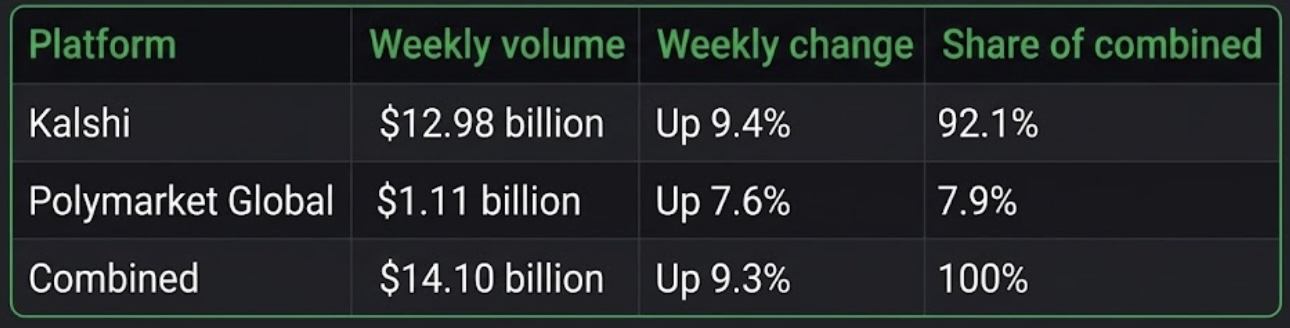
Sports represented about $3.76 billion of the combined weekly total. Kalshi contributed $3.265 billion, while Polymarket Global’s sports volume climbed 104.7% to approximately $499 million.
Kalshi’s broader momentum has been notable. Its month-to-date volume through September 13 reached $23.45 billion, roughly 53.4% higher than the comparable period in August. Over six weeks, its weekly volume rose from $8.07 billion to $12.98 billion, an increase of 60.9%.
Prediction Market Competition Is Growing Too
Kalshi was the clear leader during opening week, but it was not the only platform posting milestones.
DraftKings Predictions reportedly crossed $100 million in daily volume for the first time before reaching about $139.8 million on Sunday. Crypto.com also exceeded $100 million in daily activity for the first time, while Novig and ProphetX posted or approached records.
That wider growth matters because it suggests demand is not limited to a single operator. Football season appears to be expanding the audience for prediction-based sports products, especially among users interested in prices that change as new information enters the market.
Analysts at Citizens also found that Kalshi’s pregame moneyline and over/under prices on the Week 1 slate showed lower implied vig than comparable DraftKings and FanDuel prices in their sample—roughly 3% to 4% better. However, the same analysis found that Kalshi combo contracts carried higher implied vig, at roughly 23.8% compared with about 22% at the traditional sportsbooks before fees.
The Takeaway for NFL Betting Fans
The opening NFL weekend showed that prediction markets are becoming a meaningful part of the wider NFL betting conversation. Kalshi’s record activity, the popularity of combo contracts, and rising volume at competing platforms all point to growing consumer interest.
Still, NFL prediction markets are not automatically better than traditional sportsbooks. The best choice depends on the market, the price, fees, liquidity, and whether a user is trading a simple game outcome or a complicated multi-leg contract.
For readers following NFL betting, the key lesson is simple: compare the full cost of a position—not just the headline price. In NFL predictions markets, a lower implied vig on a straight game contract may be attractive, while a high-cost combo could be less favorable even if the interface looks similar to a parlay.
As the season continues, football is likely to remain one of the biggest tests of whether prediction markets can sustain their rapid growth beyond the opening-week excitement.


