


As the seasons begin to shift, the biannual ritual of adjusting our schedules returns.
For Daylight Saving Time 2026, the clocks spring forward one hour on Sunday, March 8, 2026, at 2:00 AM.
This shift marks the transition into longer evening daylight.
Daylight Saving Time 2026 (Spring Forward): A Brief History
Later in the year, the cycle will complete when we "fall back" one hour on Sunday, November 1, 2026, returning to Standard Time.
While the physical act of moving the clock only takes a moment, the debate over this practice continues to gain momentum across the country.
The concept of Daylight Saving Time (DST) was first popularized in the United States during World War I as a method to conserve energy and fuel.
It was later standardized by the Uniform Time Act of 1966, which established the framework for when clocks should change nationwide.
Why Do We Still Do Daylight Saving Time?
The original intent was to align "waking hours" with daylight hours, theoretically reducing the need for artificial lighting.
Today, the practice is a polarizing topic.
Proponents of DST argue that the extra hour of evening light boosts the economy by encouraging outdoor commerce and improves public safety by reducing evening traffic accidents.
On the other hand, critics point to disruptions to the human circadian rhythm, citing studies showing a temporary spike in heart attacks and workplace injuries immediately following the springtime change.
Because of this divide, there has long been legislative talk about the permanently ending Daylight Saving Time.
While many states have passed internal triggers to stay on DST year-round, federal law currently prevents states from making that change without a shift in the Uniform Time Act by Congress.
So, When Does Daylight Saving Time End Permanently?
While politicians debate the merits of a permanent schedule, traders and data enthusiasts are using prediction markets to gauge the likelihood of a legislative shift.
Unlike traditional polls, prediction markets like Kalshi allow users to trade on the actual outcome of yes-or-no events using event contracts.
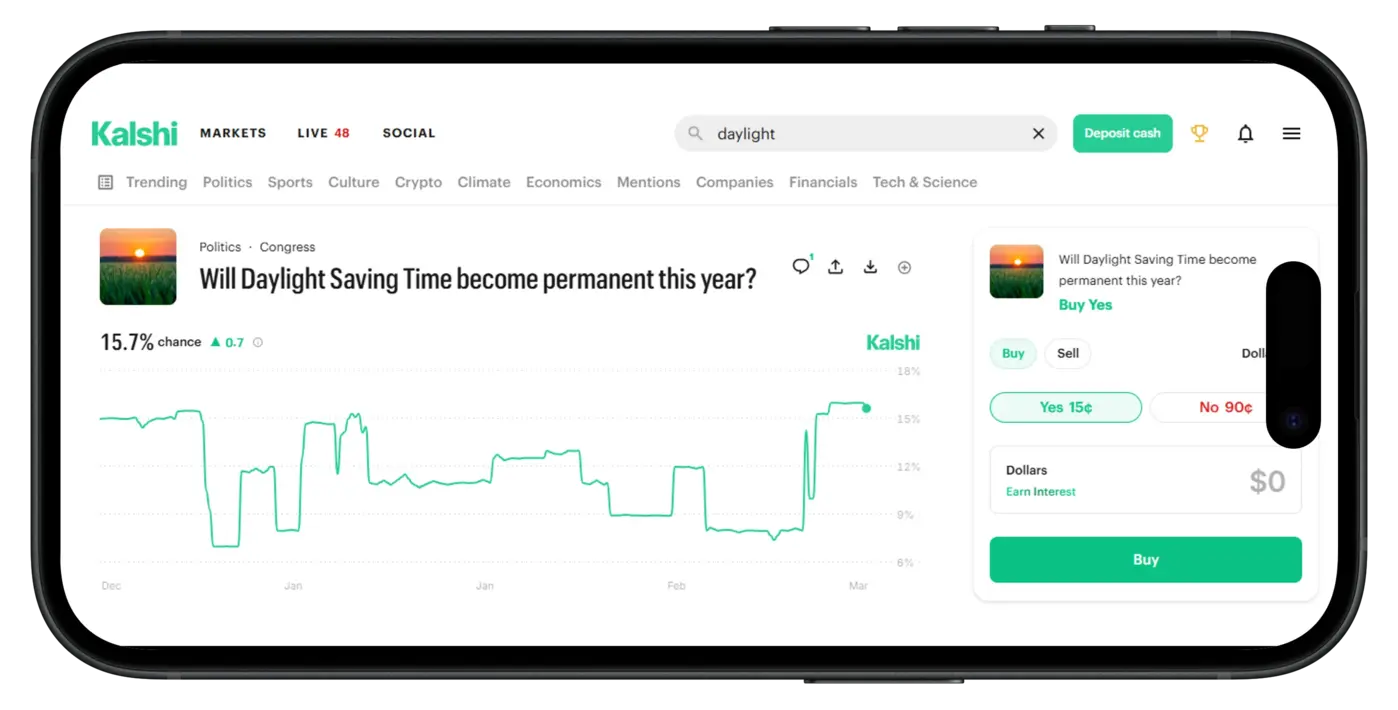
For example, Kalshi hosts a specific market:
Will Daylight Saving Time Become Permanent This year?
Here, the market asks a binary question: Will the U.S. pass a law to end the biannual time change by a specific date?
The prices of event contracts on Kalshi fluctuate between $0.00 and $1.00 based on real-time supply and demand, where each cent represents the market’s collective estimate of the percentage chance that an outcome will occur.
Because it is a live peer-to-peer exchange, you can sell your "Yes" or "No" shares at any time before the event is officially resolved to lock in profits if the odds have moved in your favor or to cut losses if they have turned against you.
Step-by-Step Process for Trading Event Contracts on Kalshi
Here's how the process looks on Kalshi:
Selection: A trader visits the Kalshi platform and selects the "Yes" or "No" contract based on their prediction.
Purchase: If you believe Congress will finally pass the Sunshine Protection Act (or similar legislation) to make DST permanent, you buy "Yes" contracts. If you think the status quo will remain, you buy "No."
Pricing: Each contract is priced between $0.01 and $0.99. If the "Yes" contracts are trading at $0.15, the market believes there is roughly a 15% chance of the change happening.
Resolution: The market resolves in accordance with the contract's rules. This market resolves to "Yes" if a federal law is enacted before January 1, 2027, or to "No" if the deadline passes without the President's signature.
Payout: If your prediction is correct, each contract you own pays out $1.00, resulting in a profit. If you are incorrect, the contract expires at $0.00.
If you're interested in trading event contracts on whether Daylight Saving Time will end permanently this year or not, you can do so on Kalshi.
Sign up with promo code , and you'll be able to
Read more about the Kalshi promo code.
The latest event contract prices on Kalshi about "Will Daylight Saving Time become permanent this year?":
Why Some States Don't Spring Forward or Fall Back At All
It is important to note that while most of the country observes Daylight Saving Time 2026, it is not a requirement.
Hawaii and most of Arizona (with the exception of the Navajo Nation) stay on Standard Time year-round.
These regions cite their extreme desert climates as a reason to avoid an extra hour of evening heat, proving that the "right" time is often a matter of geography.
The Global Landscape: Who Else is Changing?
While the United States continues its internal debate, the shift to Daylight Saving Time 2026 is a massive international logistical feat. On March 29, 2026, most of Europe, including the United Kingdom and France, will spring forward with the U.S.
However, the movement to end the biannual switch is gaining significant ground outside U.S. borders. For instance, British Columbia, Canada, has officially adopted permanent, year-round Daylight Saving Time starting on March 8, 2026, marking this as its final time change.
As more neighbors and trading partners experiment with fixed schedules, the pressure on the U.S. to choose a permanent time zone, be it Standard or Daylight time, continues to mount, potentially forcing a federal resolution sooner than current legislative gridlock suggests.
Tips for Preparing for Daylight Saving Time 2026
It's safe to assume that no legislation will be passed before March 8, 2026, so you'd best be ready for the time change when it occurs!
To minimize that jet lag feeling that comes with the March 8 time change, health experts recommend several strategies:
- ⏲️Gradual Adjustment: Go to bed 15 minutes earlier each night during the week leading up to the change.
- ☀️ Morning Sunlight: Seek out natural light as soon as you wake up on Sunday morning to help reset your internal clock.
- 🚨 Check the Sensors: Use the time change as a biannual reminder to check the batteries in your smoke detectors and carbon monoxide sensors.


