


A federal appeals court has given Nevada a major win in its battle with Kalshi over sports prediction markets. The Ninth U.S. Circuit Court of Appeals ruled that Kalshi cannot block Nevada gaming regulators from treating its sports event contracts as potentially unlicensed sports betting.
In a unanimous decision Friday, the San Francisco-based court said Kalshi had not shown that federal commodities law overrides Nevada’s gaming rules for its sports-related products.
The ruling allows Nevada to continue enforcing its laws against Kalshi’s sports contracts while the larger legal fight plays out.

Court Says Sports Contracts Look Like Bets
The case, KalshiEX, LLC v. Assad, centers on a basic but high-stakes question: Are prediction market contracts tied to sports outcomes federally regulated financial products, or are they sports bets subject to state gambling laws?
Kalshi operates a Commodity Futures Trading Commission-registered designated contract market, or DCM. The company argued that its contracts fall under the Commodity Exchange Act, or CEA, and therefore belong under the CFTC’s exclusive oversight.
Nevada regulators disagreed. The Nevada Gaming Control Board said Kalshi was offering an unlicensed sports wagering product and sent the company a cease-and-desist letter in March 2025. The state argued that contracts on game winners, player props, totals, score outcomes, and parlays are gambling products in substance, even if they are listed and traded through a federally regulated exchange.
The Ninth Circuit sided with Nevada at this stage of the case.
Judge Ryan D. Nelson, writing for the three-judge panel, concluded that Kalshi’s sports event contracts were not “swaps” as that term is used in the CEA. The court found that the products are sports bets, not financial derivatives protected from state regulation by federal preemption.
The court’s point was straightforward: Calling a sports wager an “event contract” does not change what it actually is.

Why the CEA Argument Failed
The CEA gives the CFTC exclusive authority over certain transactions, including swaps traded or executed on a designated contract market. Kalshi’s products were traded on a DCM, and the Ninth Circuit acknowledged that swaps listed on a DCM can receive federal preemption.
But the court found that Kalshi’s sports contracts failed a key test: they were not swaps in the first place.
Under the CEA, a swap must involve a payment tied to an event or contingency with a potential financial, economic, or commercial consequence. The Ninth Circuit rejected Kalshi’s expansive interpretation, warning that it had no meaningful limiting principle.
In practical terms, the court said Kalshi’s reading could pull nearly all sports wagering into federal commodities regulation. That would dramatically reshape the long-standing system in which states and Tribal governments regulate gambling and sports betting.
The opinion also noted that current CFTC Regulation 40.11 prohibits certain contracts involving gaming from being listed on a DCM. While the CFTC has the power to review and disallow contracts, the court said the existing regulation—not possible future rule changes—controlled this dispute.
Judge Kenneth K. Lee agreed with the court’s outcome in a separate concurrence. He noted that there may be an unresolved statutory question over how much discretion the CFTC has regarding gaming contracts, but he agreed that the current CFTC rule bars the relevant gaming-related contracts.
Nevada Can Resume Enforcement
The Ninth Circuit affirmed the lower court’s decision to dissolve Kalshi’s preliminary injunction against Nevada. That means the state is no longer restrained from applying its gaming laws to Kalshi’s sports-related contracts.
The appellate panel also found that the district court did not abuse its discretion when evaluating the usual injunction factors, including:
- Kalshi’s likelihood of succeeding on its legal claims
- Whether Kalshi faced irreparable harm
- Whether an injunction would be fair
- Whether an injunction would serve the public interest
The decision does not amount to a nationwide ban on Kalshi’s sports products. It also is not a final trial judgment on every issue in the litigation. However, it makes it far more difficult for Kalshi to continue offering sports contracts in Nevada without complying with the state’s licensing and regulatory framework.
The court sent the separate issue of Kalshi’s election contracts back to the Nevada federal district court for further review. The Ninth Circuit did not make a final ruling on that portion of the case.
A Direct Split With the Third Circuit
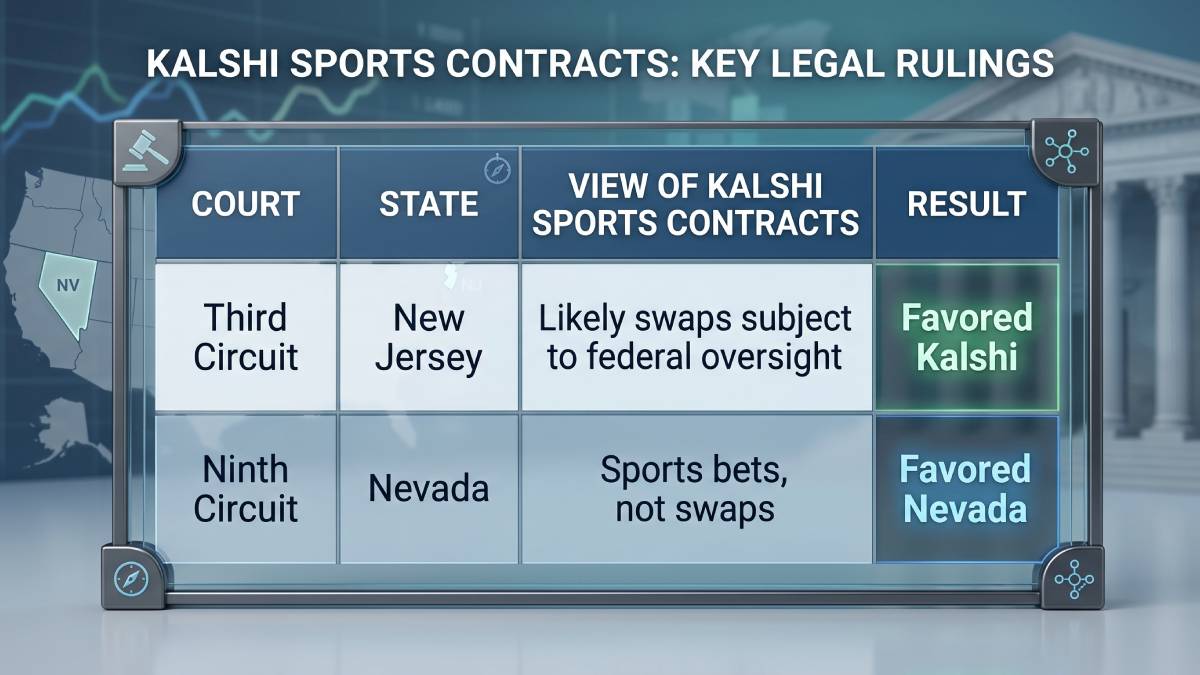
The Nevada decision is especially important because it conflicts with an April ruling from the Third U.S. Circuit Court of Appeals involving Kalshi and New Jersey.
In that case, the Third Circuit found that New Jersey could not regulate Kalshi’s platform in the same way because the court viewed the event contracts as swaps under federal law. The New Jersey ruling favored Kalshi’s position that the CEA and CFTC oversight preempt state gambling regulation.
The two courts have now reached opposite conclusions on the same central issue:
That circuit split increases the chances that the U.S. Supreme Court could eventually take up the issue. A Supreme Court ruling could determine whether prediction market operators can offer sports contracts across state lines under federal commodities authority or whether they must meet state-by-state gambling and sports betting requirements.
What The Ruling Means for Prediction Markets
The Ninth Circuit’s decision strengthens the position of state regulators, Tribal gaming interests, and licensed sportsbook operators that have argued prediction markets should not be able to offer sports wagering without following the same local rules as traditional betting companies.
Kalshi’s platform had marketed itself as “the first app for legal sports betting in all 50 states,” a statement the court highlighted while examining whether the company’s offerings were genuinely financial contracts or sports wagering products. The opinion said more than 90% of Kalshi’s 2025 trades—and 95% of its revenue—were tied to sports-related products. The company also saw a big boost during the World Cup.
The legal battle is also broader than Nevada. The Ninth Circuit noted that other courts have reached mixed results in similar disputes, with litigation continuing in multiple jurisdictions. The ruling could influence regulators in states that are considering or pursuing enforcement against Kalshi and other platforms offering sports-linked event contracts.
For now, Nevada has a clear appellate-level answer: sports prediction market contracts can be treated as sports bets under state law, even when they are offered through a CFTC-registered exchange. The larger question of federal versus state control over this rapidly growing sector remains unsettled—and now appears more likely to reach the Supreme Court.


