


Novig has quickly become one of the most closely watched names in the U.S. prediction market sector. The sports-focused platform launched its real-money exchange on August 4, 2026, after moving away from a previous sweepstakes model.
Novig has quickly raised its profile through the first partnership between an MLB team and a prediction market. The platform is the New York Mets’ exclusive official prediction market partner. Kalshi followed soon after with its own MLB partnerships, but Novig’s deal helped establish it as an early leader in the growing prediction market industry.
The company operates through Ludlow Exchange, LLC, a Designated Contract Market approved by the Commodity Futures Trading Commission in June. That federal status is central to Novig’s business model, but it is also at the heart of a growing legal fight with several states.
Novig’s Early Prediction Market Volume
Novig’s early trading results have drawn attention across the sports betting and prediction market industries.
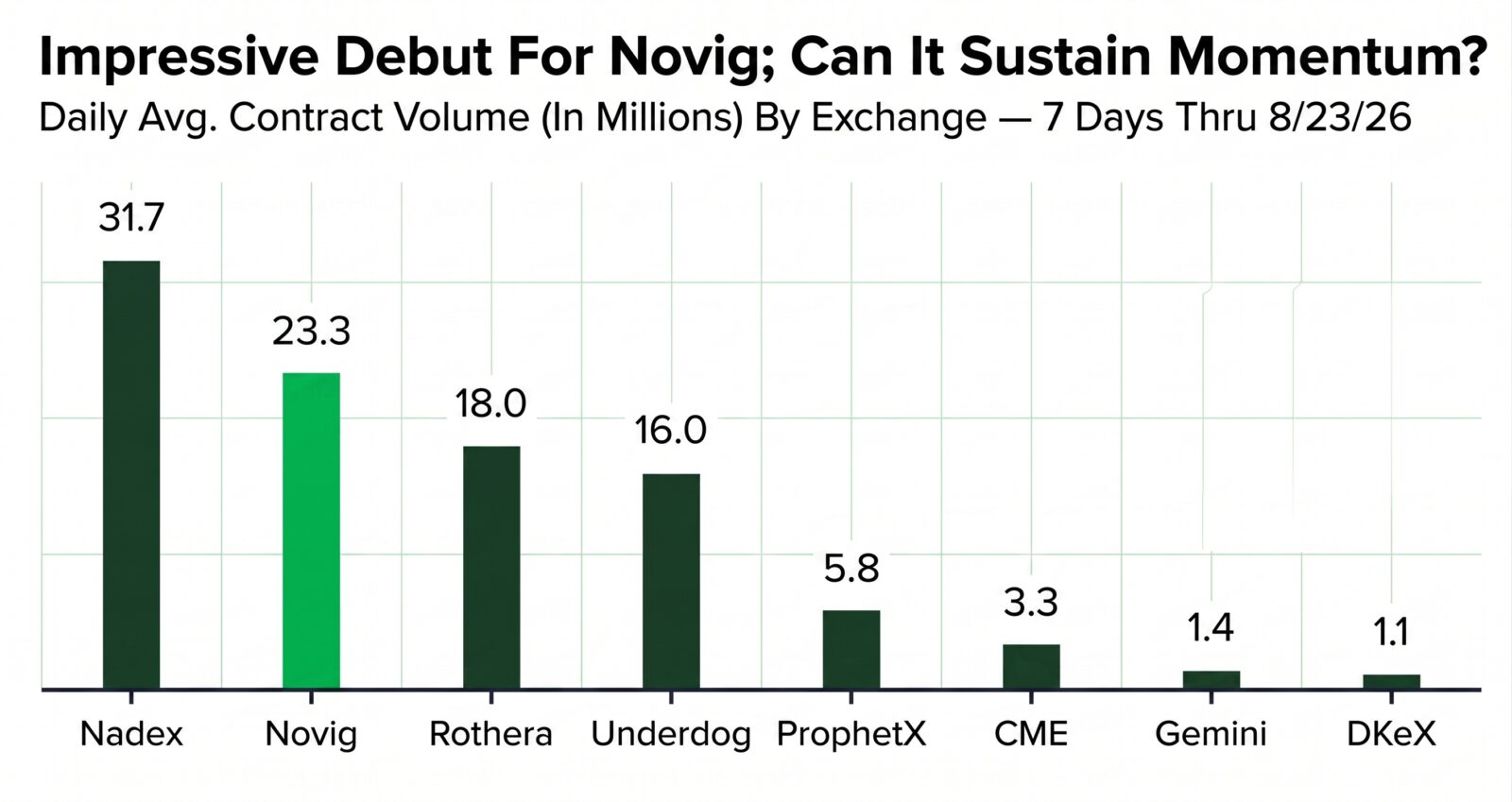
Eilers & Krejcik Gaming analyst Brad Allen reported that Novig reached average daily contract volume of about 21 million after its launch, placing it ahead of newer competitors including Rothera and Underdog’s exchange.
The platform’s first week reportedly produced more than $125 million in notional trading volume, including a single-day peak of roughly $26.3 million. Baseball helped drive activity during August, while parlays accounted for a meaningful share of trading.
That performance is notable because August is usually a quieter month for sports wagering. The NFL season, college football, major tennis events, UFC cards, and other fall sports could become an important test of whether Novig can retain and expand its user base.
Still, Novig remains much smaller than the largest prediction market operators. Kalshi and Polymarket continue to lead the broader market, particularly in categories beyond sports, such as politics, cryptocurrency, economics, and entertainment events. Take a look at the graph below, which was put together by Front Running Predictions.
How The Novig Platform Works
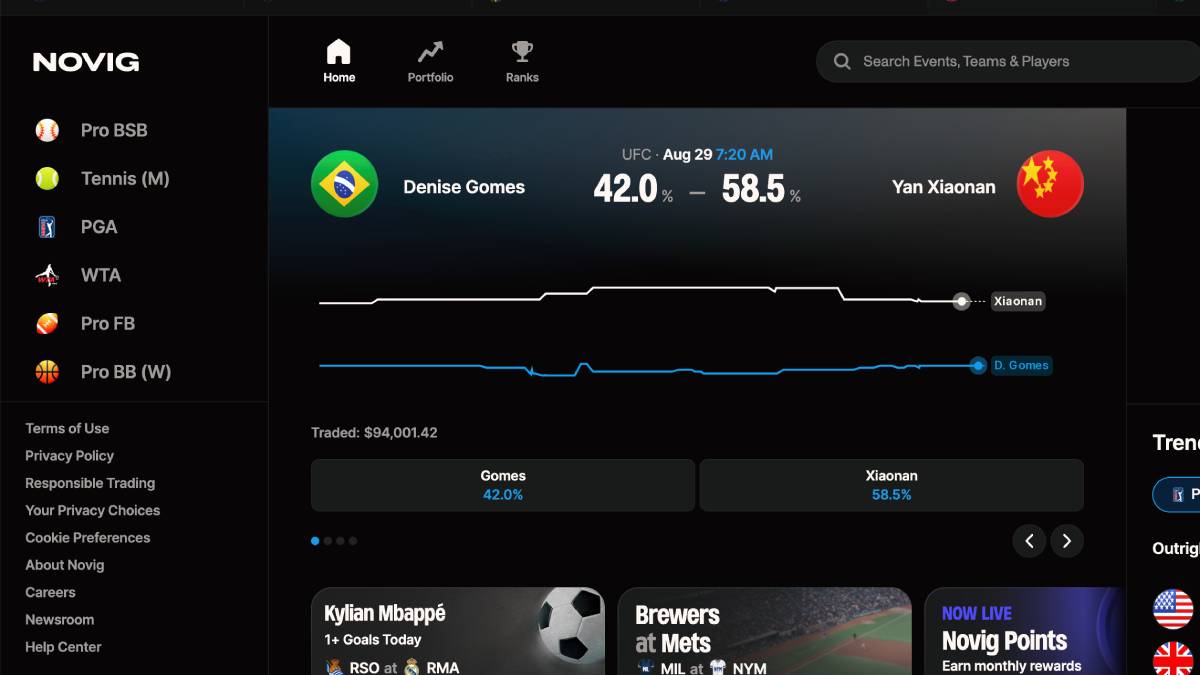
Novig positions itself differently from a traditional sportsbook. Instead of the operator setting odds and taking the other side of every wager, the Novig prediction market uses an order-book format.
Users trade contracts tied to specific sports outcomes. A contract can be structured around a binary question, such as whether a team will win a game or whether a sports event will occur. Traders can buy or sell positions as market prices change before the event is settled.
Novig has filed sports event contracts involving leagues and competitions including Major League Baseball, the NFL, WNBA, tennis, UFC, and PGA Tour events.
The company argues that this structure creates a peer-to-peer exchange experience rather than a conventional sportsbook product. That distinction matters because Novig says its contracts are federally regulated derivatives under the Commodity Exchange Act.
Why Novig Faces Legal Challenges
The major legal question is straightforward: Are sports event contracts on a federally regulated prediction market governed primarily by the CFTC, or can individual states still enforce their gambling laws against them?
Novig argues that its CFTC-regulated exchange falls under the federal regulator’s exclusive jurisdiction. The company maintains that states may regulate sportsbooks, casinos, and other forms of gambling outside federally designated markets, but cannot apply state gaming laws to trading that Congress placed under CFTC authority.
States take a different view. State regulators and attorneys general contend that contracts based on sports winners, totals, spreads, and similar outcomes are functionally sports betting. From that perspective, companies offering those products should comply with state licensing requirements, consumer-protection laws, and gambling restrictions.
This conflict is not limited to Novig. Kalshi, Polymarket, Robinhood, Crypto.com, and other platforms have faced similar questions as prediction markets expand into sports-related contracts.
Novig’s Multi-State Legal Strategy
Rather than wait for state enforcement actions, Novig has moved quickly to file lawsuits in federal court. The company has sued officials in New York, Massachusetts, New Mexico, Washington, and Wisconsin.
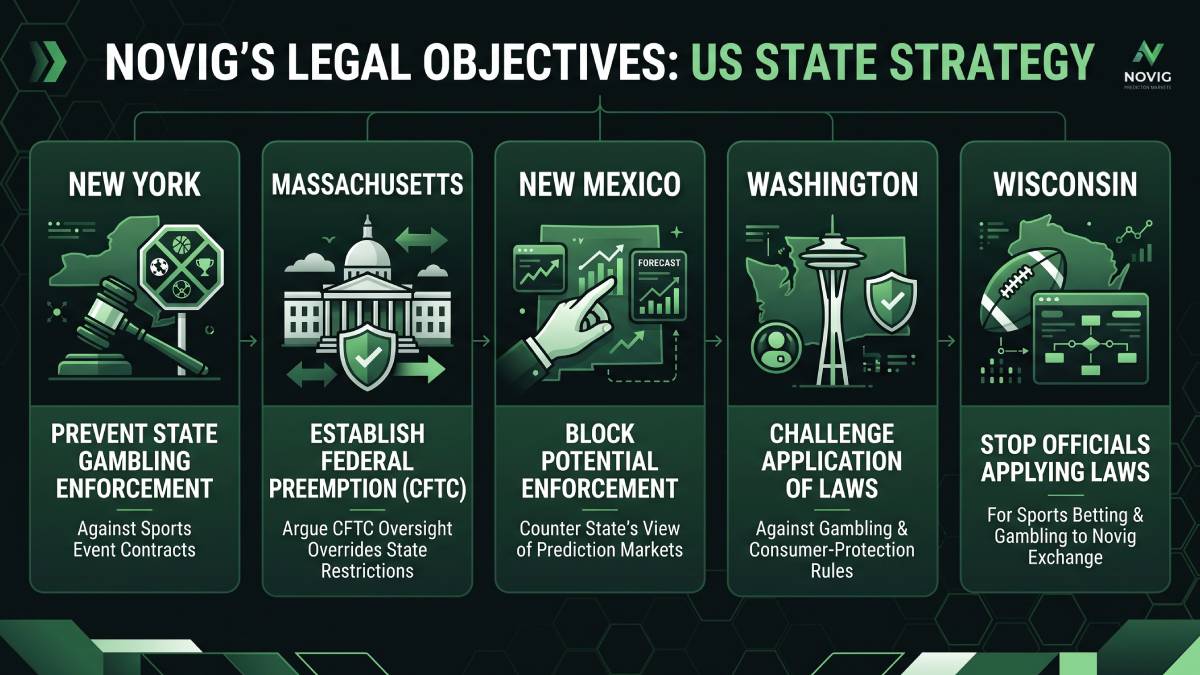
Novig filed its Wisconsin complaint on August 14, seeking expedited court protection against possible enforcement by Attorney General Josh Kaul and state gaming administrator John Dillett. The company argued that its event contracts are derivatives overseen by the CFTC, while Wisconsin has maintained that sports-based prediction contracts can violate state gambling law.
The strategy is important because filing first gives Novig the chance to frame the dispute in federal court. It also allows the company to argue that state action is preempted before a state regulator brings its own enforcement case.
What The Legal Fight Means for Novig
Novig’s regulatory status gives it a stronger federal argument than an unlicensed gambling operator would have. Ludlow Exchange received its Designated Contract Market approval on June 16, allowing it to operate as a federally regulated derivatives exchange.
However, CFTC designation does not guarantee that courts will agree with Novig’s legal position. Courts reviewing similar prediction market disputes have reached mixed results, and several states remain determined to treat sports event contracts as gambling.
For Novig, an unfavorable ruling could lead to geofencing, reduced market access, compliance costs, or additional litigation. A favorable decision, on the other hand, could strengthen the company’s national model and reduce its need to obtain licenses in every state.
Novig’s pure focus on sports also raises the stakes. Sports contracts are likely to attract the most scrutiny because they closely resemble familiar sportsbook wagers, even when offered through a prediction market structure.
Novig’s Next Test
Novig has shown that a sports-only prediction market can generate meaningful early activity, particularly with an existing user base and a federally regulated exchange structure. Its early daily contract volume has already placed it ahead of some newer competitors, even if it remains far behind major platforms such as Kalshi.
The next challenge is not just customer acquisition. Novig must prove that its federal regulatory framework can withstand pressure from states that view its products as unauthorized sports betting.
As football season approaches, Novig’s volumes may rise sharply, despite the NFL pushing back against prediction markets. At the same time, the company’s legal cases could determine where users can access the platform and whether its CFTC-regulated prediction market model can operate nationwide over the long term.


