


Prediction market apps had a record-setting NFL Sunday, according to tracker-reported notional-volume figures. The Kalshi prediction market reportedly handled $3.04 billion, while DraftKings Predictions reached $196.6 million and the Novig app climbed to $109.8 million.
Together, the records show how quickly sports-focused prediction market apps are growing in the United States.
Ironically, the NFL recently banned prediction market ads during games and at all NFL-related events. But no matter how you look at it, prediction markets aside, NFL wagering is a big business.
Prediction Market Apps Hit New NFL Highs
Kalshi’s reported $3.04 billion day placed it far ahead of other regulated U.S. prediction-market venues. The company had already set and broken several daily records during September as the NFL season gained momentum.
That scale matters because Kalshi is no longer used only for political, economic, or cultural questions. Sports markets have become one of its biggest sources of trading activity, especially on full NFL Sundays. In fact, a recent study found that more than 60% of people planned to try prediction market apps this season.
A typical market may ask a simple question:
- Will the Browns win?
- Will a team cover a point spread?
- Will the game total finish above a listed number?
- Will Quinshon Judkins score a touchdown?
- Will several outcomes happen together in a combo contract?
Each contract generally settles at $1 if the stated outcome occurs and $0 if it does not. If a “Yes” contract trades at 22 cents, the market is pricing the outcome at roughly a 22% probability.
For a trader who buys “Yes” at 22 cents, the cost is 22 cents per contract. If the outcome occurs, the contract settles at $1. If it does not, the contract settles at zero.

Why NFL Sundays Create Huge Volume
The NFL brings together several ingredients that are ideal for prediction-market activity: large audiences, frequent news, multiple games at once, and fast-moving live events. But NFL Commissioner Roger Goodell is taking a methodical approach to them.
On a full Sunday slate, prices can move in seconds after an injury, turnover, touchdown, weather change, or major coaching decision. That gives active traders reasons to buy, sell, or close positions before a game ends.
Sports also create deep liquidity in the most popular markets. A high-profile game winner, spread, total, or player proposition can attract significant trading interest from fans, professional traders, market makers, and arbitrage-focused participants.
Research published before this record weekend showed that sports were already a major force behind the industry’s 2026 growth. Pew Research reported that combined monthly trading volume on leading prediction platforms rose from $26 billion in May to $53 billion in July, largely driven by sports activity.
The Important Difference: Notional Volume Is Not Cash Risked
The headline numbers are eye-catching, but you should understand what they measure.
The $3.04 billion reported for the Kalshi prediction market is notional volume, not necessarily the total amount of customer cash placed at risk. Notional volume usually counts the face value of contracts traded. Since a winning contract settles at $1, each contract may be counted at $1 even when the buyer paid only a few cents.
The number can also include both sides of a trade. If one trader buys a contract and another trader sells it, volume reporting can reflect activity from both participants.
This becomes especially important for long-shot combo contracts.
Imagine a trader buys a very unlikely multi-leg NFL combo at 2 cents per contract. The trader may only spend a small amount of money, but the contract still has a $1 settlement value if every leg wins. When large numbers of low-priced, long-odds combos trade, the platform’s notional figure can rise much faster than the actual cash committed by customers.
That does not make the record meaningless. It means the best interpretation is that markets saw unusually intense trading and contract turnover—not that users necessarily deposited or risked $3.04 billion in cash on one day.
Parlays and Combos Are Changing the Market
Multi-leg “combo” contracts have become an especially important factor in sports prediction-market volume. They work much like parlays in that every selected outcome must happen for the contract to pay out.
For example, a combo might require all of the following:
- The home team wins.
- The game goes over the total.
- A quarterback throws two or more touchdowns.
- Another team wins later that day.
Because the probability of hitting every leg is lower than the probability of hitting any single leg, these contracts can trade at very low prices. That makes them appealing to users looking for a small-stake, high-upside outcome.
But it also means they can inflate notional volume. A large amount of activity in low-priced, high-payout combinations can produce much bigger face-value trading totals than the actual amount spent.
That distinction is especially relevant when comparing prediction-market volume with traditional sportsbook handle. They are related measures of activity, but they are not calculated in the same way.

Novig App Crosses $100 Million
The Novig app reportedly reached $109.8 million in notional trading volume on the same Sunday, making it the platform’s first reported day above $100 million.
Novig is positioned as a sports-focused prediction exchange. In June 2026, the Commodity Futures Trading Commission approved Novig’s designated contract market application, allowing it to operate as a federally regulated venue for sports event contracts.
The company began operating its regulated exchange nationwide in early August after moving away from its prior sweepstakes model.
Novig’s pitch differs from the standard sportsbook approach. Rather than setting a house line and building a margin into every wager, an exchange-style market matches opposing views between participants, with prices determined through market activity and platform fees.
That model can be attractive to experienced sports traders who care about price, liquidity, and the ability to sell a position before settlement. Still, users should review the platform’s fees, availability, contract rules, and risks before trading.
How Prediction Market Apps Differ From Sportsbooks
Prediction markets and sportsbooks can look similar because both let users take positions on sports outcomes. However, their market structure is different.
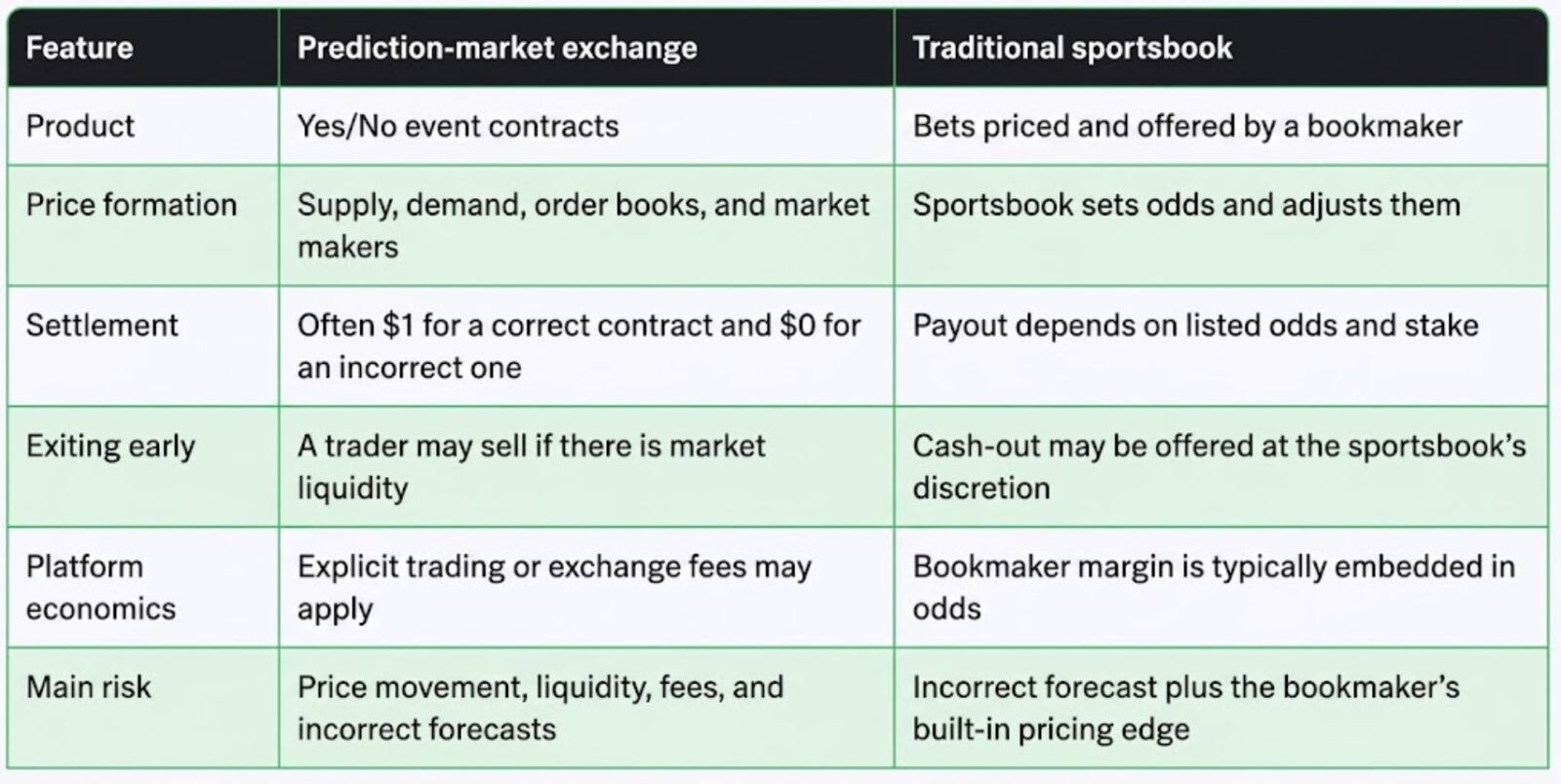 Neither model removes risk. A contract can lose all of its purchase price, and live markets can swing sharply after a single play. Thin markets can also make it harder to exit a position at an attractive price.
What the Record Weekend Means
The record set by the prediction market apps suggest that NFL Sundays are becoming the most important recurring volume events for U.S. exchanges.
Kalshi remains the clear leader in absolute scale, based on the tracker-reported figures. But the growth of the DraftKings prediction market and the Novig app shows that newer sports-focused platforms are building meaningful activity of their own.
The bigger takeaway is not simply that one platform posted a larger number than another. It is that sports contracts, live trading, and multi-leg combinations are changing the shape of the prediction-market business.
As the NFL season continues, the most useful numbers to watch will be:
- Notional volume versus estimated cash-at-risk or taker volume.
- The share of activity coming from combos and long-shot contracts.
- Liquidity in standard markets such as game winners, spreads, and totals.
- Fee structures and effective trading costs.
- State-by-state availability and regulatory developments.
- Whether rising volume produces deeper markets or only larger headline figures.
For now, the reported records mark another sign that prediction market apps are moving from a niche financial product toward a significant part of the broader sports-trading landscape.


