


The unofficial fifth major of the year is already upon us, and 123 golfers will be shooting for glory (and over four million dollars) during this week's contest.
I've said this a few times already this week, but I would be very careful in using data past a certain point for this event. The once-erratic output of results is still marginally there. Still, the move from May to March a few years ago has been more predictable since the facility was always best suited to play in colder weather, if looking for simpler returns. Personally, I would rather see the burnt-out grass that didn't generate easier overseeded Bermuda returns for the field. However, it has been a profitable output for me at this tournament over the last five years, which is more than I could say in the past. Maybe not all change is bad.
I am going to use this article to talk about some of the stats of the week (while also producing bets), but there is a lot for us to dive deeper into this week.
2026 Players Championship Odds, Predictions: PGA Picks From Proven Model
Outright Winners
Si Woo Kim
Numbers moved extremely fast this week from their opening totals. It is harder to justify some of these Si Woo Kim prices in the low 20s than it would be where I got it at 40/1, but my data did place Kim as the second-favorite to win this golf tournament, which technically would still be a value number that I have if you use the 24/1 that you can find on DraftKings.
Kim has been a ball-striking machine in 2026. We have seen him gain over 43 shots to the field over seven events. That is the type of profile that you expect to see win a golf tournament at some point, but the putter has remained ice-cold to the tune of negative 2.25 strokes per event, removing a win from his profile as perhaps the best player so far this season.
When you look at the data profile of what TPC Sawgrass demands of players, you get very clear results that point to a two-pronged approach. Give me someone who can find accuracy off the tee and dominate with their proximity buckets. If you can do those two items at a large clip, you have a chance to avoid the water and hit the greens at a higher rate than the field. Because of that answer, putting is the one stat that starts to get neutralized there and explains how Kim won this event as a 500/1 longshot nearly 10 years ago.
I ran a portion of my model that removed putting and set a threshold return to keep only the top 20 players for Expected Proximity at Sawgrass, Weighted Driving for the week, Weighted Scoring, and Weighted Strokes Gained Total. Those were all singular findings to see if any golfer in this field could land in that range over all four categories.
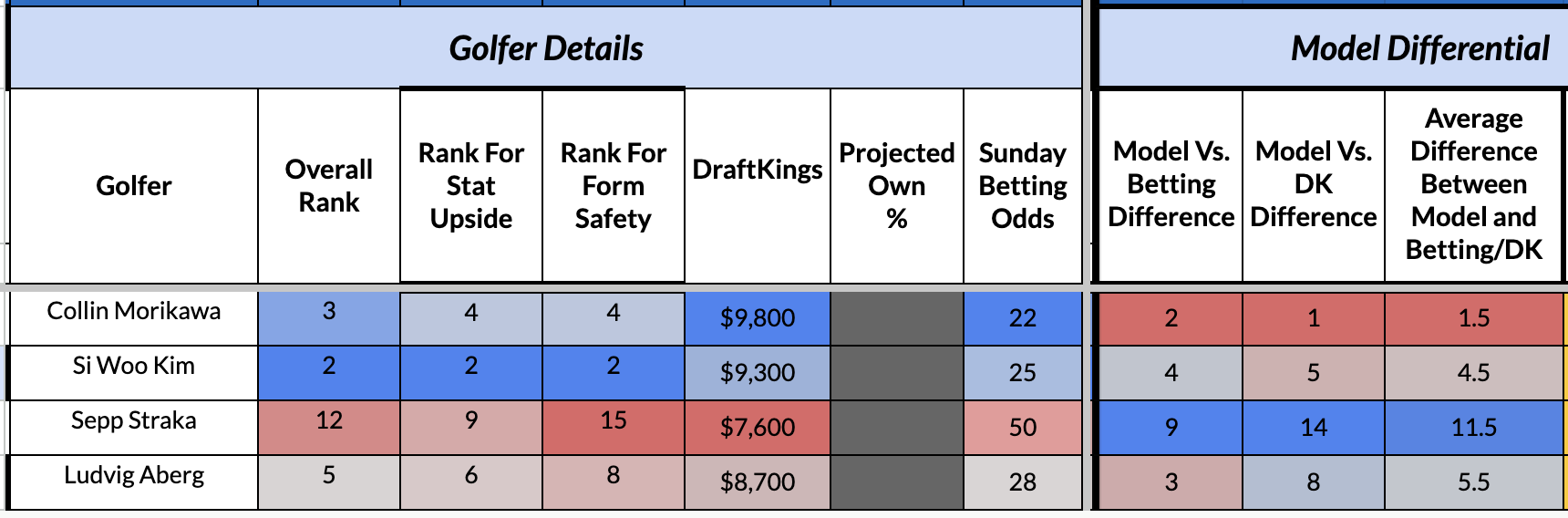
We ended up having four names who did: Si Woo Kim, Ludvig Aberg, Collin Morikawa and Sepp Straka. I would not be shocked to see the winner come from within that list, and is why I also took Aberg and Straka on my card this week.
Other Names I am Backing: Ludvig Aberg (33/1), Sepp Straka (65/1), Max McGreevy (250/1)
Matchups
Adam Scott -125 over Justin Rose
I took a deep dive into both Adam Scott’s and Justin Rose’s profiles leading into this event over the years to see if we could pinpoint any trends.
If this bet is to lose, there is a very poor return within the Rose profile that is signaling more strength than my model may be seeing this week. You will notice that the lead-in form is always a chaotic mess from him. You get made cuts. You get victories. You get everything in between. However, if you take the five-event lead-in form and just look at ball-striking totals, Rose gaining in that area typically results in a made cut — sometimes a high-end finish. When he is losing, he misses the cut. There really is no in-between with that answer. 
The problem I see is that the iron play has been so good this season that it is generating one of the best lead-in form profiles we have seen from him over the last five years. +2.24 strokes gained with his irons over the last five, resulting in +1.42 strokes gained ball-striking during that time. Obviously, if that second number for ball-striking is lower than his strokes gained with his irons, you are getting a negative return with the driver, which, if you do the math, means he is losing 0.82 strokes over the last five events on average per start.
That total is rather consistent with what we get from him each year when he comes to this tournament. Every return has generated between 0.42 and 0.58 of a loss. Technically, you are looking at about 0.30-0.40 strokes worse overall than his average, but I was more alarmed by his short-game metrics that delivered almost 1.5 strokes worse of an answer during that timeframe than his second-worst return. We see that with his negative-1.2 result over the last five events this year versus +0.36 in 2023, an event where he missed the cut.
The upside scares me here, but I thought when you added his downturn in three of the four categories and the immaculate profile to Adam Scott, who has not found much success here recently but used to be the staple of consistency early in his career, you got a matchup that might be a larger discrepancy than books posted at their initial prices.
Scott has gained 4.08 ball-striking per event over the last five tournaments and is bringing one of his best overall golf profiles we have seen from him, including a positive start to the year with his short game.
Scott has been about 3.5 shots better to start this year than Rose — the ball-striking is +2.66 shots better, and the long-term profiles tell a similar story of success when faced with comparable tests. Sure, I am worried Rose pops and turns this into a battle, but even if he does, I am hoping Scott can hold Rose off for four days. There is a reason beyond my bet for why this number has been on the move. I had proper in the -150s.


