


The future of college football is becoming increasingly dichotomous.
But despite the biggest brands realigning into just the Big Ten and SEC, hundreds of thousands still tune in Tuesday and Wednesday night to watch the MAC — oftentimes two sub-.500 teams that rank below 110th national power ratings.
Take, for example, 2024’s contest between 3-6 Ball State and 5-4 Buffalo. On paper, there really wasn’t much to get excited about. But if you didn’t tune in, you missed a buck-wild 51-48 overtime shootout that included 38 second-quarter points and 24 fourth-quarter points.
How does relatively low-level D-I college football manage to produce such a dependably entertaining product? Conference variance.
I’ve looked at conference variance the last three seasons to help pinpoint opportunities for long shots. Looking for a few of your own? Perhaps I can point you in the right direction.
Let's take a look at my college football futures and NCAAF picks for the 2026 season.

College Football Conference Variance Scores
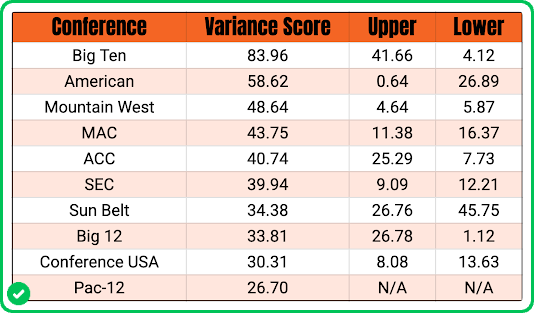
“Upper” and “lower” typically refer to the upper third and lower third of conferences.
The Pac-12 is too small a league to implement this analysis, so it is listed as “N/A.” The Sun Belt is divided up into its still-existing divisions (East, R, and West, L).
What is Variance Score?
Parity. I’ve pulled numbers to calculate Variance Score between conferences, but it’s an observable phenomenon.
How big of a gap is there between the top of the conference and the bottom? In this instance, I used aggregate preseason power ratings from multiple sources like SP+, FPI, etc., to calculate variance.
In the data above, a higher Variance Score means a larger gap between the top and bottom of the conference; therefore, there is less parity. A lower Variance Score means a tighter gap between teams and, therefore, more parity.
Let’s take a look at last year’s Variance Scores, specifically the leagues with the two lowest numbers, the Big 12 (22.40) and Sun Belt (16.63).
The Big 12 Championship Game featured a first-time winner in Texas Tech and a middle-of-the-road preseason pick that lost its starting quarterback in the summer in BYU.
The Sun Belt featured the West’s sixth-ranked preseason team, Troy, taking on favorite James Madison, but almost featured the West’s fifth-ranked team, Old Dominion.
Last year, conference variance score identified Old Dominion and North Texas as long-shot targets.
Using Variance Score to Pick Long Shots
If the Variance Score in a certain conference is really low, then there’s more parity and a higher weekly probability of close games and upsets.
Don’t know what to make of the American this year? You’re not alone, as the top third of the league has a razor-thin margin.
Looking at this year’s aggregated power ratings, No. 1-rated Navy is about a field-goal favorite over No. 7-rated Army; the gap between No. 3 Tulane and No. 8 North Texas is less than a touchdown (5.6 points).
In a theoretical matchup between any teams in between, it’s essentially a one-score coin flip. One bounce of the ball here or there changes the win-loss column entirely.
Chances are, we’ll get a lot of those one-score finishes near the top of the American this year.

Long-Shot Picks in the Pac-12 Conference
Unfortunately, oddsmakers are already on top of the variance in the American, so let’s look at another league: the Pac-12.
Boise State is the clear favorite in the rebuilt Pac-12 this coming season, both in odds and power ratings.
However, the next bunch of teams (San Diego State, Fresno State, Texas State and Washington State) all sit within one score of the Broncos in terms of preseason power rating.
Fewer teams means a smaller variance score by nature (assuming no one lags behind), but the Pac-12’s conference-wide variance score aligns more closely to the top third of the Big 12 or ACC and is far below the Big Ten’s upper third.
Conversely, Texas Tech heads the Big 12 by nearly eight points, and Miami tops the ACC by nearly 10 points.
So, when taking a mid- to long-shot in either conference, which favorite do you trust to falter more: Boise State, Texas Tech or Miami?
Close Wins and Regression to the Mean
Chances are, if you posted a really good record in one-score games one year, you’re bound to regress to the expected mean the next year. According to Phil Steele, 70.2% of teams that had two net close wins had the same or weaker record the next year.
Of those who had four or five net close wins, 83.9% ([) had the same or weaker record the next year. “Net close wins” refers to the gap between close wins and close losses; for example, a 3-1 record in one-score games falls under two net close wins.
Last year, Texas State posted a 1-4 record in one-score games. Two of those losses came in overtime and an additional one in the final 10 seconds. The Bobcats finished 7-6 and 122nd in TeamRankings’ luck metric despite finishing near even in turnover margin.
If Texas State had finished closer to the luck mean, we could've been looking at a 9-3 team that ran to the Sun Belt Championship game.
Since the Pac-12 projects to have the slimmest league-wide variance this year, there’s a greater uncertainty of outcome even for its top teams. Texas State is worthy of long-shot conference winner consideration in its new league.

Fourth Downs and Wins
A few years ago, Bill Connelly wrote a brilliant article on what he dubs “fourth down profit.” In essence, how many points per game did a team net by successfully converting fourth downs?
It’s been a few years since we’ve seen an update to this, but the concept stands.
In that study, including extreme cases like West Virginia, SMU, Maryland and Texas Tech, teams could swing nearly a touchdown or more by converting fourth downs on average.
Last year, FAU and Army finished No. 1 and No. 2 in fourth-down conversions per game with 3.5 and 3.2, respectively. Should they continue to be aggressive and find success on fourth down, there’s a chance either team swings more than a game in their favor.
And since the American looks like a low-variance, high-parity league near the top this year, Army and FAU are prime long-shot candidates to consider.
Proof of Concept for Variance Scores in College Football
All these numbers are cool and all, but does this actually mean anything? Sure, the American had a terrific story, and the MAC is always a toss-up, but is any of this actionable?
Well, let’s take a look at some of the names that Variance Score highlighted:
- In 2025, this article highlighted North Texas, Old Dominion and Kansas as prime long-shot contenders. Although the Jayhawks didn’t land, both UNT and ODU posted historic seasons, and the former ended up in the American title game.
- In 2024, TCU improved by four wins, from 5-7 to 9-4, thanks to a turnaround in luck (128th to 53rd) and an 0-5 close-win record (+2 net close wins).
- In 2023 and 2024, the MAC saw its fifth unique champion in as many years and 13th non-repeat season in a row with the lowest Variance Score both times.
This year, we’ll monitor Texas State, Army and FAU.


