


Online casinos in the United States are on a serious hot streak.
In March, the industry hit one of its biggest milestones yet, bringing in roughly $1 billion in monthly revenue. That’s not just a small bump—it’s a clear sign that iGaming has become a major force in the U.S. gambling market.
But here’s the interesting part: this growth is happening in only seven states.
Despite the slow road to online casino legislation in the U.S., revenue is on a fast track. Online casinos are popular, providing access to games like slots and Texas Hold 'em. Although the path to full legalization for iGaming has been slow and complicated, there is a lot of money being made.
So, let's take a closer look at the numbers, who's benefiting the most, and where online casino games may go from here.

A Small Map, Big Money
Right now, legal online casino gaming is limited to just a handful of states: New Jersey, Pennsylvania, Michigan, Connecticut, West Virginia, Delaware, and Rhode Island. Despite that small footprint, these markets are producing massive results.
Each of these states has taken a slightly different path to legalization, but they all share one thing in common—strong and steady growth. Some, like New Jersey and Delaware, have been in the game since 2013. Others, like Michigan and Connecticut, only launched within the last five years. Even the newest entrant, Rhode Island, is already contributing to the total.
March 2026: A Record-Breaking Month for Online Casinos
March stood out as a landmark moment. Total iGaming revenue landed somewhere between $970 million and $1.06 billion, depending on the report. Either way, it marks one of the highest monthly totals ever recorded.
That’s a big jump from a year ago. In March 2025, online casinos brought in about $834 million. In just one year, the industry added well over $100 million in monthly revenue.
Even more impressive, five out of the seven states set new all-time monthly records:
- Pennsylvania
- Michigan
- New Jersey (near-record, second-highest ever)
- West Virginia
- Delaware
The remaining two—Connecticut and Rhode Island—still posted some of their strongest months to date.

State-by-State Standouts
A closer look at the numbers shows how competitive this space has become.
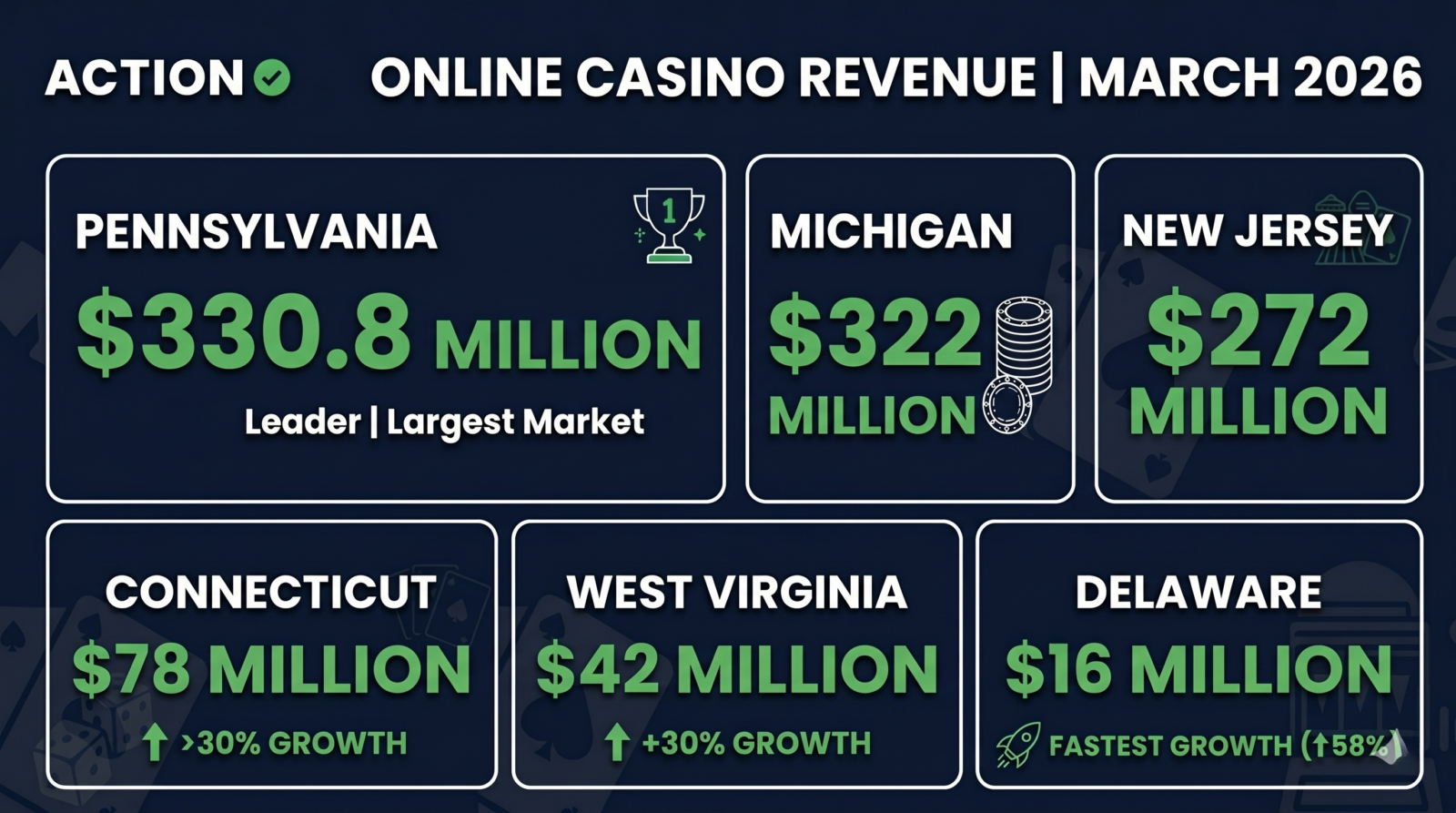
Pennsylvania led the pack with about $330.8 million in revenue. A large portion came from online slots, which continue to dominate player interest.
Michigan wasn’t far behind, pulling in around $322 million. That’s especially notable given its smaller population compared to Pennsylvania. Its growth rate—around 24% year over year—shows strong momentum.
New Jersey, one of the oldest markets, brought in about $272 million. While its growth is a bit slower than newer states, it still posted double-digit gains.
Smaller states are also making an impact:
- Connecticut generated about $78 million, up nearly 30%.
- West Virginia reached about $42 million, growing over 30%.
- Delaware saw one of the fastest growth rates, jumping roughly 58% to around $16 million.
- Rhode Island, though smaller, continues to build its base.
What’s Driving Online Casino Growth?
Several factors are fueling this surge in online casino revenue.
- Mobile apps make it incredibly easy to play. Players can access games like slots, blackjack, and poker anytime, anywhere.
- Major brands like FanDuel, DraftKings, and BetMGM are investing heavily in promotions. Bonuses, free spins, and loyalty programs help attract and keep players.
- There’s a strong crossover with sports betting. Many users who sign up to bet on sports also try casino games, especially during slower sports seasons.
Finally, these markets are simply maturing. As more players become comfortable with online gaming, participation continues to rise.
Online Casino Revenue Benefits for States
This growth isn’t just good for operators—it’s a major win for state governments.
Taxes from iGaming are becoming a significant source of revenue. For example, Pennsylvania reportedly collected over $100 million in taxes from online casinos in a single month.
That money can support public programs, infrastructure, and education, making iGaming an attractive option for states looking to boost revenue without raising traditional taxes.

The Bigger Picture for iGaming
Zooming out, iGaming is one of the fastest-growing segments of the U.S. gaming industry. The broader commercial gaming market hit a record $78.7 billion in 2025, and online casinos are a big part of that growth.
In some states, online gaming is even outperforming certain land-based casino segments. That shift highlights changing consumer habits, with more players choosing digital options over in-person visits.

What Comes Next?
Despite its success, expansion has been slow. Political debates, tax concerns, and tribal agreements have kept many states on the sidelines.
Maine may be next to launch, but beyond that, the map isn’t expected to change quickly. But there are several states on the cusp.
In the meantime, the existing states continue to push the industry forward. With consistent year-over-year growth and frequent record-breaking months, iGaming has earned its reputation as a “juggernaut.”
Still, growth may start to level off in more mature markets like New Jersey. As markets stabilize, the explosive gains seen in newer states may become harder to maintain.
March online casino revenue figures show just how powerful iGaming has become in a short amount of time. Even with limited legalization, the industry is closing in on $1 billion months on a regular basis.
If more states join in, that number could climb even higher. For now, though, the seven active markets are proving just how big iGaming can get—even on a small map.


