


On October 8, 2026, Democrat Abdul El-Sayed and Republican Mike Rogers met for their first Michigan U.S. Senate debate, with an open Senate seat and control of the chamber at stake.
I tracked Kalshi's Michigan Senate winner market before, during and after the debate, collecting minute-by-minute observations to test how sensitive prediction market prices are to breaking political news. Would traders adjust their expectations as the candidates faced off, or would it take a more consequential development to move the market?
What I found was surprising. Kalshi's prices barely moved during the debate, although Rogers' contract showed a slight increase by Friday morning. So, if a major campaign event barely moves the market, what actually gets prediction market users to change their expectations?
How Political Prediction Markets Work and Why Prices Move
Political prediction markets allow traders to buy and sell event contracts tied to election outcomes, including individual Senate races, which party will control Congress, and presidential elections.
On platforms such as Kalshi and Polymarket, prices reflect what people are willing to pay for a particular outcome. A YES contract priced at 70¢, for example, suggests a roughly 70% market-implied probability, although that's not a guaranteed forecast.
But just because political news makes headlines doesn't mean traders will change their minds about who's going to win. If a debate doesn't tell them anything they hadn't already considered, there may be little reason to adjust their positions or the prices they're willing to pay.
That's what I wanted to test in Michigan. Were traders actually reconsidering their expectations as the candidates debated, or were the small price movements just normal trading activity? By looking at bid and ask quotes, last-traded prices, volume and whether any changes held over time, I could get a better sense of what was happening.
Keep reading: Best Political Betting Sites
Why I Tracked the Michigan Senate Debate
Michigan's 2026 Senate election could affect which party controls the chamber. Democratic Sen. Gary Peters is retiring, leaving Republicans with an opportunity to flip the seat as Democrats look to regain the majority.
El-Sayed, a former public health official, and Rogers, a former Republican congressman, met at WOOD TV8's Grand Rapids studio on Thursday, October 8. Moderated by WOOD TV8 political reporter Rick Albin, the hour-long debate began at 7 p.m. ET.
The candidates argued over healthcare, tariffs, immigration, affordability and the war in Iran, while challenging each other's records and political associations.
That format gave me a pretty useful window for tracking political prediction market prices. I had a specific start and end time, unlike a scandal or endorsement that might unfold over several days, which allowed me to compare the market before the candidates took the stage, monitor the debate itself and follow the subsequent trading period.
What Kalshi Prices Said About Michigan Before October 8
El-Sayed entered debate week with a substantial market lead. On October 2, Kalshi News reported that his market-implied probability had reached 73%, a new high at the time, compared with 27% for Rogers. On October 7, Rogers called for an end to the U.S.-Canada tariff dispute, breaking publicly with President Donald Trump on an issue closely tied to Michigan's manufacturing economy.
I mention the latter because that was a big development leading up to the debate. Whether it had any effect on Kalshi's prices, though, is something the data can't tell us.
How I Measured Kalshi's Prediction Market Reaction
I monitored Kalshi's Michigan Senate winner market, identified by event ticker SENATEMI-26, using minute-level snapshots from its public market endpoint.
The analysis followed two YES contracts:
- SENATEMI-26-D: Abdul El-Sayed / Democratic
- SENATEMI-26-R: Mike Rogers / Republican
My monitoring ran from Thursday, October 8, at 9 a.m. ET through Friday, October 9, at 7:30 a.m. ET. The records include bid and ask prices, last or previous prices, spreads, volume and open interest.
For the minute-by-minute series, I used live observations first, followed by Kalshi's one-minute candles when live records weren't available. Where neither source had a new observation, I carried forward the previous recorded values. Just keep in mind those figures aren't fresh market quotes, so I haven't treated them as evidence of new trading activity.
Why Bid, Ask and Last Prices Tell Different Stories
Unlike a sportsbook, where the operator sets the odds, Kalshi works as an exchange where traders place buy and sell orders against one another. The prices you see depend on those orders and the trades that actually go through.
Take a Rogers YES contract with a 31¢ bid and 32¢ ask. The bid is the highest price someone is willing to pay, while the ask is the lowest price someone is willing to sell for. The 1¢ difference is called the spread.
The last price tells you where the most recent trade happened, which isn't necessarily the price available right now. So, Rogers' last price could rise from 31¢ to 32¢ without either the bid or ask changing.
Kalshi's Michigan Senate Market Before the Debate
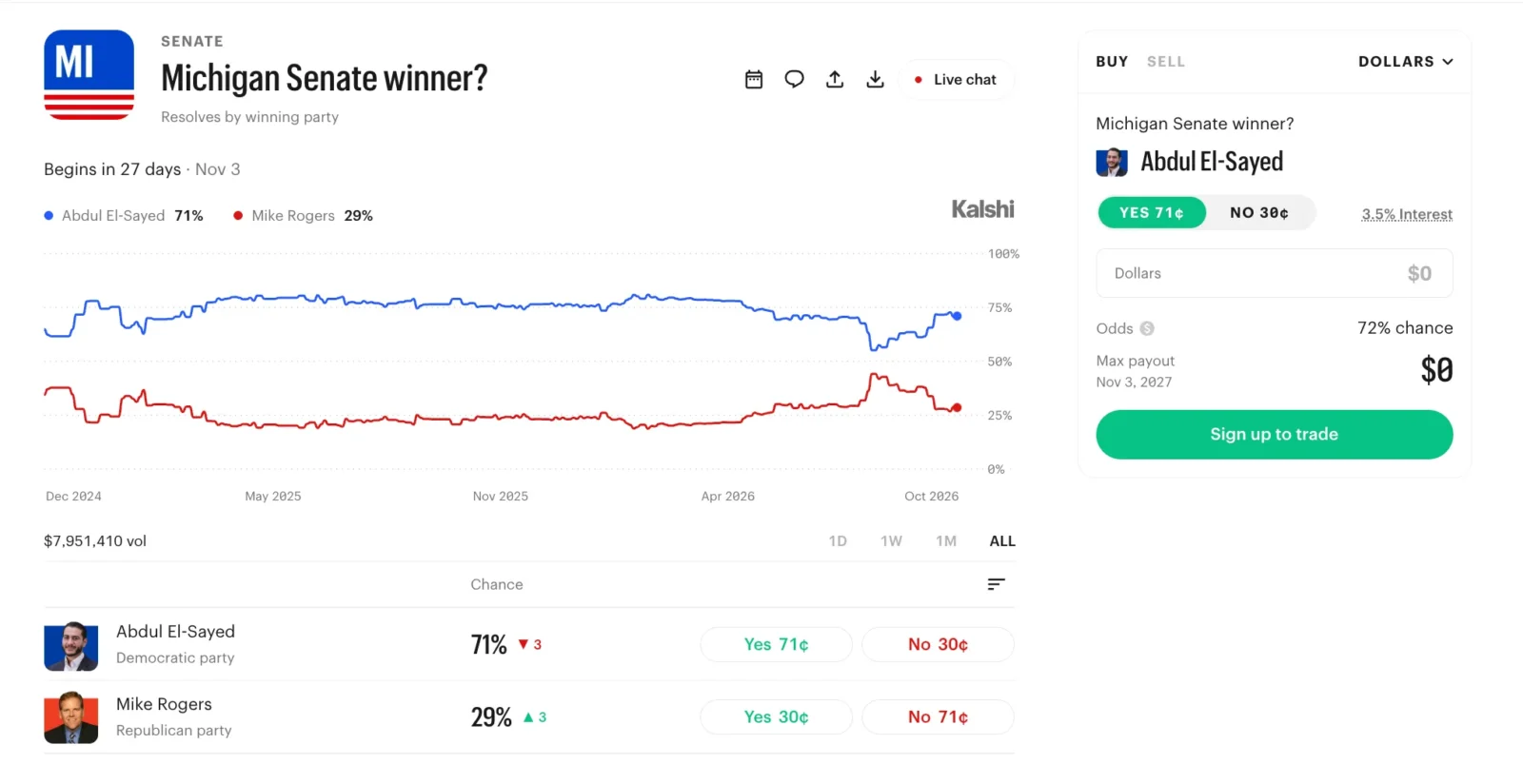
At 9:0o a.m. ET on October 8, El-Sayed's YES contract showed a 69¢ bid, 70¢ ask and 70¢ last price. Rogers stood at 30¢ bid, 32¢ ask and 31¢ last.
By 6:59 p.m., the final minute before the debate, El-Sayed had moved down to 68¢ bid / 69¢ ask / 68¢ last. Rogers' bid had increased to 31¢, while his ask and last price remained unchanged.
| Time (ET) | El-Sayed YES bid/ask | El-Sayed last | Rogers YES bid/ask | Rogers last |
|---|---|---|---|---|
| 9:00 a.m. | 69¢ / 70¢ | 70¢ | 30¢ / 32¢ | 31¢ |
| 6:59 p.m. | 68¢ / 69¢ | 68¢ | 31¢ / 32¢ | 31¢ |
Source: Action Network's Kalshi market monitoring, October 8, 2026. Both observations come from live logger records.
El-Sayed was still the clear favorite when the candidates took the stage. Those small changes had already happened during Thursday's trading, before the debate began, so they can't be attributed to anything said during the event.
How Kalshi Prices Moved During the Debate
Despite the exchanges between El-Sayed and Rogers, Kalshi's displayed quotes showed little movement.
El-Sayed held at 68¢ bid / 69¢ ask across the sampled debate checkpoints, and Rogers remained around 31¢ / 32¢ for most of the hour before his quotes moved slightly lower toward the end.
| Time (ET) | Debate moment | El-Sayed bid/ask | El-Sayed last/previous | Rogers bid/ask | Rogers last/previous | Source |
|---|---|---|---|---|---|---|
| 7:00 p.m. | Debate begins | 68¢ / 69¢ | 68¢ | 31¢ / 32¢ | 31¢ | Live |
| 7:15 p.m. | First quarter | 68¢ / 69¢ | 69¢ | 31¢ / 32¢ | 32¢ | Live |
| 7:30 p.m. | Midpoint | 68¢ / 69¢ | 69¢ | 31¢ / 32¢ | 32¢ | Live |
| 7:45 p.m. | Final quarter | 68¢ / 69¢ | 69¢ | 31¢ / 32¢ | 32¢ | Live |
| 7:57 p.m. | Final monitored live minute | 68¢ / 69¢ | 69¢ | 30¢ / 32¢ | 32¢ | Live |
| 8:00 p.m. | Debate ends | 68¢ / 69¢ | 69¢ previous | 30¢ / 31¢ | 30¢ previous | Candle |
Source: Action Network's Kalshi market monitoring, October 8, 2026. All times are Eastern. The 8:00 p.m. row comes from Kalshi's one-minute candle data. Its previous-price values are not newly observed live trades.
The First Half: Last Prices Changed, but Quotes Held Steady
The first notable difference showed up in last-traded prices. At 7:00 p.m., El-Sayed's last price was 68¢ and Rogers' was 31¢. Fifteen minutes later, both had increased by 1¢, reaching 69¢ and 32¢, respectively.
Their bid/ask quotes, however, hadn't moved. That remained true at the 7:30 p.m. checkpoint.
If you were watching only the last-traded prices, those increases might suggest some movement. The unchanged quotes, however, tell a more limited story: neither contract showed a corresponding increase in its best displayed buying or selling price.
In other words, there was little evidence of a substantial adjustment in either candidate's market-implied chances during the first half-hour.
The Final Half: No Sustained Change Before the Debate Ended
At 7:45 p.m., both contracts still had the same bid/ask quotes as when the debate began. By 7:57 p.m., Rogers' bid had slipped from 31¢ to 30¢. His ask remained at 32¢, with his last price also unchanged.
The 8:00 p.m. candle-derived observation showed Rogers at 30¢ bid / 31¢ ask, while El-Sayed remained at 68¢ / 69¢.
The changes were small, and the sampled prices never developed into a sustained move in either direction. For all the attention surrounding a Senate debate with national implications, Kalshi's market showed little evidence that traders had truly reassessed the race during that hour.
What Happened to Kalshi Prices After the Debate?
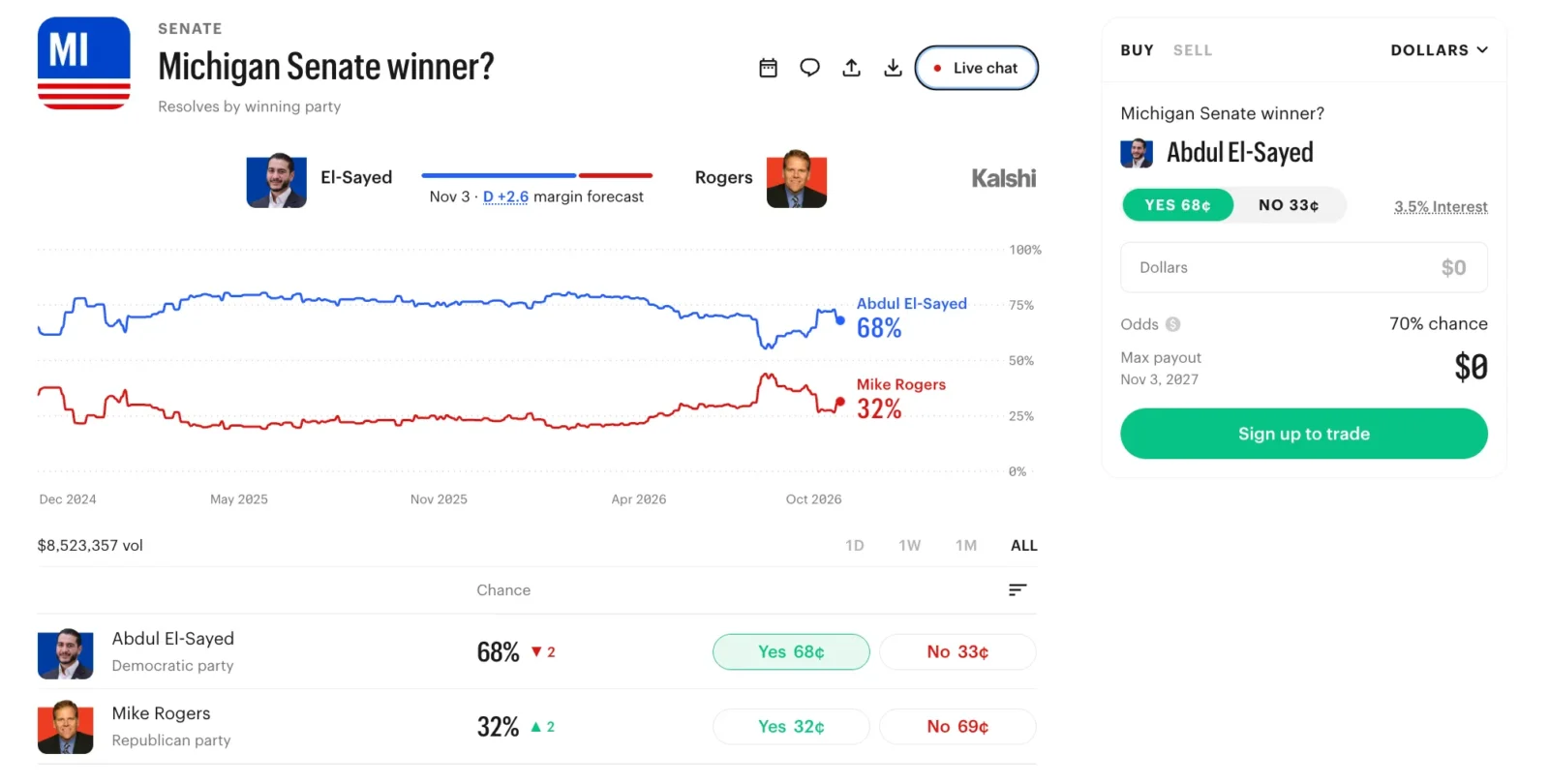
Kalshi's quotes continued to fluctuate Thursday evening, but the clearest change happened Friday morning, when Rogers' contract was priced slightly higher than before the debate.
Thursday Evening: A Brief Recovery in Both Contracts
At 8:55 p.m. ET, El-Sayed's YES contract stood at 69¢ bid / 70¢ ask / 70¢ last, while Rogers showed 31¢ bid / 32¢ ask / 32¢ last. Both contracts had higher quotes than in the 8:00 p.m. candle-derived observation.
The increase didn't hold. By 9:19 p.m., Rogers was back at 30¢ bid / 31¢ ask, while El-Sayed remained at 69¢ / 70¢.
Conclusion: Thursday evening's observations showed some movement, but no consistent change toward either candidate.
Friday Morning: Rogers' Quotes Moved Higher
By 7:03 a.m. ET on Friday, October 9, Rogers' YES contract had reached 32¢ bid / 33¢ ask / 33¢ last. Those figures were unchanged at 7:30 a.m., the final observation in our monitoring period.
El-Sayed held at 68¢ bid / 69¢ ask across both checkpoints, although his last price increased from 68¢ to 69¢.
| Time (ET) | El-Sayed bid/ask | El-Sayed last/previous | Rogers bid/ask | Rogers last/previous | Source |
|---|---|---|---|---|---|
| Thu. 8:00 p.m. | 68¢ / 69¢ | 69¢ previous | 30¢ / 31¢ | 30¢ previous | Candle |
| Thu. 8:55 p.m. | 69¢ / 70¢ | 70¢ | 31¢ / 32¢ | 32¢ | Live |
| Thu. 9:19 p.m. | 69¢ / 70¢ | 69¢ | 30¢ / 31¢ | 31¢ | Live |
| Fri. 7:03 a.m. | 68¢ / 69¢ | 68¢ | 32¢ / 33¢ | 33¢ | Live |
| Fri. 7:30 a.m. | 68¢ / 69¢ | 69¢ | 32¢ / 33¢ | 33¢ | Live |
Source: Action Network's Kalshi market monitoring, October 8-9, 2026. The 8:00 p.m. observation is candle-derived; the remaining rows are live observations.
Conclusion: Friday morning's observations showed a slight shift in Rogers' favor, with his bid and ask each 1¢ higher than before the debate. Still, the change was too small to suggest a substantial reassessment of the race.
What the Michigan Debate Tells us About Political Prediction Markets
For all the attention the Michigan debate got, Kalshi's reaction was pretty quiet. Rogers' quotes were slightly higher the next morning, but that alone doesn't tell us whether traders had genuinely changed their expectations or whether the move would last.
Did the Market Show a Lasting Repricing?
Not much changed while the candidates were onstage, and Thursday evening didn't show a clear trend either. By Friday morning, though, Rogers' contract was looking a little stronger.
When I checked Kalshi's Michigan Senate market again later on October 9, Rogers' YES contract was still at 33¢, while El-Sayed's stood at 68¢, close to where they'd been earlier that morning.
So, Rogers' small increase hadn't disappeared, but I wouldn't call it a lasting change just yet. We'd need to see whether those levels held up until November 3rd, and there's still no way to say for certain that the debate was behind the move.
Why Major Political News Doesn't Always Move Market Prices
A political debate can make a lot of headlines without telling traders much they didn't already know. By the time candidates take the stage, their positions on most issues are known, and people trading on the election may already have a fairly settled view of how the race will play out.
That doesn't mean a debate can't change someone's mind, though. Say a trader holding El-Sayed YES contracts hears something they think could hurt his chances with voters. They might decide to sell part of their position, and the same could happen with someone holding Rogers contracts. But disagreeing with a candidate's answer doesn't necessarily mean believing they're less likely to win.
I think larger price movements are more likely when something genuinely unexpected happens, like a candidate withdrawing from the race or a court ruling that significantly changes the political situation. Those developments could give traders a much stronger reason to reconsider their positions.
That's one possible explanation for what happened in Michigan. The debate may simply not have given traders enough new information to change their expectations substantially, although the recorded prices alone can't confirm that.
Market Speed, Election Forecasts and Their Limits
Just because prediction markets can react to breaking news quickly doesn't mean those reactions are always accurate. Traders can change their positions within minutes, but whether they're getting any closer to predicting the actual election result is a different story.
Take a YES contract priced at 70¢. That suggests a roughly 70% chance of the outcome happening, according to the market, but it's far from a guarantee. And depending on liquidity, bid/ask spreads, trading fees and available orders, you might not even be able to buy or sell at the price you're seeing.
There's also a difference between one trade going through at a higher price and the whole market changing its mind. Even when quotes move right after a major headline, we can't automatically assume that headline caused it.
That's how I'd look at Michigan. The debate barely moved the market, and Rogers saw a small increase the following morning. We can see that prices changed, but we can't say for certain what drove that movement or how long it'll hold.
Want to learn more about how prediction markets work? Read our guide on Understanding Liquidity vs. Accuracy at Prediction Markets.
FAQs
How Fast Can Political Prediction Market Prices Update?
Prices can change within minutes as new orders and trades come in, although there's no fixed reaction time. During the October 8 Michigan Senate debate I analyzed, for instance, Kalshi's quotes barely moved, showing that even major political events don't always change expectations.
Are Political Prediction Market Odds the Same as Election Polls?
No. Election polls measure voters' preferences or intentions, while prediction markets reflect what participants are willing to pay for contracts tied to future outcomes. Polls can influence market expectations, but a candidate's polling lead doesn't necessarily translate into the same market-implied probability.
What's the Difference Between a Short-Term Price Move and a Lasting Repricing?
A short-term move can reverse after a single trade or brief change in quotes, while lasting repricing means the market continues valuing an outcome differently over time. For example, Rogers' YES contract was still showing 33¢ when I checked Kalshi again later Friday morning, but I'd still need to see those levels hold for longer to call it a lasting change.


