


North Carolina sports betting operators will pay a higher state tax under the newly enacted North Carolina State Budget, while prediction market platforms will face a separate and much lighter tax structure.
Gov. Josh Stein signed Senate Bill 257 into law last month. The budget raises the tax on online sports betting revenue from 18% to 23% and introduces a 6% tax on certain prediction-market revenue beginning Jan. 1, 2027. The policy creates a sharp divide between the treatment of licensed sportsbooks and federally regulated prediction-market operators.
It also comes at a time the state is monitoring a battle over traditional brick-and-mortar casinos.
The change matters because North Carolina is not simply increasing gambling-related revenue. It is also drawing a line between traditional sports wagering and event-contract trading platforms such as Kalshi and Polymarket.

North Carolina Sports Betting Tax Increases to 23%
The North Carolina State Budget raises the tax on online sportsbooks from 18% to 23% of gross wagering revenue. The increase took effect with the budget and applies to the state’s legal online sports betting market.
Gross wagering revenue generally refers to the money left after sportsbooks pay winning bets, before many of the business expenses that an operator may use to measure profitability. That means the tax applies to sportsbook revenue rather than the amount customers initially wager.
North Carolina launched legal online sports betting in March 2024. Under the former 18% rate, operators had already generated more than $300 million in state tax revenue, according to reporting on the budget package.
The 23% rate gives North Carolina one of the higher flat tax rates among major U.S. online sports betting markets. For operators, the larger tax obligation could affect promotional spending, bonus offers, advertising budgets, and the overall economics of serving North Carolina customers.

Prediction Markets Get a Different Tax Structure
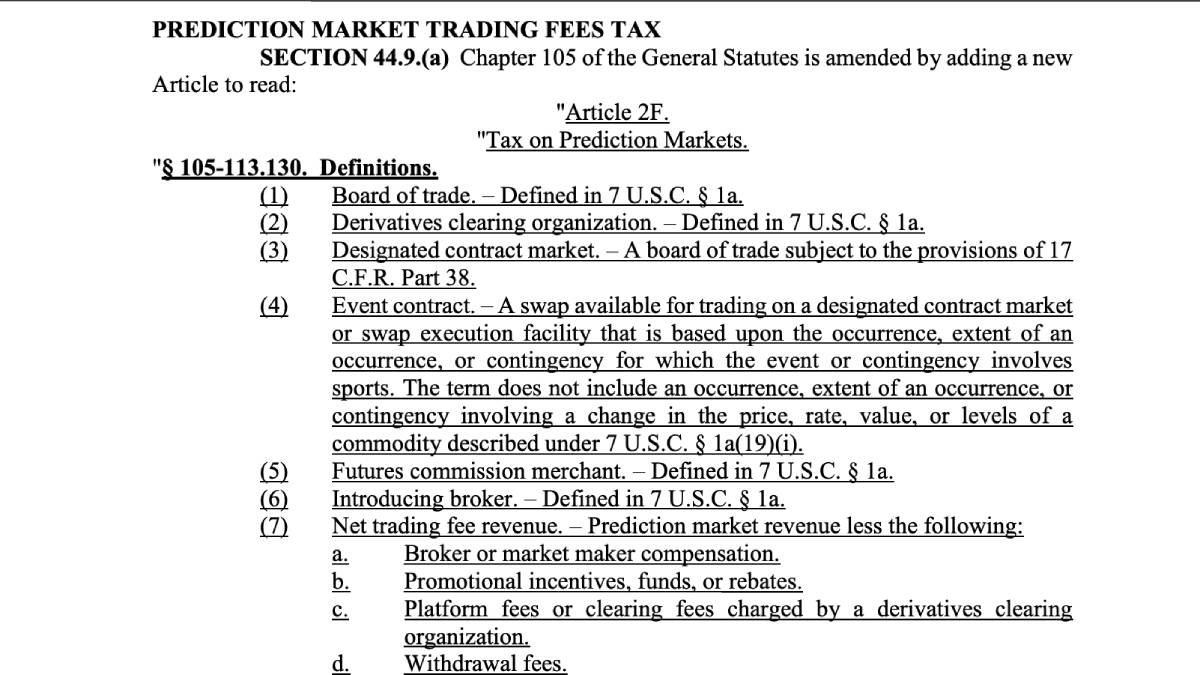
The North Carolina State Budget also creates a new tax aimed at prediction-market platforms. Beginning Jan. 1, 2027, operators will owe a 6% tax on net trading fee revenue connected to North Carolina activity. A fiscal estimate projected roughly $2 million in revenue from the tax in 2027.
That framework is notably different from the state’s treatment of North Carolina sports betting operators.
Rather than taxing the gross value of customer trades, the prediction-market tax is built around the platform’s trading-fee revenue. The measure applies to fees and commissions generated through activity tied to The Tar Heel State, with the supplied legislative summary indicating that deductions may include certain market-making, promotional, platform, clearing, and withdrawal costs.
In practical terms, a sportsbook pays the 23% rate on gross wagering revenue, while a prediction-market platform is taxed at 6% of its qualifying net fees. The difference could produce a substantially lower effective tax burden for prediction markets, depending on the platform’s fee model and operating costs.
No New State License for Prediction Markets
The biggest policy difference may be regulation, not taxation.
North Carolina sports betting is a state-licensed industry. Sportsbooks operate under North Carolina’s sports wagering rules and face state oversight, licensing requirements, geolocation standards, reporting rules, and responsible-gambling obligations.
The new prediction-market provision does not create a comparable North Carolina licensing system. Reporting on the enacted budget says it does not impose “any license, registration, or other regulatory requirements or obligations” on prediction markets.
The approach largely leaves regulation to the Commodity Futures Trading Commission, or CFTC, for platforms operating under the federal commodities framework. Supporters may see that as a practical way to collect some tax revenue without launching a state-versus-federal jurisdiction fight. Critics may view it as a competitive advantage for platforms offering sports-related event contracts outside the usual sportsbook model.
The distinction is important because sports-event prediction markets and legal sportsbooks can appeal to many of the same customers. Both allow users to take positions on sports outcomes, but they operate under different legal and business structures.
Where the Sports Betting Money Goes
The North Carolina State Budget also changes how sports betting tax revenue is distributed.
Under the revised framework, the state continues to direct money toward administrative costs, problem-gambling education and treatment, and youth sports programs. The budget also expands the pool of universities eligible to receive athletics-related funding from sports betting proceeds.
UNC-Chapel Hill and NC State are expected to become eligible for distributions beginning in July 2027. Reporting on the budget proposal indicated that Football Bowl Subdivision schools, including UNC, NC State, Appalachian State, Charlotte, and East Carolina, could receive up to $2.5 million annually under the revised formula.
The state also retains funding for the Major Events, Games and Attractions Fund, although the budget places a $30 million annual cap on that allocation. Remaining money is directed to the state’s general fund after required distributions.

Bettors Can Deduct Gambling Losses
The budget includes a separate taxpayer-friendly provision for North Carolina bettors.
Residents can deduct gambling losses against gambling winnings when calculating state income taxes. The change is retroactive to Jan. 1, 2025, according to WRAL’s review of the budget proposal.
This does not mean all gambling losses are automatically deductible in every situation. Taxpayers should maintain records of winnings and losses, including account statements, wager histories, payment records, and other supporting documents. Anyone with questions about a specific return should consult a qualified tax professional.
North Carolina and Illinois take different paths
North Carolina’s approach contrasts with Illinois, where lawmakers moved to place sports-related prediction-market products inside the state’s sports wagering framework.
Illinois created an “exchange wager” category that includes agreements, contracts, transactions, and swaps offered on a prediction market or exchange that are tied to a sporting contest or event. Illinois imposed a 1.75% transaction tax on the first 5 million exchange wagers handled by a licensee during a fiscal year, increasing to 3.5% above that threshold.
Illinois’ law suggests that prediction-market-style sports products may only be offered by licensed Illinois sports wagering operators. That model is far more restrictive than North Carolina’s tax-only approach.
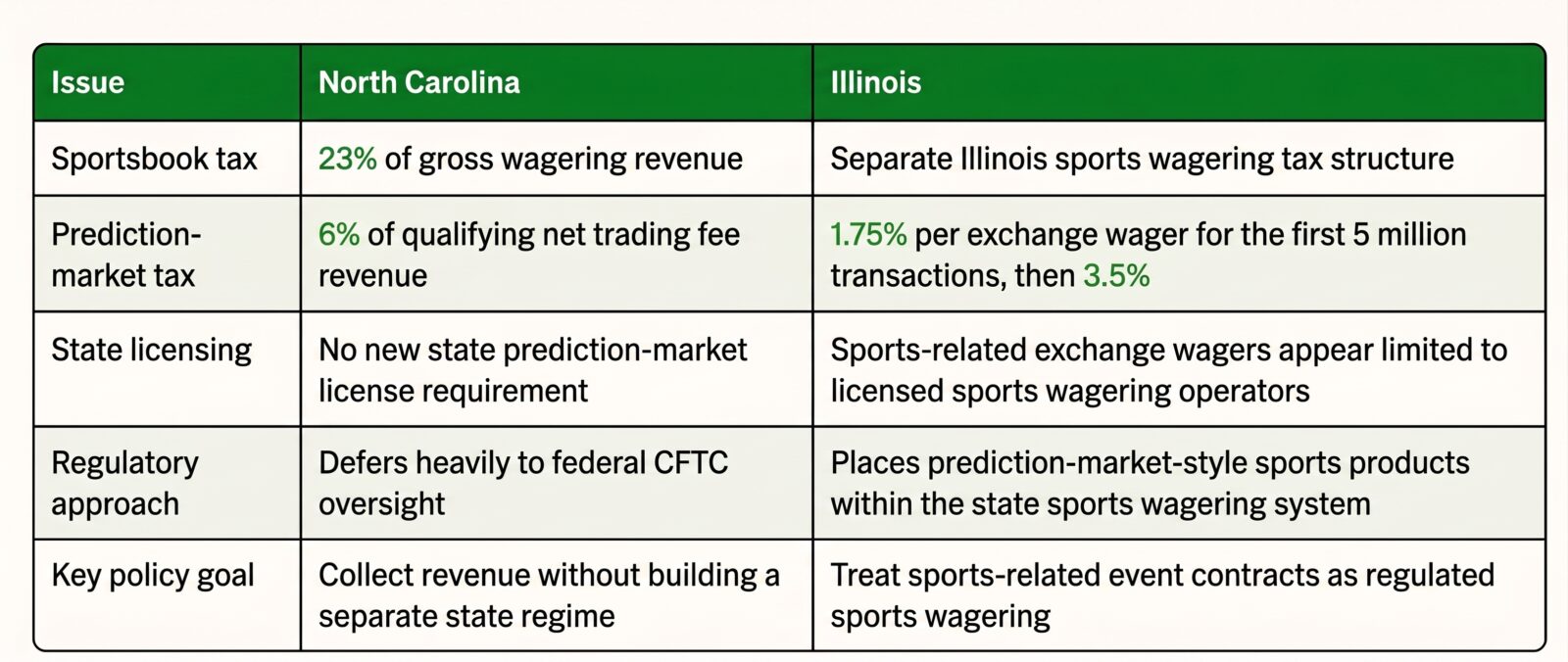
North Carolina’s model may be more attractive to federally regulated prediction-market platforms because it does not require them to obtain a sportsbook license or operate under the state’s full sports betting rulebook. Illinois, by contrast, is using its gambling framework to exert more direct control over sports-related event contracts.
What Happens Next in North Carolina?
The North Carolina sports betting tax increase is already in place, while the prediction-market tax is scheduled to begin on Jan. 1, 2027. The first full year of implementation will show whether the state’s tax structure produces meaningful revenue and whether operators change how they market sports-related event contracts in North Carolina.
Several practical questions remain. State revenue officials may need to issue guidance explaining filing procedures, residency standards, recordkeeping obligations, and how they will calculate revenue tied to North Carolina users.
The broader legal dispute also remains unsettled. Prediction-market companies and regulators continue to debate whether sports-event contracts fall exclusively under federal commodities law or whether states can regulate them as sports betting. North Carolina’s budget does not resolve that national issue, but it offers a clear policy choice: tax the activity, avoid creating a new state licensing regime, and leave much of the regulatory fight to federal authorities.
For North Carolina bettors and operators, the immediate takeaway is straightforward. Traditional online sportsbooks now face a 23% tax rate, while prediction-market platforms will face a lower 6% levy on qualifying fee revenue starting in 2027. That gap could shape competition in the state’s evolving gambling market.


