


The U.S. sweepstakes casino market is changing fast.
States are passing new restrictions, regulators are taking legal action, and operators are removing certain locations from their service areas. As a result, a sweepstakes casino list (or a list of social casinos) that was accurate a few months ago may no longer reflect where a site accepts players today. Recent reporting documents both new state laws and expanding operator restrictions.
For players, the challenge is not simply finding a website that loads. It is understanding the difference between state law, a pending legal dispute, and the rules set by an individual platform.
This guide explains the dual-currency model, highlights important state developments, and shows why location matters when reviewing a sweepstakes casino list.
What Is a Sweepstakes Casino?
A sweepstakes casino is a popular online platform that commonly uses two types of virtual currency:
- Gold Coins, which are used for entertainment-style games.
- Sweeps Coins, or a similar promotional currency, which may qualify for prize redemption under the platform’s rules.
The names vary by operator. Florida’s recent legal complaints, for example, describe Gold Coin packages bundled with Sweeps Coins or Stake Cash, with the promotional credits potentially redeemable for cash, gift cards, or cryptocurrency. Those descriptions are part of the state’s allegations, not a final court ruling.
That second currency sits at the center of the legal debate. Florida officials argue that the structure disguises real-money gambling as a sweepstakes promotion. Their lawsuits seek to stop the targeted platforms from operating in the state.
Why States Are Restricting Sweepstakes Casinos
States are approaching the issue in different ways.
Some legislatures have passed laws aimed at casino-style sweepstakes games. Other states are using existing gambling and consumer-protection laws to challenge operators in court. California and Connecticut adopted targeted laws in 2025, while Florida’s 2026 lawsuits rely on existing statutes rather than a newly enacted sweepstakes casino prohibition.
These approaches can lead to similar practical results: an operator may stop offering redeemable-currency games or leave a state entirely. However, the legal reason behind that change matters.
A newly enacted prohibition is different from a lawsuit that has not yet been decided. Neither should be confused with a company choosing to restrict access before a deadline.
Selected Sweepstakes Casino State Restrictions
The following table highlights several documented developments, including California's ban that started this year. It is a selected overview, not a complete 50-state legal guide.
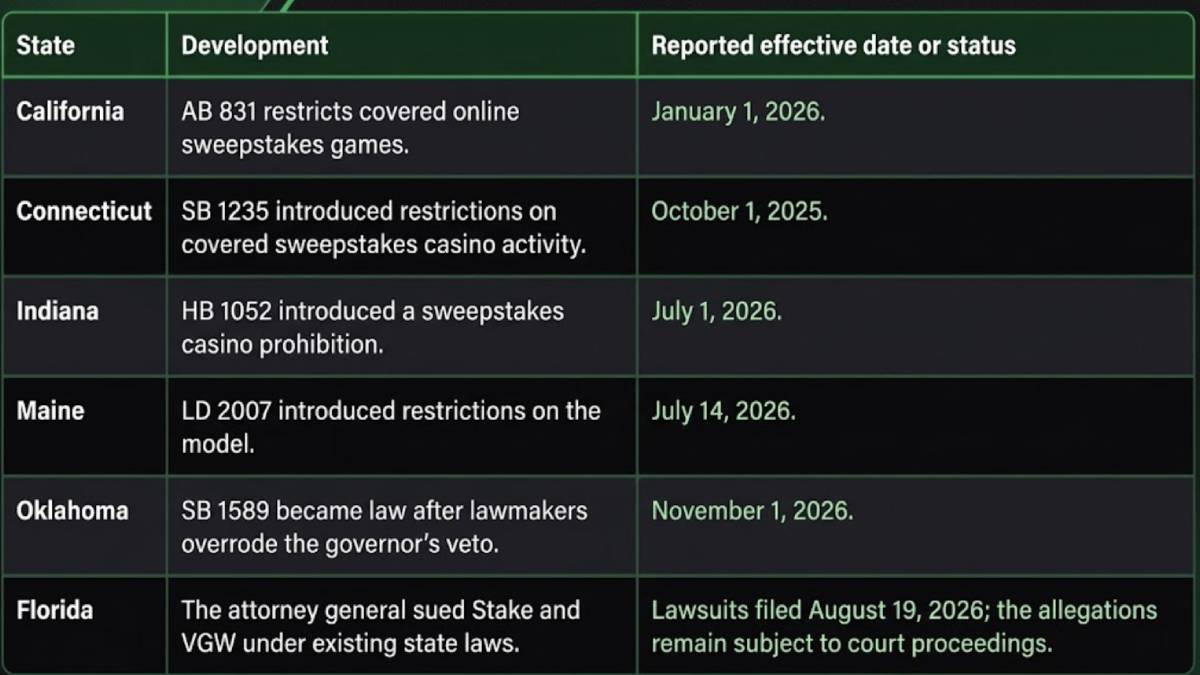
This distinction is especially important in Oklahoma. As of October 8, 2026, its law has been enacted, but the November 1 effective date is still ahead. Calling the prohibition already effective would blur an important difference.
Oklahoma’s Upcoming Ban Creates a Transition Period
Oklahoma’s legislature overrode Governor Kevin Stitt’s veto of SB 1589 in May 2026. The resulting law takes effect on November 1, 2026. Reporting indicates that operators must end covered sweepstakes casino activity by that date.
The restriction focuses on the sweepstakes side of the model. Reporting on the law distinguishes redeemable Sweeps Coin activity from Gold Coin-only play, which may continue where permitted. That does not mean every operator will keep an entertainment-only version available.
For anyone with an existing account, an operator’s own notices are important. Do not assume that a legal effective date also guarantees a particular redemption window. A useful account review should cover:
- Whether prize redemption remains available.
- Whether the operator has announced a separate redemption deadline.
- Whether identity verification is complete.
- Whether the account will become Gold Coin-only or close entirely.
Florida Shows Why “No New Ban” Does Not Mean “No Legal Risk”
Florida offers a clear example of enforcement without a new sweepstakes-specific prohibition.
On August 19, 2026, Attorney General James Uthmeier filed lawsuits against Stake and VGW. The complaints also targeted payment-related businesses and alleged illegal gambling and deceptive conduct. The state is seeking to stop the operations and recover money through several legal remedies.
Those are allegations, not established findings. The defendants have an opportunity to challenge them in court.
Still, the cases show why a sweepstakes casino list should not label a state “legal” simply because lawmakers have not passed a new, targeted ban. Existing laws may remain central to the dispute.
Why Sweepstakes Casino Lists Can Disagree
Two lists may show different state restrictions without measuring the same thing.
One may track enacted legislation. Another may include enforcement actions. A third may report every state excluded by a particular operator.
Operator policies can be broader than a list of explicit statutory prohibitions. In August 2026, reporting described VGW as excluding 16 states and Stake as excluding 22. Those figures reflected company restrictions, not a uniform nationwide count of state bans.
That is why an unexplained headline such as “20 banned states” can mislead readers. A useful list should state what it counts:
- Laws already in effect.
- Laws enacted but not yet effective.
- States with enforcement actions or litigation.
- Locations excluded by individual operators.
Keeping these categories separate gives readers a clearer picture of the market.
What to Check in a Sweepstakes Casino List
A useful sweepstakes casino list should do more than display brands and promotional offers. It should help readers understand whether its information applies to their location.
When reviewing a list, look for:
- A visible update date. Readers should know when the information was last reviewed.
- State-specific notes. A broad statement about U.S. availability does not explain individual restrictions.
- Separate legal and operator categories. A company’s blocked-state list is not the same as a legal opinion.
- Clear currency descriptions. Gold Coin-only access should not be presented as access to redeemable-prize games.
- Current operator notices. Registration, redemption, and account closure may follow different schedules.
- Sources for legal claims. Statements about bans and effective dates should identify the law or supporting reporting.
Recent operator changes show why these details matter.
Indiana's ban went into effect in July. Maine's ban went into effect one week ago. Iowa's Governor signed The Hawkeye State's ban back in May.
Frequently Asked Questions
Is every sweepstakes casino banned in the United States?
No nationwide prohibition is established by the state developments discussed here. The restrictions are state-specific, and operators maintain different service areas. A national yes-or-no answer would hide those differences.
Can a sweepstakes casino still offer Gold Coin games?
In some circumstances, an operator may retain Gold Coin-only play after ending the redeemable-currency version. Reporting on Oklahoma’s law identifies that distinction, but availability still depends on the applicable rules and the operator’s decision.
Does a website accepting registrations prove it is legal?
No. Website availability does not resolve a legal dispute. Florida’s lawsuits illustrate that regulators can challenge platforms under existing laws even without a new sweepstakes-specific statute.
Is Oklahoma’s ban already effective?
No. SB 1589 is scheduled to take effect on November 1, 2026. Operator restrictions may change ahead of that date.
Where Do Sweepstakes Casinos Go From Here?
The most useful sweepstakes casino list separates law from availability. It explains which restrictions are effective, which deadlines are approaching, and which locations an operator excludes on its own.
With state legislation, lawsuits, and platform policies changing on different schedules, that distinction is essential to understanding the 2026 market.
This article provides general information, not legal advice. It is not a guarantee that any platform is lawful or available in a particular location.


