


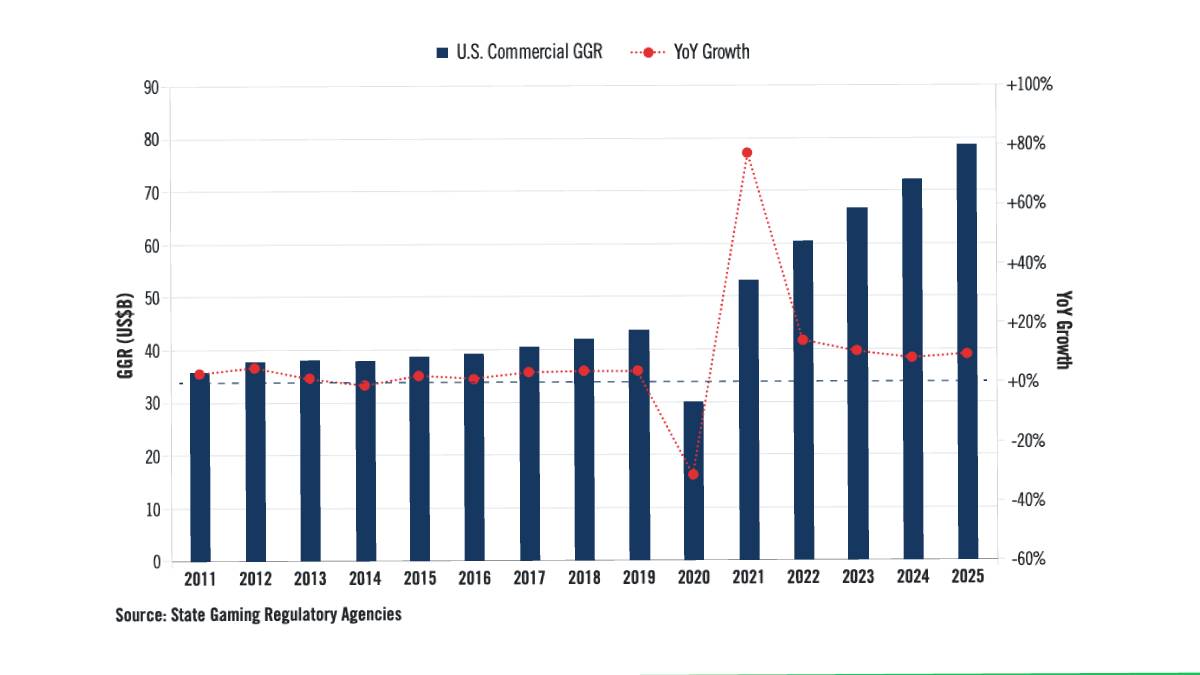
The American commercial gaming industry had another record‑breaking year in 2025.
According to the American Gaming Association’sState of the States 2026 report. This marks the sixth year in a row that casinos, sports betting, and online gaming (aka online casinos) have grown — a sign that the industry is not only strong but still expanding in new directions.
Below is a breakdown of what happened, why it matters, and where the industry is headed next.

Gaming Industry Sets Revenue Records Across the Board
The commercial gaming industry (not including tribal casinos) brought in about $78.7 billion in gross gaming revenue (GGR) in 2025. That’s a 9% jump from 2024 and the highest total ever recorded.
States and local governments also benefited. They collected $17.9–$18.1 billion in gaming taxes — money that helps fund schools, roads, public safety, and community programs.
Even more impressive: 34 out of 38 states, plus Washington, DC, set their own revenue records.
Where the Money Came From
The record numbers didn’t come from one place. They came from a mix of traditional casino play, booming sports betting, and the rapid rise of online gaming. Each segment tells a different part of the story.
1. Land‑Based Casinos: Still the Backbone
Traditional casinos — the slots and table games you find in physical properties — earned about $51 billion, growing a modest 2.3%. They remain the largest part of the industry, but their growth is slower than newer digital segments.
2. Sports Betting: Big Growth, Bigger Handle
Sports betting brought in $16.9 billion, up 22.6% from the year before. Americans wagered roughly $167 billion in total bets (“handle”), showing how mainstream sports betting has become since legalization expanded after 2018.
3. iGaming: The Fastest‑Growing Segment
Online casino gaming — legal in only seven states — generated $10.7 billion, soaring 27.6% in one year.
Two states hit a major milestone:
- Pennsylvania and New Jersey both saw online casino revenue surpass their land‑based casino revenue for the first time.
- Pennsylvania led the nation with $3.46 billion in iGaming revenue.
Taken as a whole, the numbers make one thing clear: the future of gaming is increasingly digital. Land‑based casinos remain essential, but online platforms and sports betting are shaping where the industry is headed next.

States and Cities That Stood Out
The commercial gaming industry didn’t just grow overall — it grew almost everywhere. But a few states and cities posted especially strong results, each for different reasons.
Washington, DC — The Fastest Growth in the Country
Washington, DC saw the biggest percentage jump of any U.S. gaming market, with revenue rising 75.9% to $94.5 million. This surge came from expanded sports betting options and stronger adoption of regulated platforms. Even though DC is a small market, the sharp increase shows how quickly consumer behavior can shift when new products become available. But lawmakers are talking about legalizing online casinos there.
Montana — A Small Market With Big Momentum
Montana posted a 45.1% increase, reaching $10.3 million in revenue. Montana’s gaming market is unique because it relies heavily on distributed gaming machines in bars and small venues. The strong growth suggests that even rural or low‑population states are benefiting from the broader national interest in gaming entertainment.
Connecticut — Strong Digital Performance
Connecticut grew 27.9% to $973.4 million, driven largely by online gaming and sports betting. Because the state legalized both at the same time, its digital ecosystem matured quickly. Connecticut’s results show how powerful online gaming can be when paired with established casino brands and strong partnerships.
New York — A Steady Climb in a Massive Market
New York posted 10.7% growth, which is impressive given its size. The state continues to be one of the most important sports betting markets in the country, and its casinos — especially those near New York City — remain major revenue drivers. As discussions about downstate casino licenses continue, New York’s long‑term growth potential remains high.
Pennsylvania — A Digital Powerhouse
Pennsylvania grew 12.1%, fueled by its booming iGaming sector. In 2025, Pennsylvania became the top online casino state, generating $3.46 billion in iGaming revenue — more than its land‑based casinos for the first time. This shift highlights how quickly consumer preferences are moving toward digital play.

Top Casino Markets in the U.S.
While many states saw strong growth, a few major markets continue to dominate the national landscape.
Las Vegas Strip — Still the King
The Las Vegas Strip remains the largest casino market in the country, bringing in $8.6 billion in 2025. Growth was mostly flat, with some monthly ups and downs, but the Strip’s scale and global appeal keep it firmly in the #1 spot.
Atlantic City — Holding Its Ground
Atlantic City stayed in the #2 position with $2.9 billion in revenue. While the market faces competition from nearby states, it continues to benefit from tourism, conventions, and a loyal regional customer base.
Lake Charles, Louisiana — A Rising Star
Lake Charles climbed the national rankings thanks to strong regional demand and continued recovery from past hurricane damage. Its casinos attract visitors from Texas and other nearby states, helping it grow faster than many mid‑sized markets.
Resorts World New York City — A Standout Property
Resorts World New York City remained one of the top‑earning individual casinos outside Nevada and Mississippi. Its location in Queens gives it access to one of the largest populations in the country, and it continues to perform like a major resort despite not yet having full table games.

Why the Casino Industry Keeps Growing
The industry’s momentum comes from a few major trends:
- Online casinos and sports betting are expanding faster than traditional casinos.
- Consumer demand remains strong, even with economic uncertainty in some areas.
- Legal, regulated gaming continues to pull players away from illegal offshore sites.
- The industry supports about 1.8 million jobs, according to the AGA.
But the AGA also warns that illegal gambling sites still cost governments tens of billions in lost tax revenue, and they lack consumer protections.
What This Means for the Future
The U.S. gaming industry is clearly maturing, but it’s also changing. Land‑based casinos remain important, but digital gaming is taking a larger share every year. With only seven states offering legal iGaming, there’s still huge room for growth if more states choose to legalize it.
The big picture: Gaming is thriving, and the shift toward online platforms is reshaping how Americans play and how states collect revenue.


