


Welcome to Part 1 of many in our sports betting narrative series, where we use existing research and our own research to try to prove or disprove popular sports betting narratives that lots of people peddle, but never bother to verify. Today, we're tackling how much experience really matters at The Masters.
Every Masters week, the "debut downgrade" gets floated. First-time players at Augusta, the narrative goes, are at a disadvantage since the subtleties of this course demand experience. You shouldn't bet them to win, because they can't, and you should be cautious betting them in finishing position markets or other derivatives.
And yes, it's true in aggregate.
In 2019, DataGolf ran the most rigorous version of this analysis to date, using strokes-gained data and skill-adjusted baselines from 1995–2018. Their finding: after controlling for player ability, debutants do underperform expectations. That underperformance shrinks with each year of experience, until a player's fifth or sixth Masters, when they actually start to overperform relative to expectations. DG's data also says course history is more predictive of future success at Augusta than any other course on the PGA TOUR.
We can't exactly replicate their methodology since they have historical skill baselines leading up to each Masters that they don't make available, but we can build on it with three key findings.
Winning vs. 'Playing Well'
A big part of this narrative is that debutants can't win the Masters. "Don't bet anyone to win who hasn't played here before." It's only happened once, really (Fuzzy Zoeller in 1979). But this ignores the fact that debutants are just worse golfers, and they're unlikely to win any golf tournament featuring the world's best players — it's not an Augusta-specific thing. It's actually never happened at the U.S. Open (well, since World War I), but we never really talk about it there.
I also think just trying to quantify "winning trends" (i.e. 10 of the past 11 Masters winners check XYZ boxes) in golf tournaments is the wrong approach because only one player can win. If a debutant finished second in each of the past five years, would you say that a debutant couldn't win this year?
When I'm betting the Masters, I care about much more than just the winner. Finishing position bets, pools, round score bets, and exotic markets are all available. I care about player performance top to bottom, so I wanted to measure every rookie and how they perform relative to their expectations.
1. The betting market already seems to factor this in
I wanted to look at DataGolf's pre-tournament model vs. what sportsbooks said to see how the betting market viewed debutants compared to just a single source. And consistently, DG's model gives rookies a better chance than the betting market. I used Pinnacle here, thinking it's the best representation of a true betting market in golf. I also filtered out the players, mainly amateurs, at the bottom of the board who either didn't have odds or had literally zero chance to win. Most never appear in a Masters again.
Everyone above the line below had better odds from the betting market than the model, and everyone above the line was valued higher by the model than the betting market.
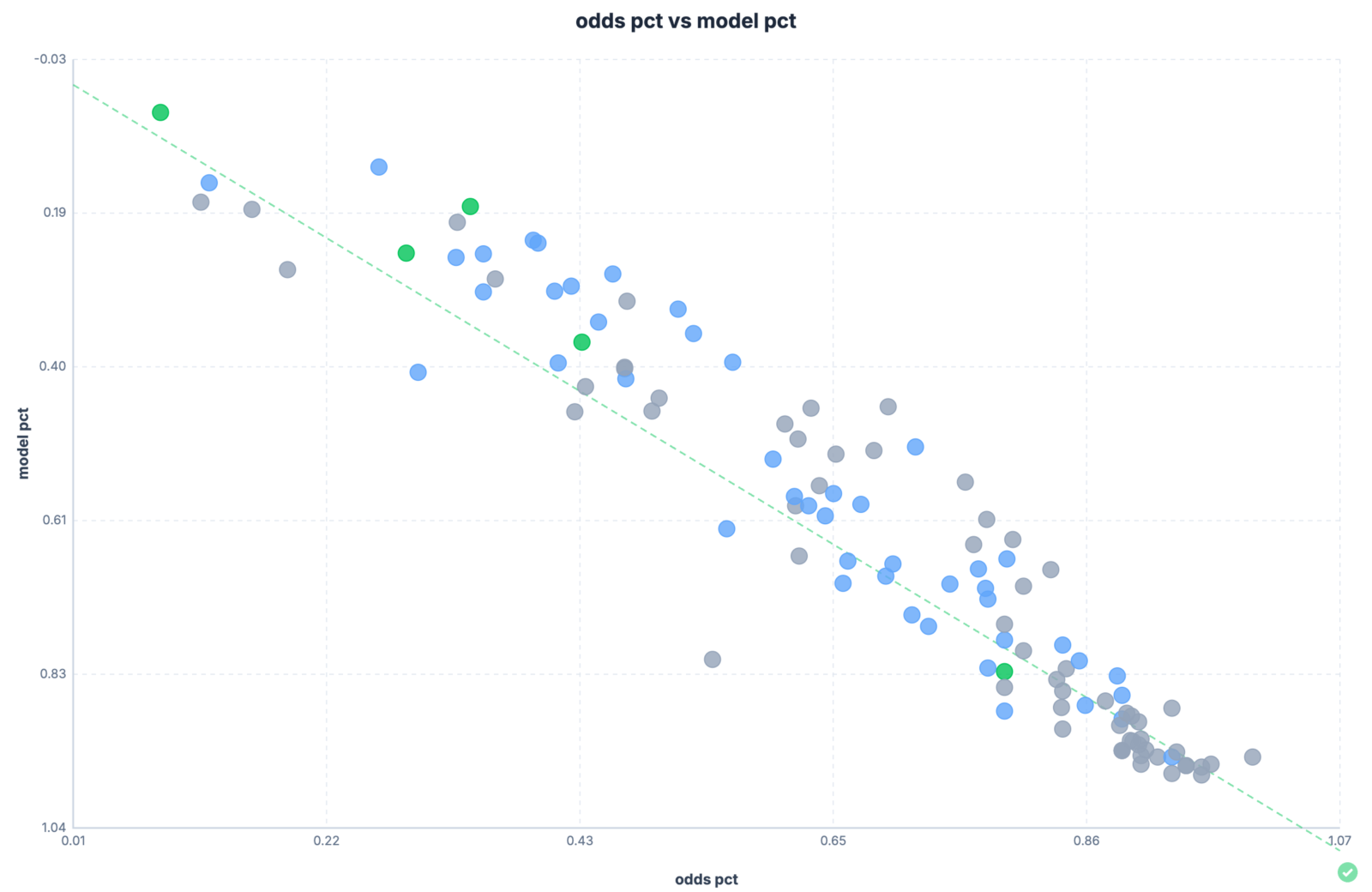
In every year since 2020, the model has been more bullish than the market on average.
And in some years, the market has been lower on every single debutant.
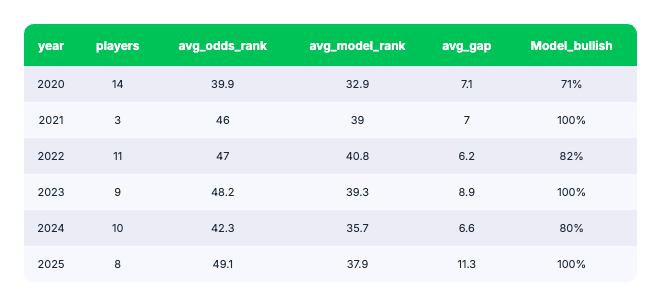
So, the market is downgrading debutants and upgrading veterans, though it's impossible to know for sure if that's why the market is pricing players that way. It could be for any number of reasons unrelated to experience.
2. There are no 'Round 1 nerves'
Do Masters debutants play worse in Round 1 (maybe because they're nervous, or don't fully yet understand the nuances of the course)? Yes. But again, debutants are worse players. When you control for player skill, there's no Round 1 penalty.
This doesn't mean nerves don't exist, but we can't detect them in aggregate scoring data once skill is properly controlled. It's possible that individual players experience Augusta nerves, and it shows up in specific situations. But as a systematic, measurable effect across all debutants, it's not there in the 2019-2025 data.
3. How often do debutants actually contend?
While in aggregate, debutants do underperform, that doesn't mean players never contend. But again, they tend to be really good players. Ludvig Aberg was eighth on the odds board in 2024. Will Zalatoris and Sungjae Im were already budding stars, or quickly proved those results weren't flukes.
Since 2012, we've had six rookies finish top 5, 11 in the top 10, and 19 in the top 15. But those who finished near the top were already good players, or it quickly became apparent that they were good.
Who are the 2026 debutants?
There are 15 players with a real chance to be the top debutant, and there's some real talent on this list.
I don't think any of these guys will win, which isn't saying much considering only three of them are less than 100-1. But it's an interesting mix of skill profiles and current form, including some prolific DP World Tour/European players (Marco Penge, Tom McKibbin, Casey Jarvis), 2026 PGA TOUR winners (Chris Gotterup, Jacob Bridgeman), and underrated players who haven't made much noise yet on TOUR but might soon (Rasmus Neergaard-Petersen, Michael Brennan, Johnny Keefer).


