


A new Gallup poll shows that fewer U.S. adults say they gambled in the past year than at any point in the pollster’s recent tracking history.
Just 45% of adults reported taking part in at least one gambling activity, a sharp decline from 64% in 2016 and from roughly two-thirds of adults in Gallup surveys conducted in 2003 and 2007.
The findings are interesting because they come during an era of wider legal sports betting, online gaming growth, and expanding interest in prediction markets. Yet the latest Gallup results suggest that access to more gambling products has not translated into broader self-reported participation among U.S. adults.

Gallup Poll Shows a Broad Gambling Decline
Gallup found lower participation in nearly every major gambling activity it tracked.
State lottery tickets remained the most common form of gambling, but participation fell to 31% in 2026 from 49% in 2016. In-person casino gambling also dropped substantially, declining from 26% a decade ago to 14% in the latest survey.
Office pools, such as wagers tied to the Super Bowl or World Series, have also become less common. Gallup reported that 7% of adults participated in an office pool, down from 15% in the early 2000s. The change may reflect the shift toward remote work, which has reduced the traditional workplace settings where informal betting pools often formed.
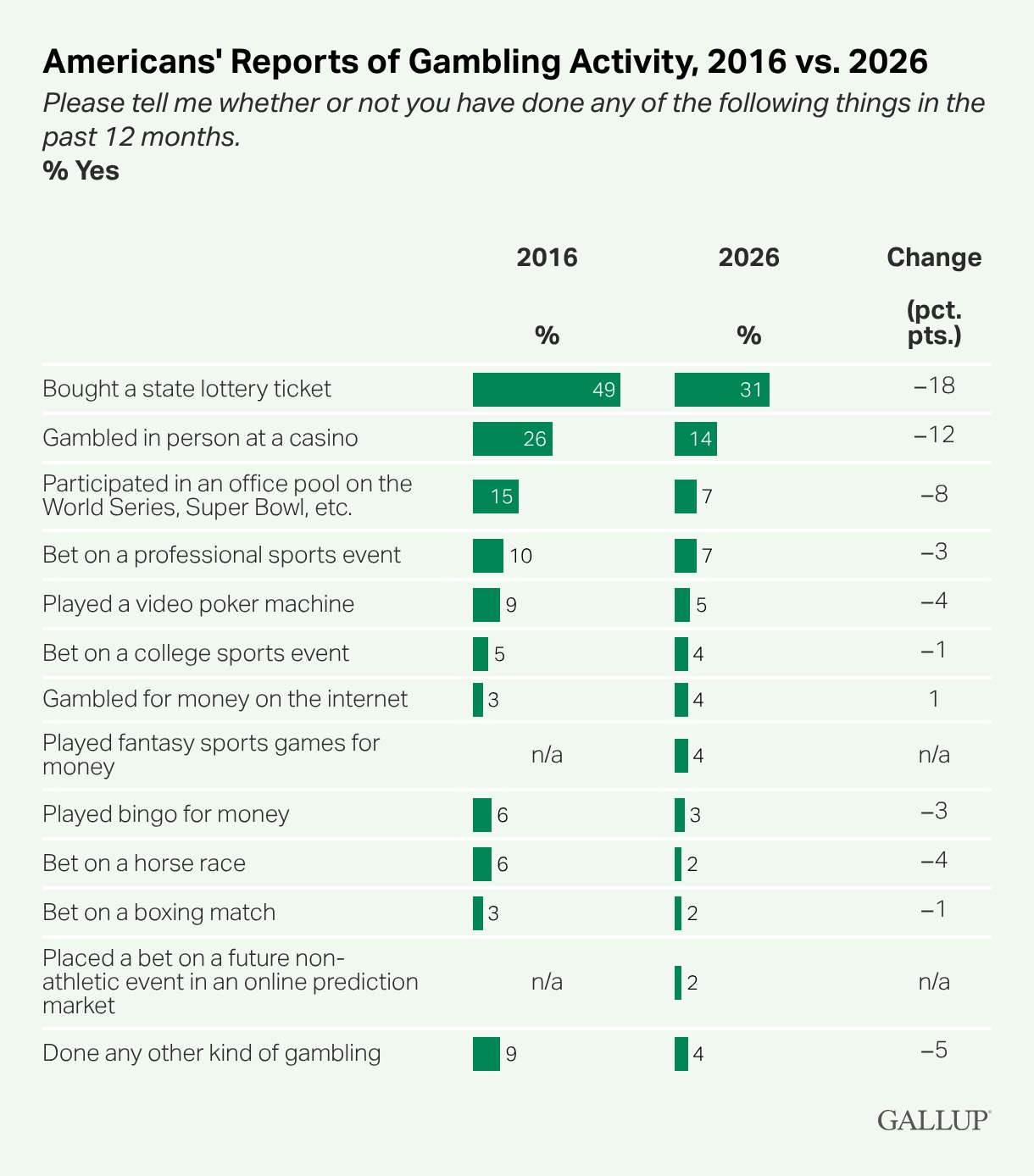
Other gambling activities reported in Gallup’s telephone survey included:
- Professional sports betting: 7%
- Video poker: 5%
- College sports betting: 4%
- Internet gambling for money: 4%
- Fantasy sports for money: 4%
- Bingo for money: 3%
- Prediction markets: 2%
- Horse racing: 2%
- Boxing: 2%
Internet gambling for money, or real-money online casinos, was the only activity Gallup said had not declined over time. However, at 4%, it remains a relatively small share of the overall adult population in the phone-based survey.

Who is Most Likely to Gamble?
The Gallup poll found that participation declined across major demographic groups, with drops ranging from about 15 to 25 percentage points compared with 2016. Even so, gambling participation remained higher among certain groups.
Those reporting gambling in past year, with household income of $100,000 or more 54%, include:
- Men 49%
- Women 40%
- Adults age 50 and older 50%
- Adults under 50 41%
- Women ages 18 to 49 35%
Upper-income adults were more likely to report gambling than middle-income and lower-income adults. Gallup also found that men were more likely than women to say they gambled, while adults age 50 and older reported higher participation than younger adults.
Younger women were the least likely demographic group to report gambling activity.
Phone and Web Results Tell Different Stories
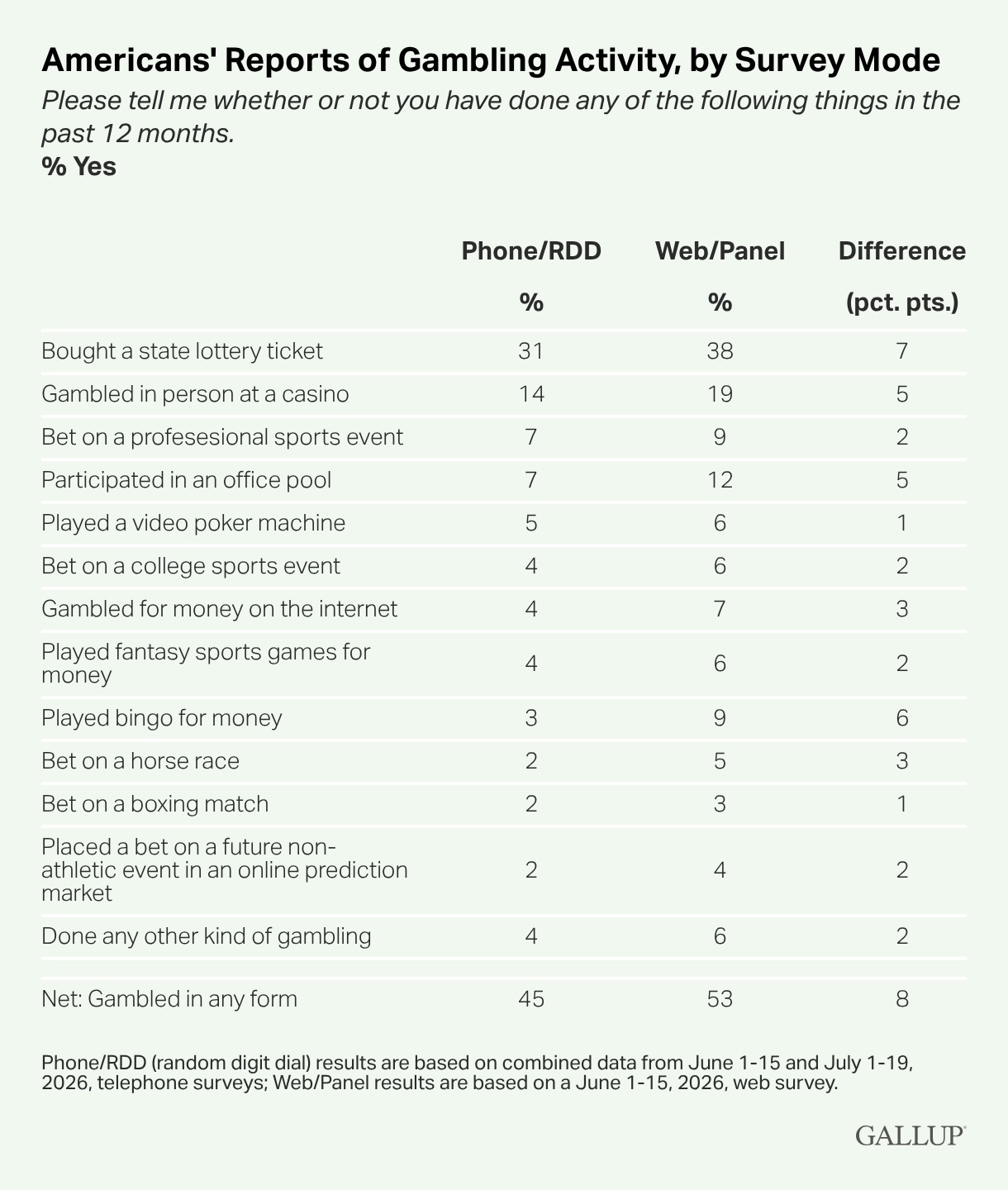
One of the most important details in the Gallup poll is the difference between its survey methods. Gallup’s primary result came from telephone interviews conducted from June 1 through July 19, 2026, using a random sample of 2,201 U.S. adults age 18 and older. The margin of sampling error was plus or minus 3 percentage points.
Gallup also conducted a separate web survey between June 1 and June 15 with 2,043 adults from the Gallup Panel. In that survey, 53% of adults said they had gambled in the prior year—eight points higher than the phone estimate.
That gap may indicate a survey-mode effect. People speaking to a live interviewer may be less willing to disclose gambling behavior, especially if they believe gambling has become less socially acceptable. There are studies to back it up. Gallup noted that the share of Americans who consider gambling morally acceptable fell from 67% in 2016 to 57% earlier in 2026.
Still, the web result was lower than earlier Gallup telephone benchmarks. That means the data supports at least some genuine decline in participation, even if phone interviews may understate the total number of people who gamble.
Problem Gambling Remains Uncommon
The Gallup poll also examined self-reported concerns about gambling. Three percent of all U.S. adults said they sometimes gamble more than they think they should, equal to 7% of people who reported gambling in the past year.
Meanwhile, 9% of adults said gambling had caused problems in their family, which a study by the National Bureau of Economic Research recently looked into. That figure is slightly higher than Gallup’s readings in the late 1980s and 1990s, when between 4% and 5% of adults reported family gambling problems.
These results do not necessarily measure clinical gambling disorder. Instead, they reflect respondents’ personal assessments of whether they gamble too much or whether gambling has created trouble within their families.
But they come at a time when states like New Jersey are pushing for stronger responsible gambling restrictions.

Why Gambling Participation Can Fall While Revenue Rises
The Gallup findings may seem inconsistent with recent commercial and online gaming revenue records. However, participation rates and revenue do not measure the same thing.
A smaller number of people can generate more revenue if they gamble more often, place larger wagers, or choose products with higher spending levels. Industry revenue may also be easier to track as gambling moves toward regulated sportsbooks, licensed casinos, state lotteries, and other formal channels. Informal betting, on the other hand, is more difficult to measure consistently.
The latest Gallup poll does not prove that Americans are abandoning gambling altogether. It does show that far fewer adults are willing to say they gambled over the past year than they were a decade ago. For operators, regulators, and gambling-industry observers, the key question is whether this marks a lasting participation shift or a change in how comfortable people feel reporting their gambling activity.


