


The countdown to Augusta is here. We can now count the seconds until golf's biggest event is in the limelight of the sporting world.
However, until we can get ourselves to think about pimento cheese, azalea flowers, Amen Corner, or the donning of the green jacket, we are going to need a few more sleeps (and rounds of golf) to get ourselves visually driving down Magnolia Lane.
As always, my goal is to help grow that bankroll by hitting a few bets, so without further ado, let's dive into a few players I like at the Valero Texas Open. If you have any additional questions, please consider following me on Twitter @TeeOffSports!
2026 Texas Open Odds, Predictions: PGA Picks From Proven Model
Russell Henley +2000
I have been beating this drum for the past few years that Russell Henley is better than public perception suggests. We saw a massive shift last year when he won the Arnold Palmer Invitational and jumped inside the top 10 in the world, but I still don't think most bettors view Henley as someone who should open anywhere near 20/1 to win a tournament.
Despite us getting a strong Valero field of names like Tommy Fleetwood, Ludvig Aberg, Hideki Matsuyama, and others, it was actually Henley who ranked as the man to beat in my model, ranking inside the top eight across all seven statistical categories I weighed this week.

The math next to Fleetwood makes them a true 1A versus 1B of the slate, but I decided to take the few extra points of value on a difference that could barely separate the two golfers.
Robert MacIntyre +2200
I don't ever play a ton of Robert MacIntyre. The ball-striking splits are always "concerning," but there wasn't an iteration of my model that wanted to place him outside the five favorites in this field, which was generating some value on the slate early in the week before we got a little buy-back in the market on him at different locations.
MacIntyre's profile is strange in my model. I am going to include anything used in some capacity to highlight the data, but what you will notice is a lot of high-end marks (mixed with some very poor approach play).

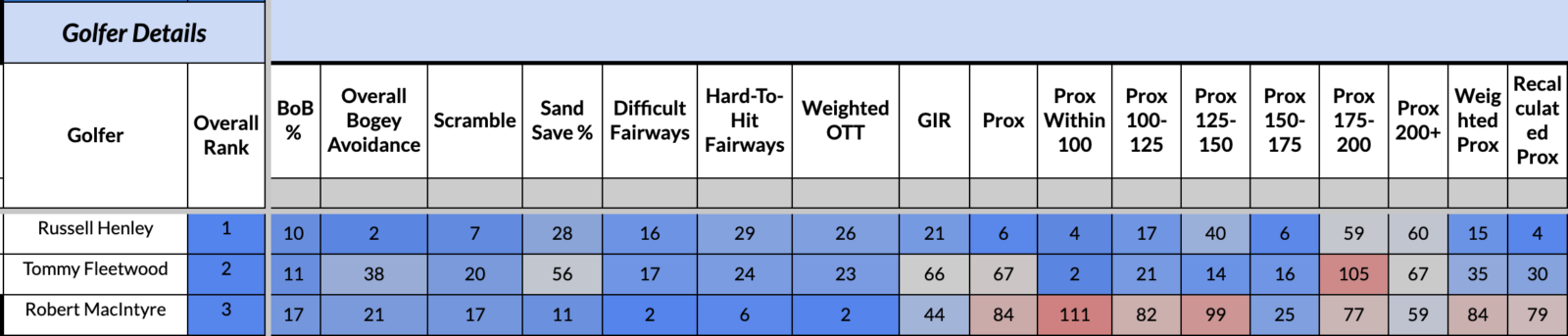
MacIntyre's proximity to any nature of that answer is going to rank far behind Henley and Fleetwood. However, what you are going to notice are all the top-five categories over and over again when trying to look elsewhere.
If my Henley take becomes wrong, it is going to stem from the need to score on these par-five locations, and I am going to trust MacIntyre's first-place grade to give him a built-in floor and increased upside potential. We will see where I go for OAD contests, but I almost lean in this direction because of my lack of wanting to use him a ton elsewhere.
Thorbjorn Olesen +6200
The Gary Woodland victory last week made me think long and hard about my outright strategy. I talked in my article at the Houston Open about liking Woodland and trying to find different ways to gain exposure to him in the head-to-head market, but I didn't get there with him as a ticket to win this event.
It can be tough when we see market corrections that watch players go from 200/1 to 50/1 after one contest. I've always been a believer in getting ahead of those moves and will continue to fight that battle against the short-term form chasers, but I decided to run a version of my model to highlight massive upside shifters when including one-week form.
Here are the names to warrant upside ticks when including stats, course history and that one-week answer. For the sake of ease, let's consider only golfers who are over 50/1 on the slate and produced top-25 win equity marks for greater volatility:
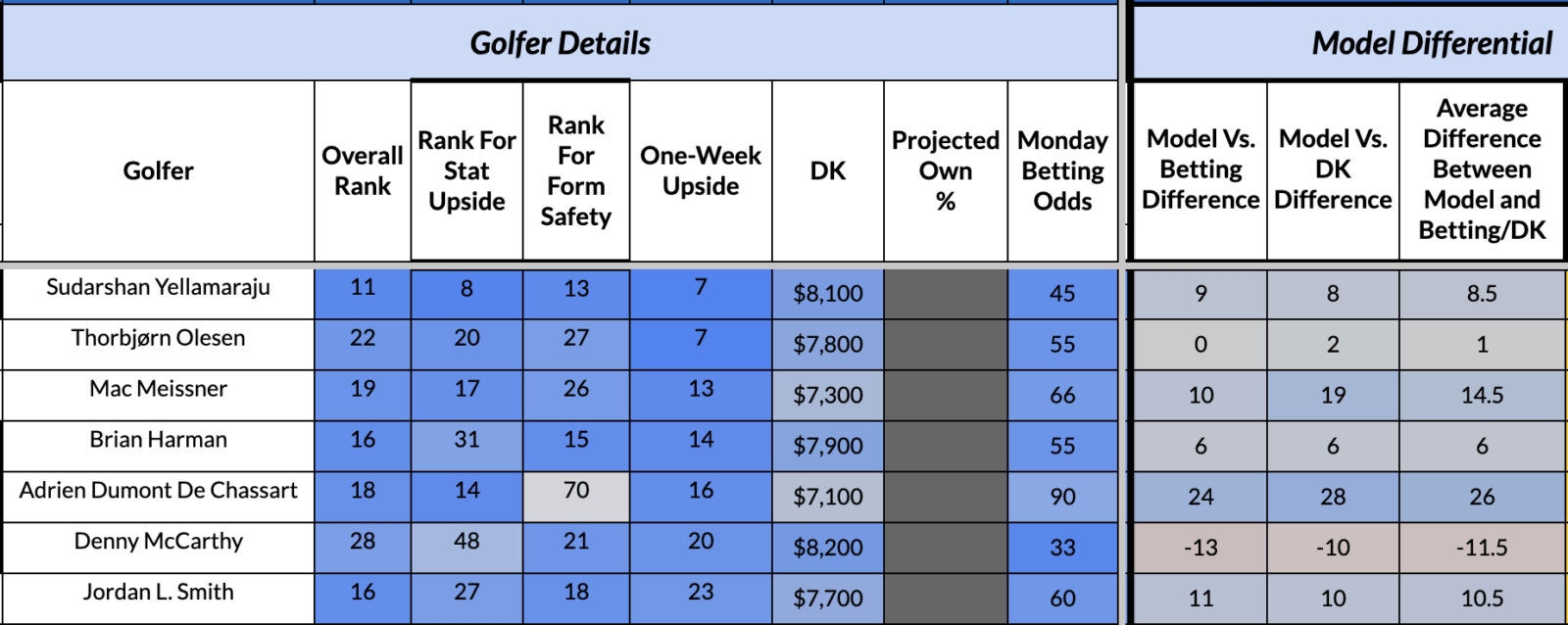
If you are looking for a long-shot wager or some placement bets, all of those names above would make logical sense.
Adrien Dumont De Chassart +10500
Look, there are about six names above who all make logical sense to consider when taking deeper shots on this board, and that's before we throw caution to the wind and add in options like Alex Smalley (terrible course history) or Zecheng Dou. There's a lot to consider, and these cards are never as straightforward as, "this is the only path." If you have more room, I wouldn't be talking anyone out of most of these options.
I went with Adrien Dumont De Chassart over the others for one reason. His four straight top-26 finishes on tour and third-place grade for Weighted Scoring (calculated to feature similar hole layouts) ended up being way too much for me to ignore.
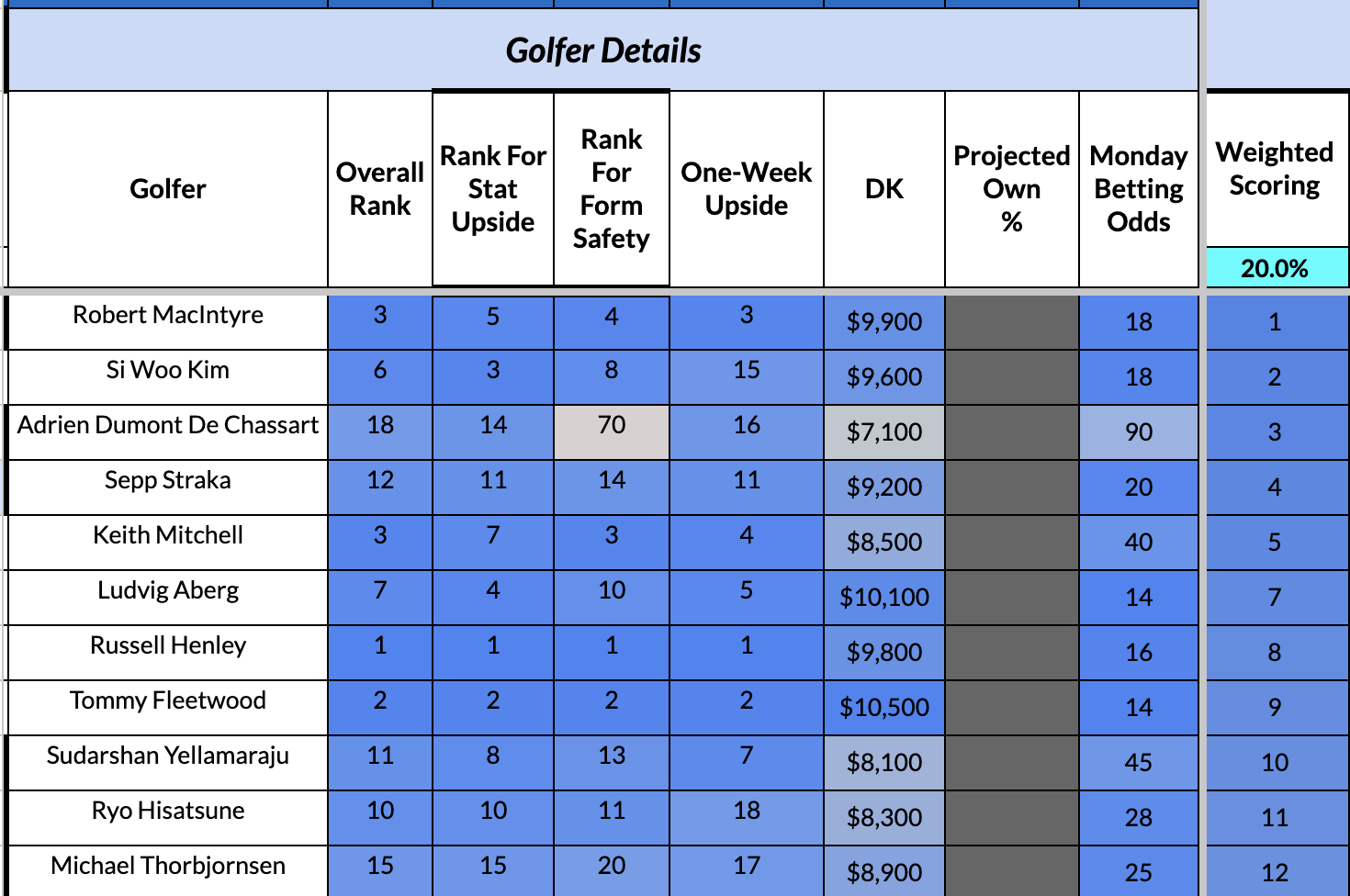
Chassart entered himself into a range that lands next to the favorites, and that is enticing to me when I had very little room left on my card after starting Henley/MacIntyre. The floor is very low, but the potential to produce is there.
Matchups
Eric Cole -120 over Seamus Power
When you look at a matchup like this between Eric Cole and Seamus Power, it is hard not to see two golfers who are struggling early in the season. Power has posted five straight finishes over the past five weeks of 30th or higher, including two missed-cut performances. Cole, on the other hand, is generating a similar production of five straight outside the top-30, with two missed cuts himself during the process.

I generally like these volatile pairings because they give me the ability to take cheap stands on some unknown variables. It doesn't mean that Cole isn't going to find himself four-over on day one and out of the running. However, it also doesn't mean we don't have multiple paths forward to win this battle, including the missed-cut versus missed-cut route if we believe Power's profile is extremely inconsistent.
One of the things I have talked a lot about during my time at Action Network is recalculating projections to fit course-specific viewpoints. How do players perform versus their baseline expectation on similar green complexes? How do stats improve or decrease in windy conditions that could mimic the week? Does the expected dispersion for a course make a golfer better or worse than their long-term output? These are all questions you should be asking yourself (or building weekly into a model).
I noticed a very interesting trend take place for Cole this week when extrapolating out the expectations to produce a heightened short-game output. TPC San Antonio has historically generated about 20% of its strokes-gained correlation from around-the-green metrics. That's over five percent in likelihood to continue to produce once a player has shown the ability to do so in earlier rounds and also generates over 3% of the necessary output for top-10 performers yearly.
That's a lot of math to say scrambling and saving par will matter, but it is relevant in this situation since it turns one of the worst drivers of the ball in Cole into someone who produces top-25 results for both Weighted Strokes Gained Total and In-Event Dispersion because of that stout short-game expectation.
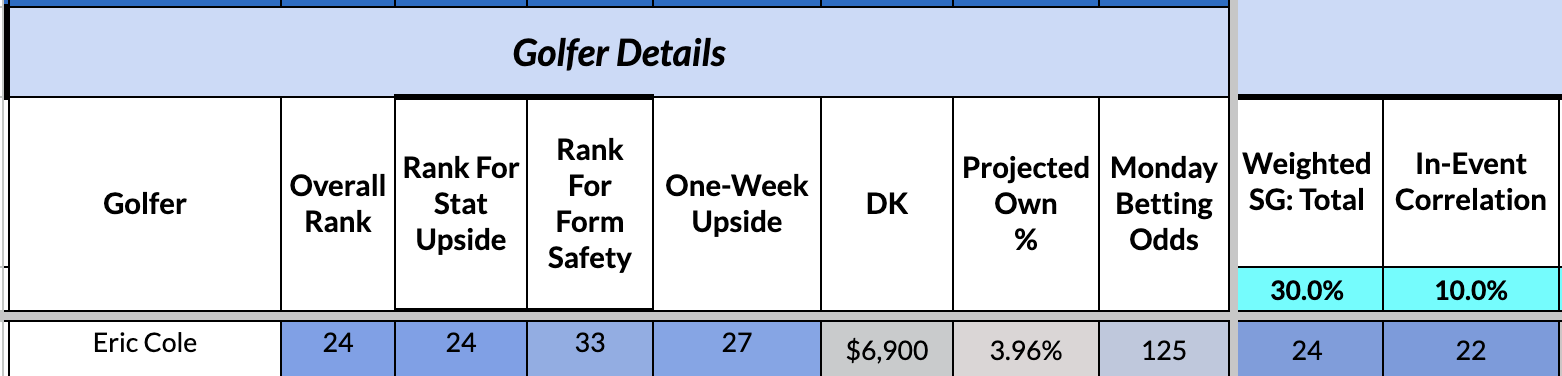
Cole's 125th-place grade in Weighted Driving doesn't just go away because of his magical touch around-the-green, but players have found it difficult in the past to separate off the tee because of the hard-to-hit fairways, and Cole's generally low GIR rate does give him some weird advantages when this heightened scrambling nature plays right into his wheelhouse of churning out a score daily. I think that is what my model keeps finding when using long-term data to project its viewpoints this week.
Finding the true upside here in his profile might be more challenging than with Power. Still, the circle completes itself when we try to dive into Power's profile of poor Poa Trivialis in the past, which includes averaging -1.23 shots per round over 12 rounds here and missing the cut in four of five attempts. While some of the upside profiles do like Power's ability to perform on a high-end level outside of his flat-stick (as you can see in the first image comparing these two), the safety marks are what I am eyeing at TPC San Antonio.
As the adage says, "Drive for show. Putt for dough." In reality, neither one offers much on the driving front, so let's hope Cole's putting can get us a ticket to cash at the window for a little dough of our own.
When is the Texas Open?
The 2026 Texas Open tees off on Thursday, April 2, 2026.
- What: 2026 Texas Open
- When: April 2-5, 2026
- Where: TPC San Antonio (Oaks Course), San Antonio, Texas
- Par: 72
- Length: 7,438
- Purse: $9.8 million
Where to Watch the Texas Open?
2026 Texas Open TV Schedule
Round 1: Thursday, April 2
- Live stream: ESPN+ (8:15 a.m. to 7 p.m. ET)
- TV coverage: Golf Channel (4 to 7 p.m. ET)
Round 2: Friday, April 3
- Live stream: ESPN+ (8:15 a.m. to 7 p.m. ET)
- TV coverage: Golf Channel (4 to 7 p.m. ET)
Round 3: Saturday, April 4
- Live stream: ESPN+ (10:15 a.m. to 6 p.m. ET)
- TV coverage: Golf Channel (1 to 2:30 p.m. ET); NBC (2:30 to 6 p.m. ET)
Round 4: Sunday, April 5
- Live stream: ESPN+ (10:15 a.m. to 6 p.m. ET)
- TV coverage: Golf Channel (1 to 2:30 p.m. ET); NBC (2:30 to 6 p.m. ET)


