


The 40th MLB Home Run Derby takes place at 8 PM ET on Monday night at Citizens Bank Park in Philadelphia, PA, with the festivities airing live on Netflix.
The Derby returns with a new format, scrapping the clock in favor of a swing-based competition. Players will have a minimum of 20 swings in the first round and 15 in both the semifinals and finals, but if they homer on their final allotted swing, they keep going until failure.
There is no bracket in the first round. The top four hitters advance and are then reseeded (1 vs. 4, 2 vs. 3) for the semifinals based on their first-round totals.
First-round tiebreaks are decided by home run distance, and a three-swing swing-off decides any ties in the semifinal and final.
There are numerous ways to bet on the Derby, including head-to-head matchups, props, exactas, and outright winner selections.
Below, I'll take you through some of those home run derby betting markets and provide my thoughts and 2026 MLB Home Run Derby predictions and picks.
2026 MLB Home Run Derby Odds
| Player | Odds |
|---|---|
| Kyle Schwarber (Phillies) | +300 |
| Junior Caminero (Rays) | +250 |
| Munetaka Murakami (White Sox) | +550 |
| Jordan Walker (Cardinals) | +650 |
| Jac Caglianone (Royals) | +700 |
| Bryce Harper (Phillies) | +1000 |
| Ben Rice (Yankees) | +1100 |
| Willson Contreras (Red Sox) | +1300 |
Odds via FanDuel Sportsbook

2026 MLB Home Run Derby Methodology
Although the format has changed over the years (and will again in 2026), I backtested the factors that led to success in every Derby of the Statcast pitch-tracking era (2016-present, nine derbies and 72 participants) to model the field for 2026.
Every stat was computed from pitch-level Statcast data through the day before each Derby and then normalized within each year's eight-man field to account for changes in venue, baseballs, and format. I also compiled closing odds for all 72 entrants to test the betting market itself, and matchup-level results for all 55 bracket-era head-to-heads.
The dataset is relatively limited, and potentially not all that instructive for building a model, but the findings were interesting nevertheless.
Maximum Exit Velocity is King
This data point is considered the best predictor of power potential, and the fact that it showed the highest correlation (r = .41) among more than 20 data points tested was unsurprising.
The leader in maxEV over the 30 days leading up to the Derby won five of nine events outright (Junior Caminero for 2026 at 116.9 mph; Jordan Walker at 116.6).
Additionally:
- Six of the nine Statcast-era winners ranked top-two in their field in maxEV, and seven of nine ranked top-four.
- The field's maxEV leader reached the final six times in nine years and advanced past round one seven times.
- Across all 55 bracket head-to-heads, each one-standard-deviation increase in maxEV advantage added roughly 17 points to the matchup win probability.
Implied win probability correlates with field maxEV at 68%, meaning the books already price in the main power signal.
Zero Holes in Statcast Profile
No player ranked at the bottom of the field in any exit-velocity stat has won the Derby.
These are significant red flags for Ben Rice (last in Max EV, EV50, max distance, and average HR distance) and Bryce Harper (last in avg EV and hard-hit rate).
Harper also has the worst 30-day MaxEV and ranks among the two oldest hitters in the field.
Age Mattered Before, But It May Not Now
The two oldest hitters in a given field are a combined 0-for-18 with one finals appearance, and hitters over 30 are 1-for-17 (Teoscar Hernández in 2024, the exception to nearly all of our findings).
The age effect was concentrated in the timed-bracket era, but it may matter less if players swing 20 times per round rather than 40.
Simple Screener Beats a Complicated Model
Three filters captured seven of nine winners:
- Top-four in field maxEV
- Not among the two oldest
- No ranking in the bottom of the field in any Statcast datapoint
For 2026, the three players who fit the criteria (Junior Caminero, Jac Caglianone, and Jordan Walker) rank as my trio of top contenders (and potential +EV bets).
Murakami and Schwarber fail only the top-four maxEV cut (fifth and seventh, respectively). Contreras fails on age (34.2, oldest in the field). Rice fails twice (outside the top four in maxEV and last in four separate categories). Harper fails all three criteria.
Irrelevant Home Run Derby Data
The following data points showed minimal to negative correlation with Derby performance.
- Season production (first half OPS and SLG)
- Hot Streaks (30-day HR pace, recent SLG/OPS) relative to a player's baseline
- Game HR Efficiency: Home runs per batted ball and per PA
- Pull Side Approach: Median winner ranked seventh in their field in Pull Air% — everyone can pull 60 mph batting practice balls
- Hitting Order: The second hitter in bracket matchups won 49% of the time — target-chasing and added rest didn't provide a boost
- Home Crowd/Park: Bryce Harper won in 2018 in Washington D.C., but Wil Myers (2016), Justin Bour (2017), Carlos Santana (2019), and Matt Olson (2025) all exited in round one at home
Inconclusive Home Run Derby Data
The following data points are worth monitoring as we gather more information in the coming seasons.
- Bat-Tracking Data (Bat Speed, Squared-Up, Blast, Swing Length): Only two derby fields have this data, so nothing is significant. Still, the directional pattern is exactly what theory predicts for 2026's swing-count format: in the pitch-limited derbies, squared-up rate (r = .37), blast rate (.27), and swing length (.25) outperformed barrel%. Still, game swings are not equivalent to batting practice.
- Derby Experience: Returnees won 21% of the time versus 8% for debutants, and players with prior finals experience (Junor Caminero, Kyle Schwarber, Bryce Harper, and Murakami, if you count NPB experience) made 36% of finals appearances.
- Handedness and the Ballpark: Citizens Bank Park carries a 133 HR park factor for lefties — No. 1 in MLB — against 99 for righties, and five of the eight 2026 entrants bat left-handed. But regular-season park factors are built on marginal 330-to-390 foot fly balls, while Derby homers average 420-plus feet and clear any fence. Historically, lefty-friendly venues have not reliably produced lefty winners (righties won at Globe Life '24 and T-Mobile '23, and righties took six of the nine Statcast-era derbies overall). I still provided a small bump for lefties, but not nearly as dramatic as I would for a regular season game.

Our Top 2026 MLB Home Run Derby Picks & Expert Predictions
Each hitter gets an HR-per-swing rating from the backtested data weights, emphasizing maxEV, blast rate, EV50, squared-up rate, and barrel rate, with small adjustments for age, handedness, and prior derby experience, layered over the market odds.
Notably, I didn't penalize Murakami for his recent injury stint, and I might flip him and Schwarber in the rankings.
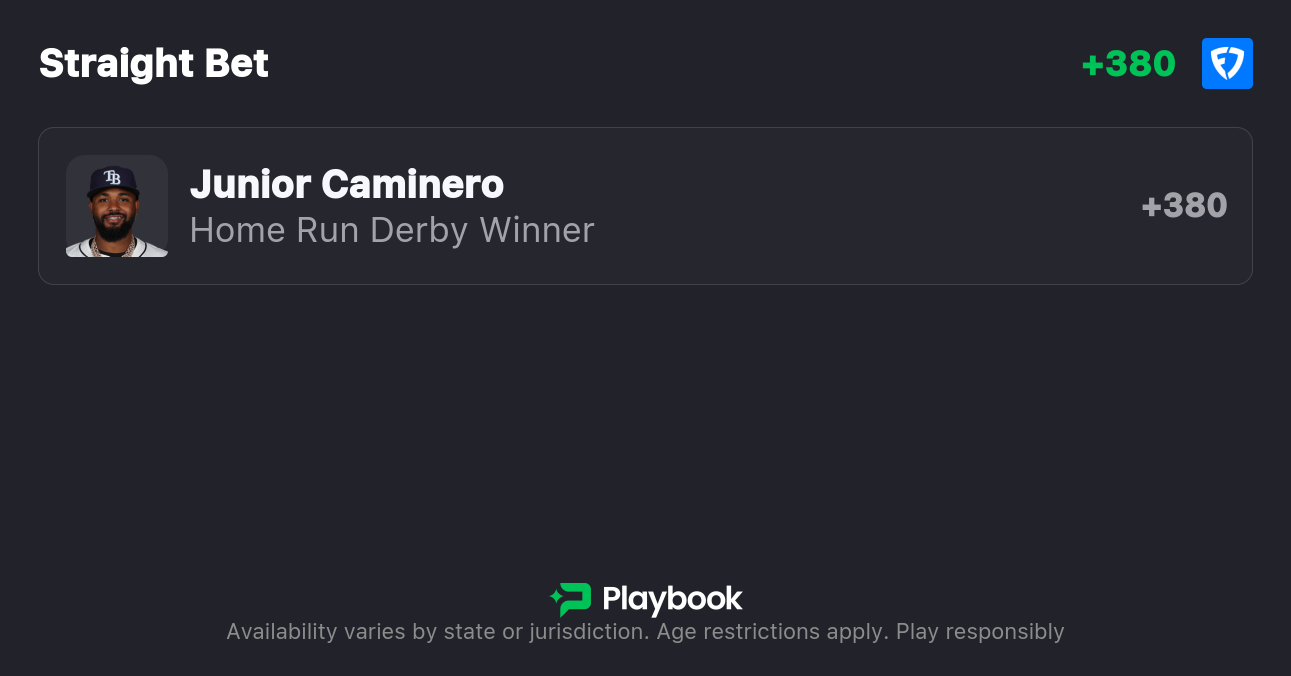
Caminero is the model's dream profile: tops in the field in max EV (116.9), bat speed (79.9 mph, hardest swinger in MLB), blast rate, max distance (463 ft = tiebreak insurance), and he's been to a derby final (2025 runner-up). He checks every box the backtest validated.
The market ranks Caminero third, but the model says he should be a clear favorite.

Caglianone and Walker are the other two young raw-power monsters, both priced behind Murakami and Schwarber. Walker gets a distance edge (459 max) over Caglianone (444) for tiebreaks, but Caglianone gets the CBP lefty bump. They rank second and third in the field, respectively, in bat speed.
Schwarber ranks fourth, but his profile matches his 2022 profile, when I picked him as the +330 second choice, only to watch him lose to a retiring, 41-year-old Albert Pujols in the first round.
While Schwarber has an MLB-leading 32 HR and is both the hometown and market favorite, he ranks just sixth in maxEV and is last in blast and squared-up rate.
Despite his prior finals experience (lost to Harper in 2018), I'd favor the younger hitters against Schwarber in the semifinal or final from a stamina perspective, and, given Schwarber's age, he's likelier than the rest of the field to go through a round in which he hits a lot of pop-ups.
Murakami is the wild card, just a few days removed from an IL stint for a hamstring strain.
I couldn't get his odds past 13%, even on the high end, and he's a bigger guy whose conditioning may be lessened after an IL stint for a leg injury. He has Derby experience from 2019 in Japan, but also seems the likeliest to post a huge first round before getting gassed in the bracket stage.
Despite two prior finals appearances for Bryce Harper (won in 2018, and lost to Yoenis Cespedes in 2013), I've stated all of the marks against him: second-oldest hitter in the field, ranks last in several Statcast categories, and (perhaps most importantly) ranks dead-last in the field on maxEV over the past 30 days (108.1 mph).
Even with a home boost at The Bank, Harper is my biggest fade in the field.
Rice hasn't benefited greatly from the short porch at Yankee Stadium (27.4 expected HR vs. 29 actual HR).
Still, he has the worst distance profile in the field (433 max, 389 avg) and, given that I project a first-round tiebreak 38% of the time, he's the guy most likely to miss the cut.
Contreras winning would be similar to Teoscar Hernandez taking down his field. He's older, and nothing in his statistical profile necessarily stands out apart from elite bat speed (96th percentile). Willson is an excellent hitter, but he's three years removed from the maxEV levels that would make him more competitive here.
Ultimately, I would recommend Junior Caminero down to +390, Jac Caglianone down to +600, or Jordan Walker down to around +600, with any of those three bets representing an edge of 2% or more relative to my projection. But I'd be willing to take Caminero closer to +375, or even +350.
I also show value on those same three players to make both the finals and the semifinals, with bigger edges on Caminero in those markets than on his outright odds.
Rather than betting on these players individually to advance to the finals, you can consider dabbling in the exacta or name-the-finalists markets and sprinkle multiple combinations at long odds.
There is seemingly more value in the name-the-finalists market than in the exacta market. I would consider playing Caminero & Caglianone (+1400) and Caminero & Walker (+1700) small to both make the finals, but you can also bet them individually to advance, make the finals, or win outright at bigger edges.
Our Best MLB Home Run Derby Props
There are several Derby prop markets you can also bet on, some of which I think are fairly priced and others that are actionable.
For example, the round-one total HR (projected 73.4 vs. 74.5 listed) or the winner's total HR (projected 29.9 vs. 29.5 listed) seem aligned with my projections.
Longest HR can be hard to handicap, particularly with MLB using baseballs with less drag in 2026. Recent derbies split right around 485 (Oneil Cruz 513 in 2025 and Aaron Judge 513 in 2017, but several years topped out in the 470s).
I lean Over with the juicier baseballs, but would probably pass on the distance market. I also lean Over on Total Derby Home Runs (projected 121.2, listed 117.5) and would take that prop to -150, but it's difficult to project given the new format.
One prop that definitively offers value, compared to my projection, is the American League at -160 (projected -185) to win the Derby. Caminero and Caglianone are my top two selections, and Murakami is the biggest boom-or-bust player in the field. I would bet that prop at -170 or better.
I also projected out odds for round-one totals, all round-one head-to-head matchups, the first-round leader, and the longest HR of the night.
Caminero unsurprisingly rates highly in all of those categories too, and you can consider laddering his Round 1 leader prop and his longest HR odds, alongside his odds to advance through each stage and win.
Other considerations here are to either take Unders on the totals for my fades (Harper, Rice, Schwarber) or to bet against them (and Contreras) in head-to-head matchups with Caminero, Caglianone, Walker, and Murakami.
Our MLB Home Run Derby Expert Picks
For additional bet notifications, follow me in the Action Network App.
- Finalists: Jac Caglianone vs. Junior Caminero (+1800, 0.1u), Caesars; bet to +1200
- Finalists: Jordan Walker vs. Junior Caminero (+2240, 0.1u), Kalshi; bet to +1400
- HR Derby Winner: Junior Caminero (+425, 0.25u), DraftKings; bet to +390
- Highest Exit Velocity: Junior Caminero (+250, 0.1u), Caesars; bet to +150
- League of Winner: American League (-160, 0.25u), Caesars; bet to -170
- Longest HR: Junior Caminero (+375, 0.1u), Polymarket; bet to +300
- Make the Final: Junior Caminero (+220, 0.25u), Caesars; bet to +170
- Miss the Final: Kyle Schwarber (-160, 0.1u), Polymarket; bet to -250
- Make the Semis (Final 4): Jac Caglianone (-105, 0.5u), Caesars; bet to -125
- Make the Semis (Final 4): Junior Caminero (-145, 0.5u), Caesars; bet to -185
- Make the Semis (Final 4): Jordan Walker (+105, 0.5u), Caesars; bet to -135
- Miss the Semis (Final 4): Ben Rice (-150, 0.1u), Kalshi; bet to -170
- Round 1 HR H2H: Jac Caglianone > Bryce Harper (-120, 0.1u), Caesars; bet to -150
- Round 1 HR H2H: Munetaka Murakami > Kyle Schwarber (+130, 0.1u), DraftKings; bet to +115
- Round 1 Most HR: Junior Caminero (+500, 0.1u), DraftKings; bet to +450
- Round 1 Total HRs: Ben Rice Under 9.5 (-130, 0.2u), DraftKings; bet to 8.5 (+110)
- Round 1 Total HRs: Bryce Harper Under 8.5 (+105, 0.1u), DraftKings; bet to +100
- Round 1 Total HRs: Kyle Schwarber Under 10.5 (-110, 0.2u), DraftKings; bet to 9.5 (+100)
- Round 1 Total HRs: Jordan Walker, Over 9.5 (+110, 0.1u), DraftKings; bet to +105
- Round 1 Total HRs: Willson Contreras, Over 6.5 (-155, 0.15u), Kalshi; bet to -200


