


Editor’s Note: This guest post is from PoolGenius, whose expert bracket picks and tools have helped subscribers win over $2.8 million in prizes since 2017.
Most bracket advice focuses on the wrong question.
Every March, millions of people fill out NCAA Tournament brackets the same way. They watch some games, read a few previews, pick teams they think are best, and hope their predictions hold together long enough to stay competitive.
The problem is that this approach rarely wins bracket pools.
It might help you predict the tournament reasonably well, but that is not the objective in most bracket contests.
The goal isn’t to build the most accurate bracket. The goal is to finish first against the other entries in your pool, and that difference should change how you approach almost every decision.
Winning brackets aren’t built by simply identifying the strongest teams. They’re built by making picks that maximize your chances of beating the rest of the field.
If you want to see customized March Madness bracket picks built specifically for your pool’s size and scoring system, you can explore the PoolGenius tool here.
NCAA Tournament Bracket Picks: Our Strategic Model
Three factors ultimately determine how valuable any bracket pick is:
- Team win probability
- How often are other people picking that team
- The structure of your specific pool
Most bracket players only consider the first factor. They focus on predicting which teams will win games.
But if a team is already being picked by a large percentage of your opponents, choosing that team may not help you gain ground.
Conversely, if a team has strong advancement odds but is being overlooked by the public, that pick can create meaningful leverage.
The structure of your pool also matters. Scoring systems, pool size, and upset bonuses all change the optimal level of risk your bracket should take.
With that framework in mind, here are five principles that consistently separate stronger bracket strategies from the rest of the field.
Tip 1: Scoring Rules Should Drive Bracket Strategy
Many people fill out their bracket the same way regardless of how their pool is scored.
That’s a mistake that starts before the first game is even picked.
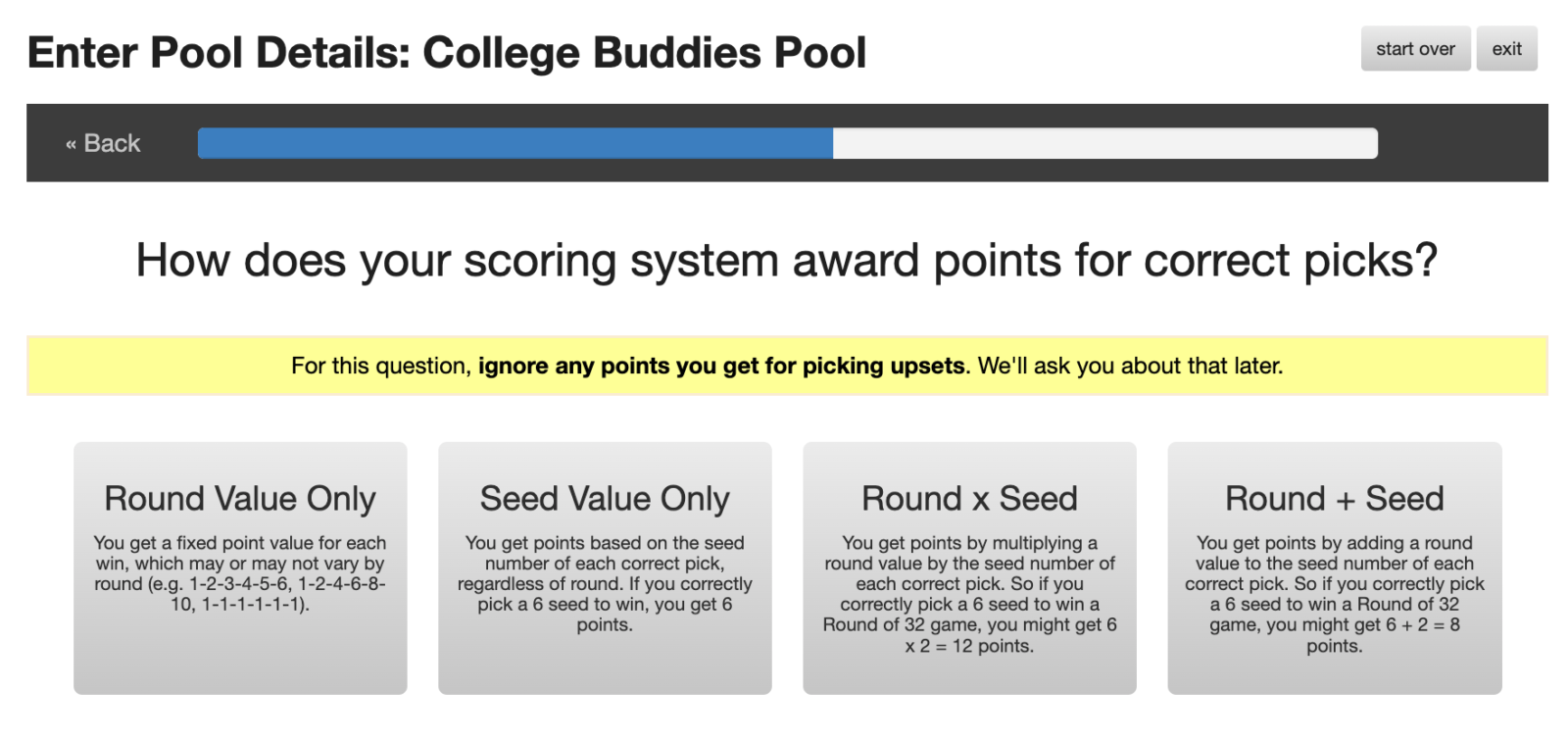
In traditional 1-2-4-8-16-32 scoring, points double every round. That makes the late rounds dramatically more important than the early ones.
Consider the math. A perfect 32-for-32 first round earns 32 points. Correctly picking the national champion also earns 32 points. That means someone who misses half of the first-round games but gets the champion right can still outscore a perfect first round if that champion loses.
In these formats, obsessing over early upsets usually provides little strategic value.
In flatter scoring systems such as 1-2-3-4-5-6, the math changes. Your champion is only worth six times a first-round win instead of 32 times. Early rounds matter much more, and a strong first weekend can legitimately decide the pool.
Upset-bonus formats shift things even further. When points are awarded based on seed differential, advancing double-digit seeds can create outsized value. You don’t need many of those picks to hit for them to have a major impact on your score.
Understanding your pool’s scoring format is the first step toward determining how aggressive your bracket should be.
Any bracket strategy needs to start with those rules, which is why the PoolGenius bracket optimizer begins by asking for your pool’s scoring system and structure.
Tip 2: Pool Size Determines Risk
Once you understand the scoring system, the next key variable is pool size.
In smaller pools, conservative strategies tend to perform better. In a 10- or 20-person contest, the chance that someone hits a truly outlier bracket is relatively low. Letting opponents eliminate themselves with overly aggressive upset picks can be a viable approach.
In very large pools, the dynamic flips.
If 300 or 500 entries are competing, someone is likely to benefit from a few low-probability outcomes that inevitably occur.
The bracket that wins a 15-person pool could easily finish outside the money in a field that large.
Larger pools require identifying teams with strong advancement odds but who are underselected by the public. Stacking a few of those undervalued picks can help create separation from the rest of the field.
Get Your Customized Bracket Picks for 2026. Discounts Courtesy of the Action Network.
Tip 3: The Public Misprices Teams
Every year, some teams are selected far more often than their true odds of advancement justify, while others are overlooked despite strong metrics.
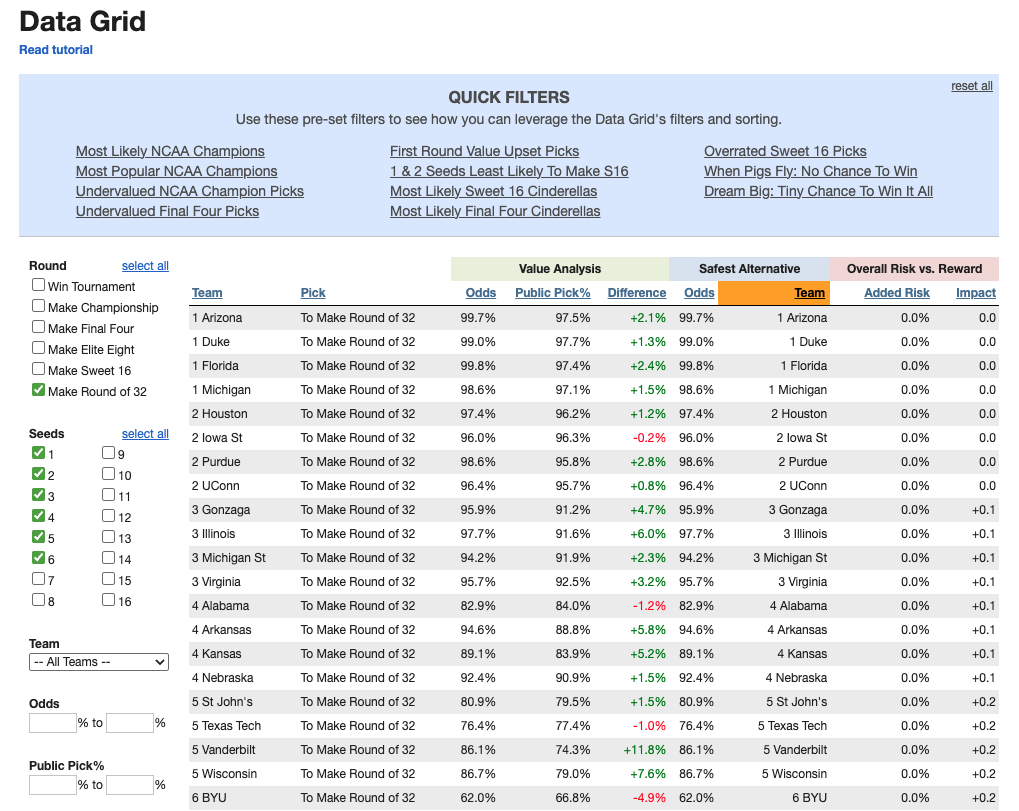
The opportunity lies in identifying the gap between public pick rates and actual probabilities.
For example, Virginia’s 2019 championship run illustrates how public perception can lag behind a team's underlying strength. After becoming the first No. 1 seed to lose to a 16 seed the year prior, the Cavaliers were significantly under-selected by many bracket players despite still having elite efficiency metrics. When they won the title, anyone who had them gained leverage over a large portion of the field.
This phenomenon occurs in smaller ways throughout the bracket as well.
In some cases, the public under-selects a team favored to reach the Sweet 16 or Elite Eight. When that team advances, those picks create an advantage over opponents without adding meaningful risk.
The key is finding situations where a team’s probability of advancing is higher than the percentage of brackets that pick it.
The PoolGenius Data Grid highlights this gap by comparing each team’s advancement odds with its public pick popularity, making it easy to identify where real leverage exists in your pool.
Tip 4: Most Brackets Pick Too Many Upsets
Upsets are one of the most enjoyable parts of the NCAA Tournament, and that excitement often carries over into bracket selections.
But when we analyzed results from 21,709 bracket pools, we found that most players consistently choose more upsets than optimal strategy would suggest, especially in standard scoring formats.
Part of this comes down to psychology. Calling a surprise result is memorable. Correctly predicting a higher seed to win a game rarely gets the same attention.
However, early-round upsets typically offer limited scoring upside while introducing significant risk. When those picks fail, the damage compounds across multiple games.
Successful bracket strategies usually reserve risk for situations where the potential payoff is meaningful relative to the scoring structure.
Tip 5: Build Picks for your Specific Pool
Understanding scoring rules, pool size, and public pick tendencies is helpful, but translating those concepts into a full bracket can still be difficult.
A March Madness bracket requires 67 interconnected picks. Each decision influences the value of other picks later in the bracket. Evaluating all those possibilities while accounting for opponent behavior quickly becomes extremely difficult.
This is where many otherwise solid bracket strategies break down.
The best picks are rarely determined by a single statistic or matchup. They emerge from balancing multiple factors simultaneously.
This is Difficult to do Manually
Constructing an optimal bracket requires evaluating thousands of potential tournament outcomes while considering how other participants are likely to fill out their brackets.
Even experienced college basketball fans rarely have access to:
- Reliable public pick-rate data
- Realistic advancement probabilities for every team
- Simulations showing how different bracket paths perform against a specific pool field
Without those inputs, it becomes extremely difficult to quantify which picks actually increase your chances of winning.
Get Your Customized Bracket Picks for 2026. Discounts Courtesy of the Action Network.
How PoolGenius Approaches Bracket Optimization
The PoolGenius Bracket Picks Tool was built to solve this problem.
Users enter their pool size and scoring format, and the tool runs large-scale simulations that evaluate how different brackets perform under those specific conditions.
The system incorporates several key inputs:
- Tournament win probabilities based on power ratings and market data
- Public pick-rate information aggregated from major bracket platforms
- Simulation models that estimate how competing brackets are likely to behave
By evaluating those factors together, the optimizer identifies bracket combinations designed to maximize your probability of finishing first in your particular pool.
Across the 21,709 real bracket pools we’ve tracked, subscribers using customized picks have won prizes 3.1x more often than expected based on pool size.
Since 2017, PoolGenius users have reported more than $2.8 million in bracket pool winnings, with over half winning a prize in at least one pool each year.

Get Your Customized Bracket Picks
For less than the cost of most bracket pool entry fees, the PoolGenius bracket optimizer generates picks tailored to your specific pool settings.
Enter your pool size and scoring system, review the recommended bracket, and adjust as needed before the tournament begins.


