


Detroit rock city is rocking.
Detroit casinos brought in $110.5 million in total revenue in October 2026, with table games and slots accounting for most of the earnings. The monthly results showed growth from both September 2026 and October 2025, although performance varied among the city’s three commercial casinos.
According to the Michigan Gaming Control Board, table games and slots generated $108.1 million, while retail sports betting added $2.4 million in qualified adjusted gross receipts. MotorCity posted the strongest year-over-year growth in table games and slots, while MGM Grand Detroit remained the market leader.
How Much Did Detroit Casinos Make in October?
Table games and slot revenue at Detroit’s three commercial casinos rose 5.2% from September and 2.1% compared with October 2025. Those figures cover MGM Grand Detroit, MotorCity Casino, and Hollywood Casino at Greektown.
The October report breaks revenue into two main categories:
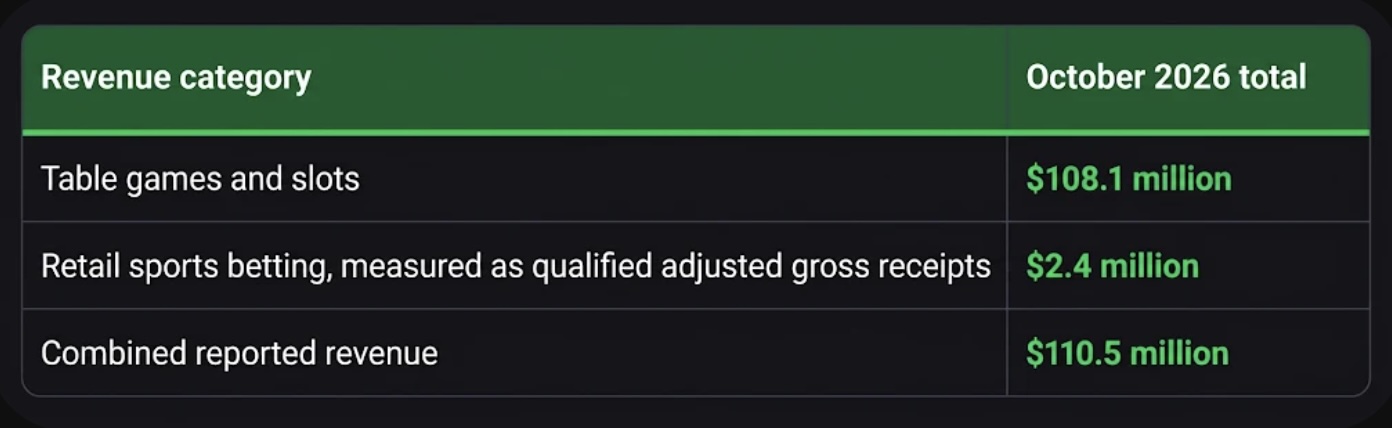
The figures are rounded.
Keeping these categories separate matters. The $108.1 million figure describes table games and slots—not the casinos’ total revenue when retail sports betting is included.
How the Three Casinos in Detroit Performed
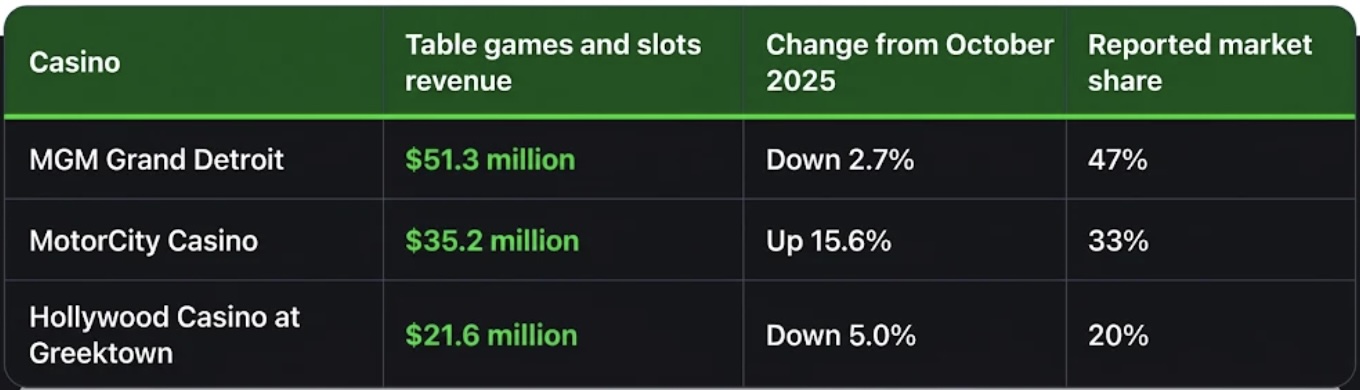
The city’s overall gain did not mean every casino reported growth. MotorCity’s increase contrasted with lower table game and slot revenue at MGM Grand Detroit and Hollywood Casino at Greektown.
MGM Grand Detroit Kept the Largest Market Share
MGM Grand Detroit generated $51.3 million from table games and slots, giving it the largest share of the Detroit market at 47%. However, its revenue fell 2.7% from October 2025. MGM led in total revenue even though its own results were lower than a year earlier.
MotorCity Casino Led Year-Over-Year Growth
MotorCity Casino reported $35.2 million in table game and slot revenue, an increase of 15.6% from October 2025. It held a reported 33% market share. As the only one of the three properties to post a year-over-year increase, MotorCity drove the combined market’s growth.
Hollywood Casino at Greektown Reported a Decline
Hollywood Casino at Greektown brought in $21.6 million from table games and slots, down 5.0% from the same month in 2025. Its reported market share was 20%, placing it third among the three casinos in Detroit.
Retail Sports Betting Added $2.4 Million
Retail sports betting contributed $2.4 million in qualified adjusted gross receipts, or QAGR, during October. That was up 56.0% from October 2025 and $1.6 million above September’s result.
The casinos reported $12.87 million in retail sports betting handle—the total amount wagered. That figure should not be confused with revenue: the MGCB listed handle separately from the $2.4 million in QAGR.
MotorCity also led the retail sports betting results:
- MotorCity Casino: $928,607 in QAGR.
- MGM Grand Detroit: $746,215 in QAGR.
- Hollywood Casino at Greektown: $729,350 in QAGR.
Sports betting added to October’s total, but table games and slots remained the much larger source of reported casino revenue.
What Detroit Casinos Paid in Gaming Taxes
For table games and slots, the casinos paid $8.8 million in state gaming taxes during October, compared with $8.6 million a year earlier. They also reported submitting $13.4 million in wagering taxes and development agreement payments to the City of Detroit.
Retail sports betting produced separate tax payments of $90,878 to the state and $111,073 to the city. These amounts were reported apart from the table game and slot-related payments.
What These Results Mean for Michigan Casinos
These figures cover Detroit’s three commercial casinos, not every casino in Michigan. They also do not represent statewide online casino revenue.
Within Detroit’s commercial market, October brought both a month-over-month rebound and modest annual growth. From January 1 through October 31, 2026, combined table game and slot revenue was up 2.3% compared with the same period in 2025.
The property-level results show why the details matter. MGM Grand Detroit held the largest market share, but MotorCity supplied the growth that lifted the combined table game and slot total. Retail sports betting provided an additional revenue source, while remaining much smaller than traditional casino gaming.


