


Las Vegas has long ranked among the most-visited destinations in the United States, but new data point to a clear shift. The latest Nevada Gaming Control Board report highlights a growing decline in Las Vegas tourism, raising concerns about the Strip’s future performance and its increasing reliance on non-gaming revenue.
Visitor volume fell by nearly 8% in 2025, reducing casino profits and weakening key revenue streams, including hotels, dining, and entertainment.
The report comes out just days after we learned that it took a last-minute deal to save the casinos in Primm, Nevada.

How Much Did Las Vegas Strip Profits Fall in 2025?
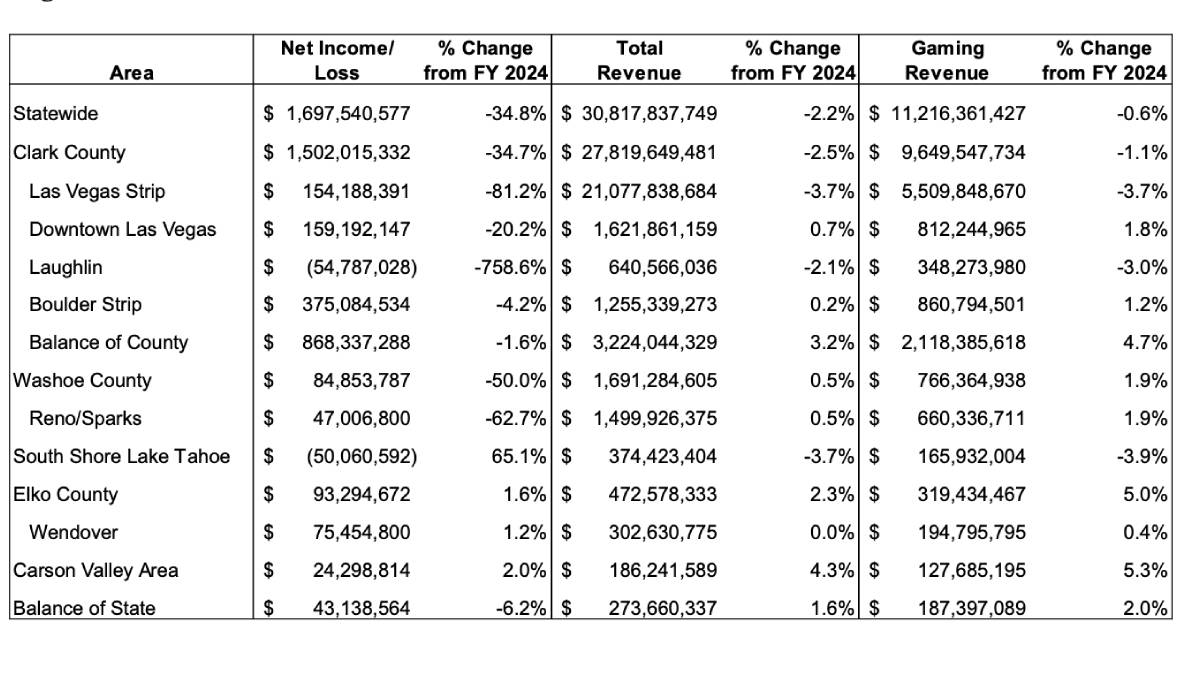
The biggest takeaway from fiscal year 2025 is how far profits fell on the Las Vegas Strip. Numbers have been down across the board on the Strip and at the airport for months, and now we are seeing the effect.
Net income dropped to $154.2 million, an 81% decline compared to the previous year. While total revenue remained high at $21.1 billion, it still fell 3.7% from the record set in 2024.
This gap between revenue and profit shows how sensitive casinos have become to even small shifts in visitor behavior. The ongoing decline in Las Vegas tourism has made it harder for operators to maintain margins, especially as costs continue to rise.
Fewer Visitors, Lower Spending
The decline in Las Vegas tourism is closely tied to a drop in visitor volume. Southern Nevada welcomed 38.5 million visitors in 2025, down 7.5% year-over-year. This marked 12 straight months of declining visitation.
Several factors contributed to this trend:
- Higher travel costs, including flights and hotel stays
- Increased resort fees, dining prices, and parking charges
- Broader economic uncertainty affecting leisure spending
- Growing “price fatigue” among tourists
Even though hotel occupancy slightly increased to 89.1%, the average daily room rate fell by 2% to $250.72. This suggests that while rooms were filled, casinos had to lower prices to attract guests during the decline in Las Vegas tourism.
Non-Gaming Revenue Feels the Pressure
Modern Las Vegas resorts rely heavily on non-gaming revenue streams such as hotels, dining, and entertainment. In FY2025, gaming made up just 26% of total revenue on the Strip.
This shift has worked well in strong tourism years, but it poses a risk during a decline in Las Vegas tourism. When fewer visitors arrive, spending drops across multiple categories, not just gaming.
For example:
- Room revenue fell 5.1% to $7.1 billion
- Gaming revenue declined 3.7% to $5.5 billion
- Operating expenses increased slightly, further squeezing profits
With a net margin of just 0.7%, even small changes in demand had a major impact on overall profitability.

Downtown Las Vegas Outperforms
While the Strip struggled, Downtown Las Vegas showed greater resilience during the decline in Las Vegas tourism. Its different customer base—focused more on locals and value-conscious visitors—helped stabilize performance.
Key highlights for Downtown in FY2025 include:
- Net income of $159.2 million, down 20.2% but far less severe than the Strip
- Total revenue increased 0.7% to $1.622 billion
- Gaming revenue rose 1.8% to $812.2 million
- A record $951.2 million in calendar-year gaming win
- Unlike the Strip, Downtown properties generate about half of their revenue from gaming. This makes them less vulnerable to drops in tourism-related spending, like hotel stays and entertainment.
Southern Nevada hasn't been as lucky. The last of the casinos in Primm, Nevada, was on the verge of closing on the 4th of July. So, it's not just the Strip that is feeling the heat.

A Shift in Market Dynamics
The decline in Las Vegas tourism also highlights a broader shift in Nevada’s gaming landscape. While Strip revenues softened, other markets such as the Boulder Strip and local casinos performed better, helping the state reach a record $15.8 billion in total gaming revenue.
This suggests that regional and local demand remains strong, even as destination travel slows.
What It Means Going Forward
The data show that Las Vegas is not in crisis, but it is entering a more complex phase. The decline in Las Vegas tourism reveals how dependent the Strip has become on high visitor volumes and non-gaming spending.
Operators may need to adjust strategies by:
- Offering more value-driven pricing
- Enhancing loyalty programs to retain repeat visitors
- Balancing luxury experiences with affordability
- Strengthening appeal to domestic and regional travelers
While early 2026 data shows mixed results, the FY2025 numbers serve as a clear warning. Even a modest decline in Las Vegas tourism can significantly impact profitability in a market built on high volume and premium pricing.


