


Tyler Jacobsma is the founder of Flowframe.xyz, which provides in-depth content and tools for prediction market traders.
The Kalshi word-mention contracts for Trump's State of the Union speech are mispriced. Retail traders are guessing based on vibes rather than transcripts, the Supreme Court tariff ruling, and the structural requirements of the address.
As a result, several contracts — which I'll detail below — offer 10-50 points of edge.
If you want to trade on the State of the Union address at Kalshi, sign up using our Kalshi promo code. This prediction market app is legal in most states and offers a variety of unique markets, including sports, politics, weather, and culture.
State of the Union Prediction Markets
Kalshi lets users trade on whether Trump will say specific words or phrases during the State of the Union. Each contract resolves YES or NO based on the official transcript, and over $3.5 million has been traded on this market.
The contracts settle on words spoken only from the rostrum. Hot mic audio during the entrance walk does not count. This is a major contract detail because Trump routinely talks to reporters and members of Congress while walking down the center aisle. If he says a target word to a reporter in the aisle, but never repeats it at the podium, the contract resolves NO.
Additionally, it's important to consider the broader context that shapes the speech — the Supreme Court struck down most of Trump's IEEPA tariffs in a 6-3 ruling on February 20, the administration's largest legal defeat of Trump's second term.
What Will Trump Say During the State of the Union?
The Trades
Buy "Fake News" at 49 cents
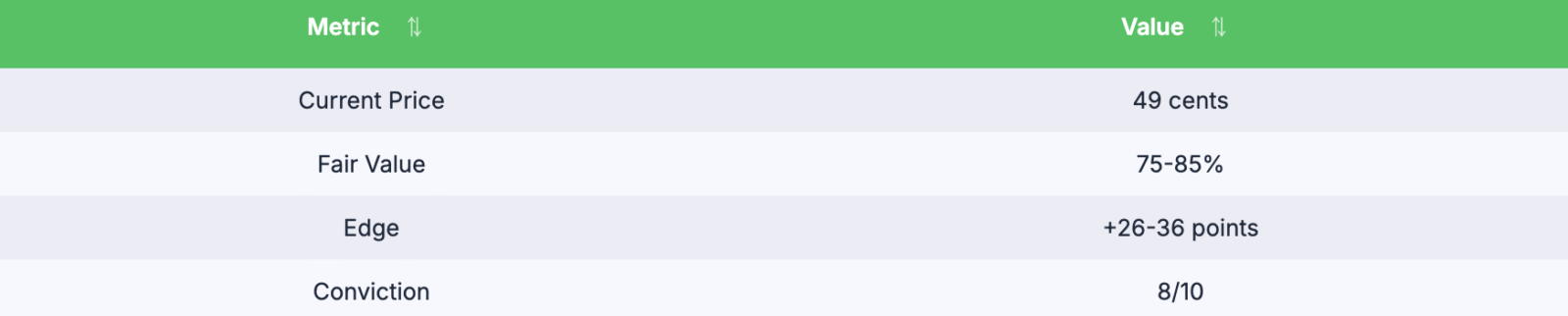
This contract is a misread of how Trump responds to institutional defeat. The retail market is treating "fake news" as a casual aside that might get dropped from a formal address. That misses the behavioral pattern entirely.
The Supreme Court struck down Trump's IEEPA tariffs on February 20 in a 6-3 ruling, with Chief Justice Roberts writing that IEEPA "does not authorize the President to impose tariffs." Trump, when informed during a governors meeting, called the decision "a disgrace". His established response to institutional losses isn't to attack the institution directly, but to attack the media's framing of the loss.
He did this after the Mueller investigation, after impeachment, and also after the 2020 election challenges. It's possible he does it again with a new Government Shutdown, too. In short, the media becomes the proxy target.
The proof that "fake news" is in his active vocabulary right now is 19 days old. At the National Prayer Breakfast on February 5, Trump pointed at the press pool and said, "that's a lot of fake news" and "I never get a fair break from the fake news." That was at a religious event with no political reason to say the phrase. He said it anyway, entirely unscripted.
The State of the Union, delivered to a national audience of 30+ million while he is still processing the tariff defeat, is a far more natural venue to say "fake news". At 49 cents, you're getting near-certain rhetoric for coin-flip pricing. The risk-to-reward is heavily skewed.
Buy "Vaccine/Autism" at 53 cents
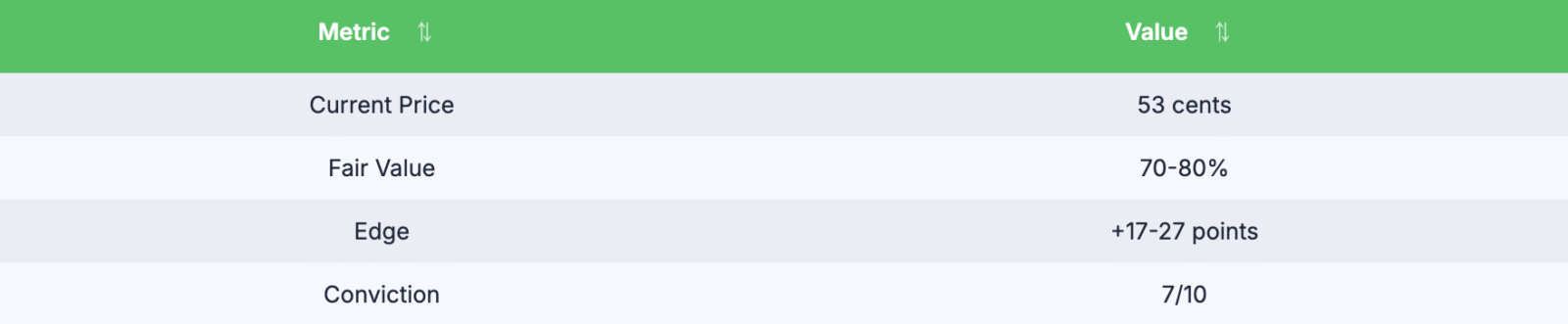
This is a combined contract. It resolves YES if Trump says either "vaccine" or "autism" during the address.
The retail side of this market is anchored on whether Trump will wade into the vaccine-autism debate, but that framing misses the point. You don't need Trump to deliver a monologue on developmental disorders, you just need him to say the word "vaccine" one time.
Trump has made vaccine policy a signature issue of his second term. Robert F. Kennedy Jr. is running HHS, the
administration paused multiple childhood vaccine recommendations in late 2025 and directed the CDC to revise its language on vaccine-autism links. This is not a fringe talking point for this White House. It is active, ongoing federal policy.
In September 2025, Trump held a press conference where he called for splitting the MMR vaccine, removing mercury and aluminum from vaccines, and delaying hepatitis B vaccination. The CDC website was subsequently changed to say the vaccine-autism link "cannot be ruled out."
A State of the Union is where presidents highlight their policy achievements to a national audience and the vaccine schedule overhaul is one of the administration's most visible health care actions. Even if the speechwriting team softens the framing, a single reference to "reforming the vaccine schedule" or "protecting children from unnecessary vaccines" resolves this contract YES.
The word does not need to appear in a controversial context. It just needs to appear.
The "autism" leg provides additional upside. While much less likely than "vaccine" Trump has shown a pattern of going off-script on this specific topic. He has repeatedly connected vaccines to autism in interviews and press events throughout 2025. Even if the prepared text avoids "autism," Trump's ad-lib tendencies on a subject he clearly feels strongly about add probability that the word surfaces during the address.
At 53 cents, this is priced as a coin flip in a market where one of the two trigger words is embedded in active federal policy. The combined structure makes this a high-probability YES.
Risk factors
Teleprompter Discipline: If internal advisors force strict teleprompter adherence following the tariff ruling, ad-lib phrases like "fake news" become less likely.
This is the primary risk to the Tier 1 trade. Trump has historically struggled to stay on script, but the political pressure after the SCOTUS loss could produce an unusually disciplined performance. If he sticks to the teleprompter, "fake news" probably doesn't make it into the prepared text.
Last-Minute Rewrites: A geopolitical crisis between now and February 24 could force a wholesale rewrite of the address. An Iranian escalation or an unforeseen domestic emergency would push planned topics out of the speech to make room for crisis rhetoric. This risk applies to all thematic positions.
Hot Mic Invalidation: Kalshi's rules explicitly exclude words picked up on a hot mic during the entrance or exit. Trump engages in lengthy, unscripted conversations while walking down the center aisle of the chamber. If he says "fake news" to a reporter in the aisle, but does not repeat it at the rostrum, the contract resolves NO.
Bottom Line: The highest-edge trade is "Fake News" YES at 49 cents. The Supreme Court tariff ruling landed four days before the speech, and Trump's behavioral pattern after institutional defeats is to attack the media.
He said "fake news" unprompted at the Prayer Breakfast 19 days ago, and the market is priced as a coin flip for what should be a 75% event. All contracts settle on the official transcript after the speech concludes, and positions should be entered before 9:00 p.m. ET on February 24.


