


Control of Congress will be decided on Election Day, Tuesday, November 3. All 435 House seats, along with nearly three dozen Senate seats and Governor's races, are up for grabs on Tuesday and in the coming weeks. Republicans currently control both chambers, but markets expect that to change by Tuesday night.
Here's where you can trade on the midterms legally in the U.S., and where the odds stand heading into Election Day. Prediction markets will stay live throughout election night as results roll in.
Platforms Where You Can Trade the U.S. Midterm Elections
There are a number of platforms where you can trade politics, among many other events.
- Kalshi is a CFTC-regulated prediction market available in most U.S. states and it has the deepest menu of midterm markets. That includes the basics like House control, Senate control, the full balance of power, every Senate and governor's race, individual House districts, plus dozens of derivative markets like margin of victory, county-level results and voter turnout.
- Polymarket US, the regulated U.S. version of the world's largest prediction market, offers House and Senate control, individual Senate and governor's races, and combo markets that pair outcomes together (like a Senate and governor's race in the same state).
- Sportsbook brands now have their own prediction-market apps. DraftKings Predictions has a dedicated midterms section, separate from the DraftKings Sportsbook app. FanDuel Predicts also offers event contracts.
- Robinhood, the stock trading platform, is again offering event contracts on the election through its derivatives arm, subject to account approval and state availability.
- What you won't find: election odds at traditional U.S. sportsbooks like DraftKings, FanDuel or BetMGM. State gaming regulators limit licensed sportsbooks to sports. Every legal U.S. option for betting the midterms is a federally regulated prediction market.
How to Trade Midterms on Kalshi
We've covered the basics of trading on Kalshi and other prediction markets extensively, and you can check out our full explainer video above.
Kalshi is the biggest U.S. market for midterm trading. Here's a walkthrough using its Texas Senate market, the most heavily traded race in the country, with more than $88 million in volume as of Election Day morning.
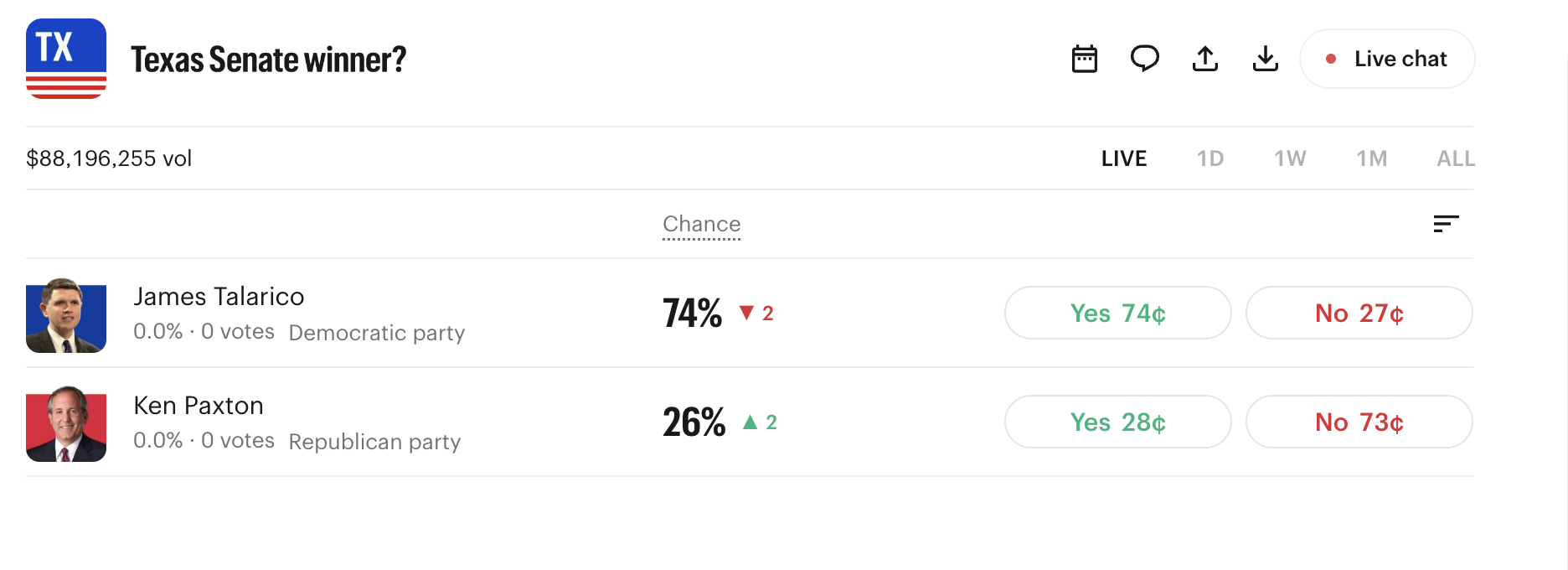
1. Pick a market and an outcome
Each race has its own market with a row for each candidate. In Texas, James Talarico is listed at 74% and Ken Paxton at 26%. That percentage is the market's implied chance of each candidate winning, and the arrow next to it shows how much it has moved recently.
Once polls close, each row also shows the candidate's share of the vote and vote count as results come in.
2. Choose Yes or No
Every candidate has two buttons. "Yes" means you think that candidate wins; "No" means you think they lose.
- Talarico Yes at 74¢: Pays $1 per contract if Talarico wins.
- Talarico No at 27¢: Pays $1 per contract if Talarico doesn't win.
- Paxton Yes at 28¢: Pays $1 per contract if Paxton wins.
- Paxton No at 73¢: Pays $1 per contract if Paxton doesn't win.
Pro tip: In a two-person race, "No" on one candidate is nearly the same trade as "Yes" on the other, so check both. Here, Talarico No (27¢) is a penny cheaper than Paxton Yes (28¢), which means a slightly better price for essentially the same position. The one difference: Talarico No would also pay out if a third-party candidate somehow won.
3. Figure out your payout
This is where people usually get a bit confused. Payouts display in the apps automatically, but it's helpful to understand the mechanics of the payouts.
Contracts settle at $1 if you're right and $0 if you're wrong no matter what, so your price is your risk.
- $100 on Talarico Yes at 74¢ buys about 135 contracts and you'd profit 26 cents on each contract if he wins. If he wins, you get about $135 back, which is roughly $35 in profit.
- $100 on Paxton Yes at 28¢ buys about 357 contracts. If he wins, you get about $357 back: roughly $257 in profit.
Kalshi charges a trading fee on each order, so your actual return will be slightly lower.
4. Read the order book (optional, but useful)
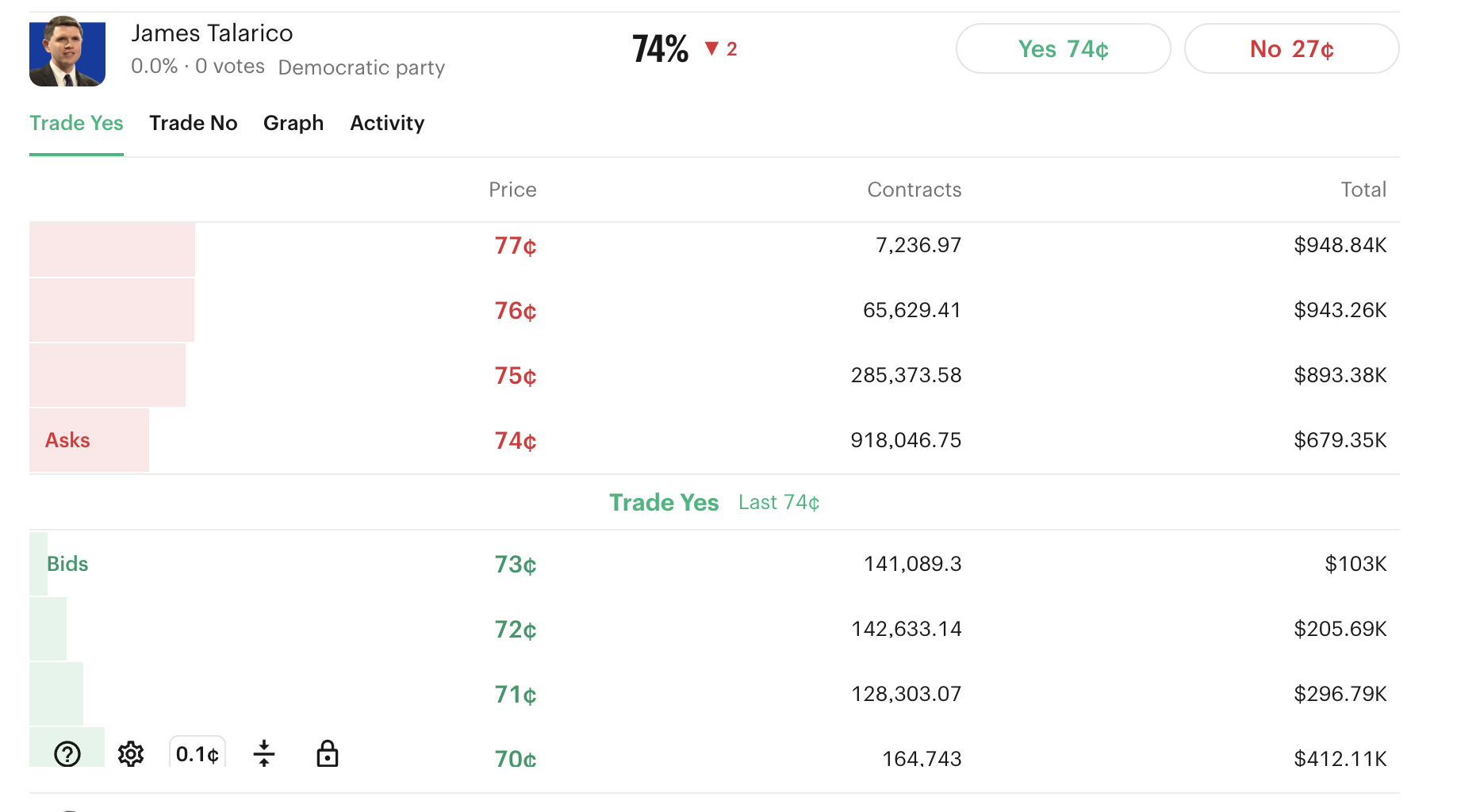
Tap a candidate to open the order book. The red "Asks" are prices people are willing to sell at; the green "Bids" are prices people are willing to buy at.
- Buying right now: The lowest ask for Talarico Yes is 74¢, with more than 900,000 contracts available at that price. A market order fills there instantly.
- Naming your price: The highest bid is 73¢. You can place a limit order at 73¢ or lower and wait for someone to sell to you. You'll save a penny or more per contract, but your order may never fill if the price moves away.
- The spread: The 1¢ gap between the best bid (73¢) and best ask (74¢) is the spread. Tight spreads mean a liquid market. In smaller races, spreads can be several cents wide, and that's where limit orders matter most.
5. Sell anytime before the race is decided
You don't have to hold until the result. If Talarico jumps to 85¢ after early returns, you can sell contracts you bought at 74¢ and lock in an 11¢ profit per contract minus fees, or cut your losses if things move against you. Prices can swing quickly on election night as counties report.
Use the Graph tab to see how a market has moved over time, and the Activity tab to see recent trades.
Midterm Election Odds Entering Election Day
Kalshi odds as of 9 a.m. ET Tuesday, Nov. 3.
- House control: Democrats 94%, Republicans 6%
- Senate control: Democrats 76%, Republicans 24%
Democrats need a net gain of four seats to flip the Senate. Entering Election Day, markets favor them in every competitive Republican-held seat except Nebraska.
Senate Odds in Key States
- Alaska: Democrat Mary Peltola is a 71% favorite over incumbent Republican Dan Sullivan. Alaska uses ranked-choice voting, so a final result could take days if no one clears 50% in the first round.
- Georgia: Incumbent Democrat Jon Ossoff is a 97% favorite over Republican Rep. Mike Collins.
- Iowa: Still the closest race on the board, but it has flipped. In the open race to replace Joni Ernst, Democratic state Rep. Josh Turek (53%) is now a slight favorite over Republican Rep. Ashley Hinson (47%). Hinson was favored as recently as the weekend.
- Kansas: The biggest move of the final stretch. Democrat Adam Hamilton is now a 63% favorite over incumbent Republican Roger Marshall, after jumping 10 points in the last day. Marshall was a 63% favorite on Friday.
- Maine: Democrat Troy Jackson is a 74% favorite over longtime incumbent Susan Collins, who has a long history of outperforming her polls.
- Michigan: The only competitive Democratic-held seat. In the open race to replace Gary Peters, Democrat Abdul El-Sayed has pulled away to a 79% favorite over Republican Mike Rogers.
- Nebraska: Incumbent Republican Pete Ricketts is a 67% favorite over independent Dan Osborn, who has said he wouldn't caucus with either party.
- North Carolina: In the open seat left by Thom Tillis, former Democratic Gov. Roy Cooper is a 97% favorite over Republican Michael Whatley. It's the Democrats' likeliest pickup on the map.
- Ohio: In the special election for JD Vance's former seat, Democrat Sherrod Brown is a 72% favorite over appointed incumbent Jon Husted.
- Texas: The most heavily traded race in the country. In the open seat after John Cornyn lost his primary, Democrat James Talarico is a 73% favorite over Republican Ken Paxton.


