


As we head toward Opening Day, I'm previewing MLB futures markets.
This particular story is my player MLB awards preview covering the MVP, Cy Young, Rookie of the Year, and Manager of the Year markets.
Make sure to check out my other preseason futures previews, including Team Futures and Player Stat Futures.
Below, I'll provide my projections and simulated leaderboards (using a Monte Carlo simulation) for MLB player awards, guide you through each category, and tell you where I'm placing my money for the 2026 MLB season.
There is one strong edge (5-10%, labeled three stars), 14 two-star edges (2-5%), and up to 32 one-star leans (0.5%-1.9%) — or borderline bets — in this article.
Pick a few bigger edges you really like and increase bet sizing, or spray the board and build category portfolios for smaller stakes.
I have over 20 bets in this article, but allocated just around two units among them, compared to over 21 units across 25+ team futures, and 9+ units across 90+ stat leader and player prop bets. I also don't have more than a half-unit allocated to any specific player between props and awards combined – one injury won't kill me.
As a reminder, I will post any new bets I make throughout the season to the Action Network app. Download the app, follow me, and get notifications when I place a bet.
| Click on a category to skip ahead |
| MVP |
| Cy Young |
| Rookie of the Year |
| Manager of the Year |
| All Bets |

MLB Award Picks: MVP Analysis
After getting shut out in the (largely chalky) Awards markets last season, I ran an updated correlation study to revamp my awards models.
So, before breaking down the potential list of Most Valuable Player candidates for 2026, let's talk about my updated findings in terms of what matters and what does not matter to MVP voters.
Key Findings
- Wins Above Replacement (WAR) is King: For MVP voting, fWAR (r = .791; R2 = .626) outperforms bWAR (r = .752; R2 = .565), meaning about 63% of vote share variance is explained by fWAR, compared to 57% for bWAR. Thirty of the past 32 MVP winners (94%) ranked in the top three in fWAR in their respective leagues. Twenty-one (70%) of those 30 winners finished as the league leader in fWAR, including both Aaron Judge (11.2 WAR) and Shohei Ohtani (9.4 combined hitting/pitching WAR) in 2025.
- OPS is Next Best:OPS explains 51% of vote share variance (r = .714; R2 = .510), nearly as much as WAR itself. It vastly outperforms its components: OBP (r = .566), SLG (r = .681), and BA (r = .352), which technically includes HR (r = .561). Every offensive MVP winner since 2001 (except Ichiro) has posted an OPS above .850, which generally limits the MVPs…
- Position: Over the past two decades, two pure pitchers (Clayton Kershaw and Justin Verlander) have won MVP (three in 36 years). Outfielders and corner infielders have won more than 75% of the time, including 18 of the 22 most recent recipients (second baseman Jose Altuve and DH/pitcher Shohei Ohtani are the only exceptions). The WAR positional adjustment for middle infielders or catchers isn't enough to overcome superior offensive production from corner positions.
Largely Irrelevant
- Hits and Steals: Batting Average (r = .352) and Stolen Bases (r = .187) rank 10th and 12th among 14 categories for MVP prediction. Despite the stolen base boom, voters still don't treat speed as an MVP skill. In 2022, stolen bases actually had a negative correlation with vote share.
- Making the Playoffs: Twelve of the past 50 MVP winners (24%) failed to make the postseason. Perhaps more importantly, in 2022, none of the three finalists in either league made the postseason, the most dramatic shift in the history of MVP voting. That said, I still factor in team context (playoff odds and division contention) into the model to a small extent (<10% of the total score).
- Teammates Competing for Votes: Since 2000, the closest teammates in MVP voting, relative to the actual MVP winners, have ranked around 10th, on average. Only one pair of teammates has finished first and second (Jeff Kent and Barry Bonds in 2000). Five additional pairs have finished in the top three of voting, including Aaron Judge and Juan Soto in 2024. Five MVP winners finished with multiple teammates in the top 10, including Ronald Acuña Jr. in 2023 (alongside Matt Olson, fourth, and Austin Riley, seventh). Conversely, there are five instances where three teammates finished in the top 10 without winning any awards, potentially stealing votes from one another. However, I have also concluded that these teammates are almost always selected in the same order across ballots, providing evidence that strong performers statistically lift other teammates (stacking) while still receiving appropriate credit for their contributions, rather than competing for positioning in the final tally.
Here are my projected AL MVP contenders for the upcoming season, along with their listed odds in the betting market and my sim ranking, which analyzes the field using weighted projection data:
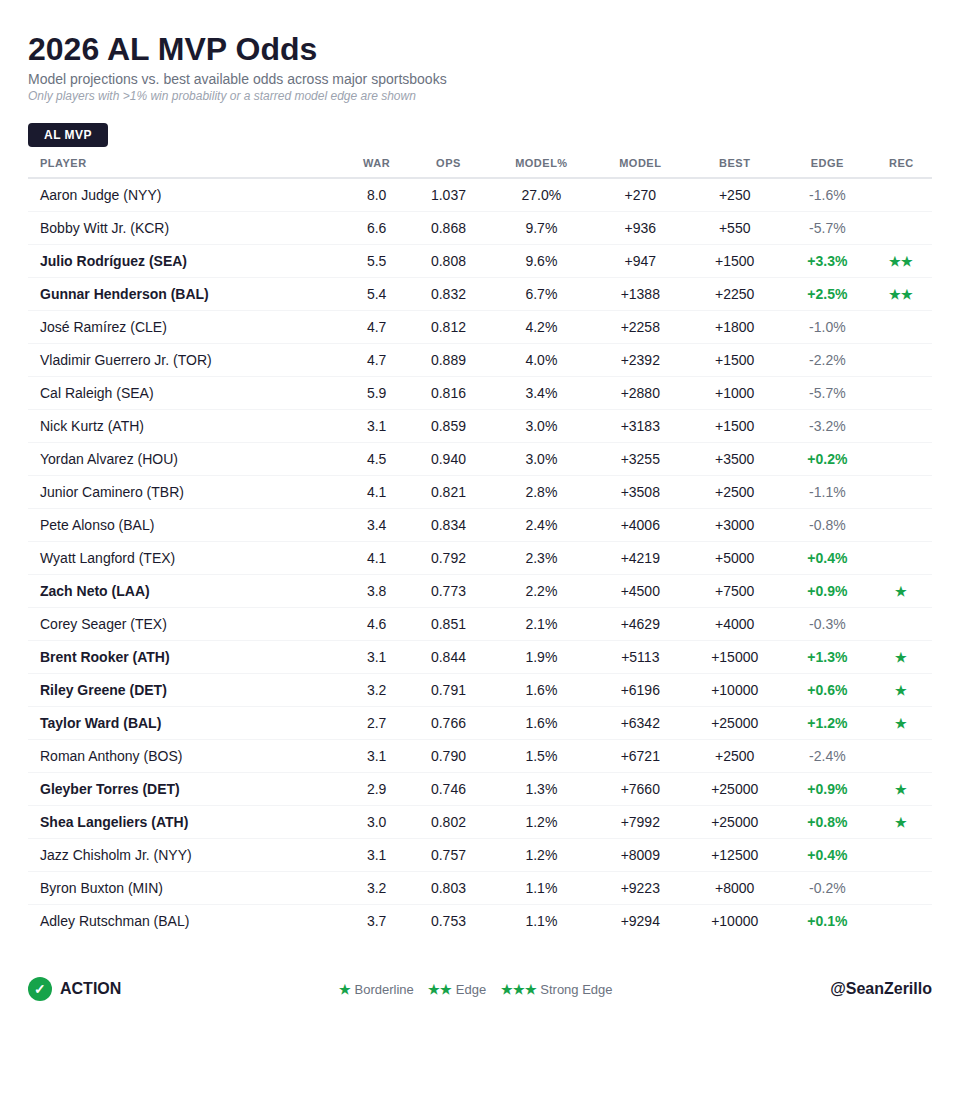
The average OPS projection for my top projected AL MVP value bets falls short of that .850 OPS threshold I just cited.
However, Julio Rodríguez (.853 OPS in his rookie season) and Gunnar Henderson (.893 in 2024) have cleared that benchmark in prior seasons.
Henderson offers more reliable projections and forecasts for an OPS as high as .865 with 6.5 WAR from OOPSY, compared to .828 and 6.1 WAR for Rodríguez from the same system.
In fact, Cal Raleigh has a higher average WAR and OPS projections, and a higher peak public projection (.852 OPS, 7.3 WAR from the BAT), than his teammate. That said, my player models also incorporate ATC's volatility metrics to capture a broader range of tail outcomes.
For example, Rodríguez has a strong positive skew (+0.96) in his projection distribution, meaning his upside outcomes are meaningfully higher than his median. Raleigh has a heavily negative skew (-1.22), meaning his distribution is tilted toward the downside. Moreover, Julio scores much higher on the Dim (Diminishing Returns) adjustment (4.6 to 2.6).
Raleigh's WAR projection is already concentrated near his ceiling as a catcher, and the model thinks we've already seen his peak season or close to it in 2025.
Rodríguez's projection distribution is wider, while Henderson's is more symmetric (with a neutral skew), but both offer substantial upside relative to their odds. My player awards models reward projection asymmetry because MVP, Cy Young, and Rookie of the Year outcomes are inherently right-tail events — you need to be the best player or pitcher in the league, not merely one of the best.
Rodríguez and Junior Caminero (+0.75) have the highest skew ratings in the AL, while Raleigh (-1.22), Aaron Judge (-0.84), Yordan Alvarez (-0.51), and Nick Kurtz (-0.41) have the lowest. Yet, I still show a slight positive edge on Alvarez.
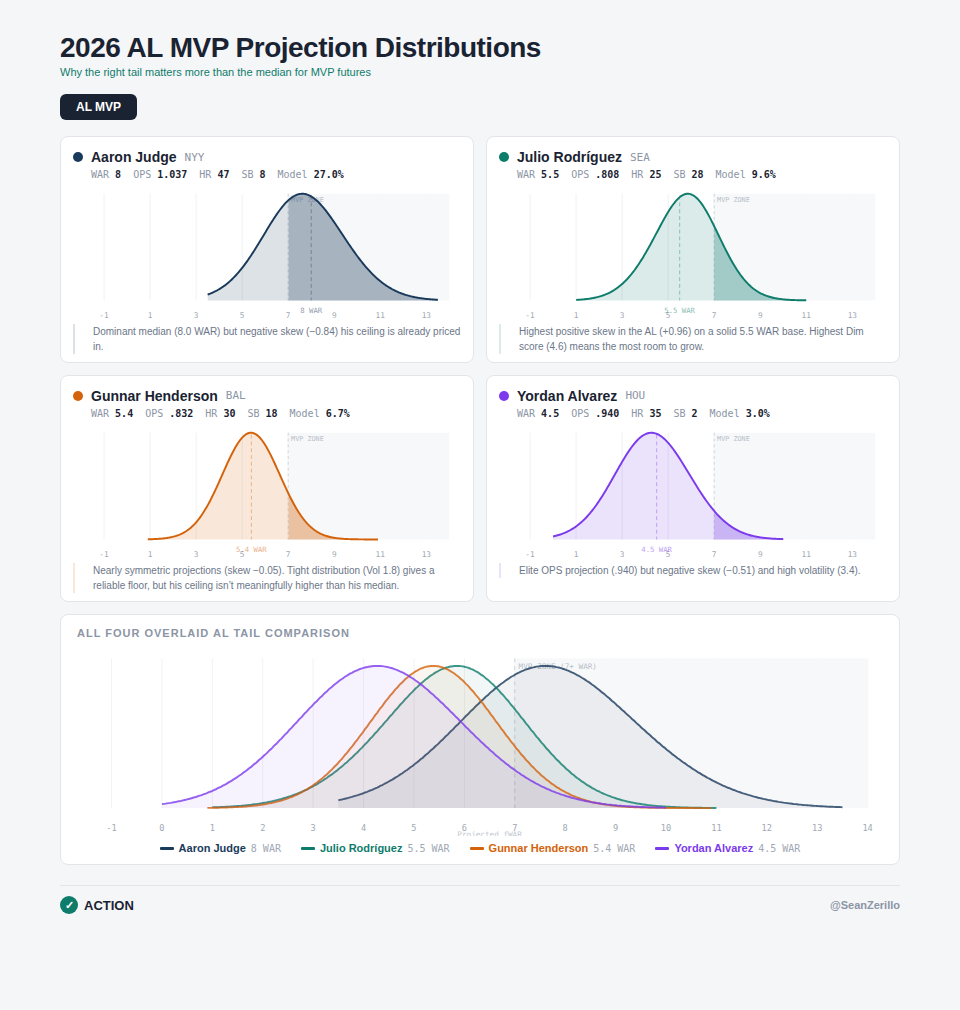
Yordan owns a career .961 OPS and is one of the few hitters capable of breaking the WAR correlation for voters by posting elite numbers at the dish. He was +1100 in the same category last season, and I passed on those odds in favor of his home run and RBI leader props (both at +2500; currently +5000 and +2800 for 2026). If you're going to triple the price, I'm back in on Yordan's MVP odds instead.
Henderson was also +800 to win the award in 2025, but his price has more than doubled after a letdown campaign.
I'm high on a few of the one-star players, but don't think any is necessarily worth an MVP wager yet.
Riley Greene is a talented athlete (92nd percentile in bat speed) who hit 36 homers last season, but generated just 2.9 WAR. Greene needs to cut down on the strikeouts (28.5% career; 12th percentile in whiff rate), square up the ball more frequently (17%, 1st percentile or bottom of the league in 2025), and improve defensively (-7 DRS, 1 OAA in 2025) to progress toward a 5 WAR season (3.9 in 2023) let alone MVP contention. The power is real, but watch for an improved plate approach in April.
Zach Neto (3.5 WAR in 2024, 3.1 in 128 games in 2025) should surpass the four-WAR mark with a full season of playing time in 2025 — four of eight projections have him surpassing that benchmark (peak of 4.5 from Zips Depth Chart). Still, his peak OPS projection (.793) matches his 2025 mark. He's extremely well-rounded, and DRS (+13 in 2025, +11 in 2024) rates him as a much better defender than OAA (-6 in 2024, -8 in 2025), but Neto doesn't quite walk enough or hit for enough power to post an MVP-caliber stat line.
Here are my projected NL MVP contenders for the upcoming season, along with their listed odds in the betting market and my sim ranking, which analyzes the field using weighted projection data:
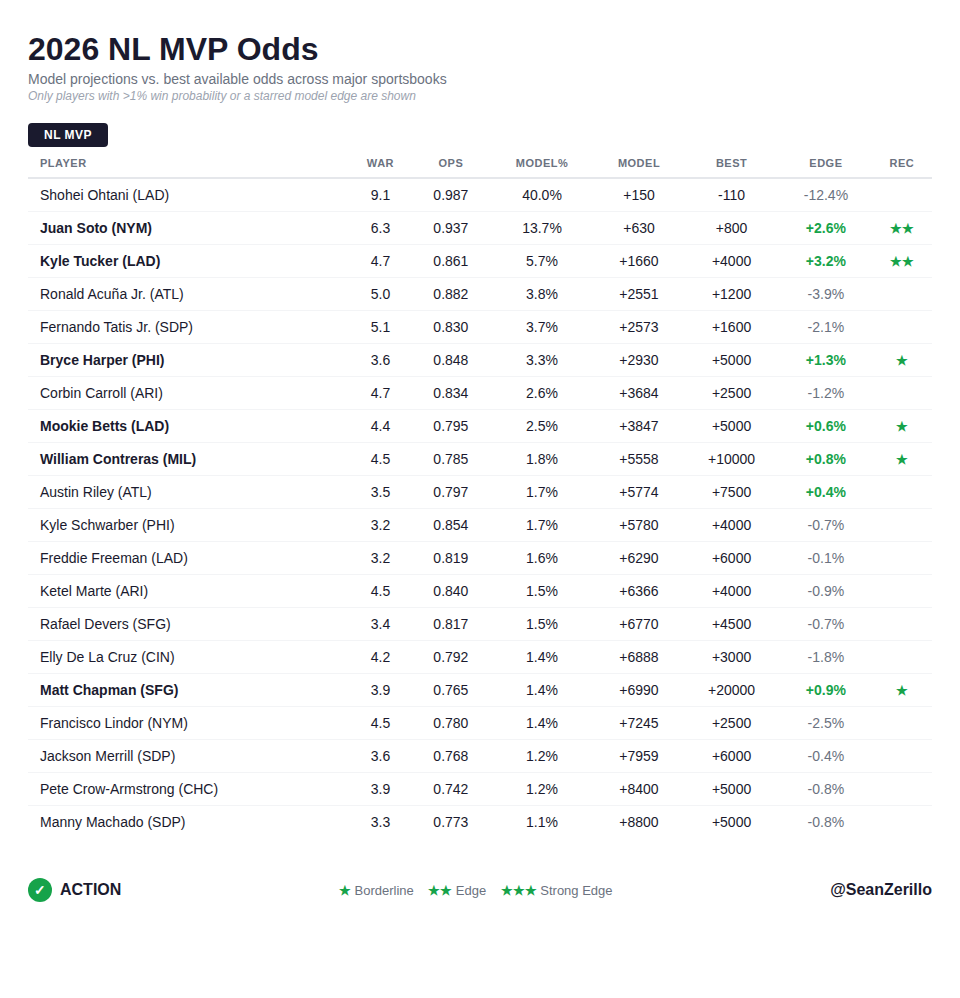
Even combining Shohei Ohtani's hitter and pitcher WAR, I had difficulty getting him past 40%, which is especially surprising given that I bet him in both the home run and RBI leader markets.
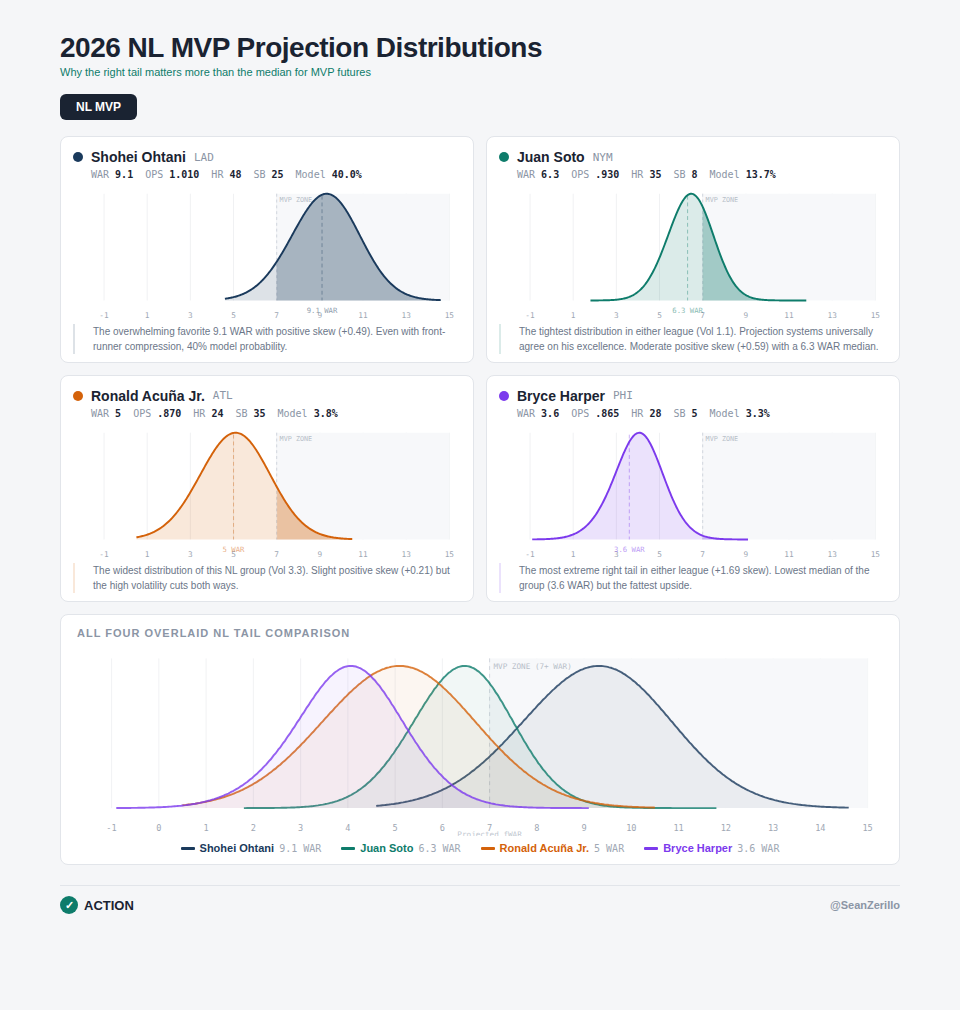
The NL field has much more positive skew than the AL Field.
Bryce Harper (+1.69) has the highest skew in either league by a wide margin, and the model sees a realistic path to a much bigger season than the median projection suggests. He was +1600 last season.
Kyle Tucker is the NL's version of Raleigh, with a solid average projection but a negative skew pulling his model probability down. Notably, the model still has Tucker as a two-star play because it views him as the likeliest awards beneficiary in the event of an Ohtani injury. I tend to think you wait and still get similar odds if it happens, but Tucker was also just +1700 last preseason as the Cubs' perceived primary star.
I have about one-third of a unit on Juan Soto in the home run market (across his Over/Under, category outright, and 50+ milestone prop), and there's a strong case for him finally securing his first MVP trophy in 2026. A high Dim (4.1) and the positive skew (+0.60) give Soto significant upside in the right tail of his projection, but he also has the lowest volatility rating (1.1) in the NL, which means he pairs an elite floor with still meaningful upside.
William Contreras (+0.80 skew) projects closer to the 5.5-WAR player we saw in both 2023 and 2024, rather than his sub-four-win 2025 season, even though his average projection for 2026 splits the difference. While he should continue to DH on his off days, that's no guarantee (maybe he struggled last season because he needed more time off), especially since catchers and center fielders are the most-injured position players.
Moreover, despite what the model says, I don't think he has the most upside on his own team. If there's a futures MVP on the Brewers, it's probably Jackson Chourio. And if it's not Chourio, then it's 18-year-old prospect Jesús Made, maybe before the decade is out.

MLB MVP Bets
- AL MVP: Julio Rodríguez (+1500, 0.1u), Fanatics
- AL MVP: Gunnar Henderson (+2250, 0.1u), ScoreBet
- AL MVP: Yordan Álvarez (+3500, 0.05u), Fanatics
- NL MVP: Juan Soto (+800, 0.2u), HardRock
- NL MVP: Bryce Harper (+5000, 0.05u), Parx

MLB Award Predictions: Cy Young Analysis
Historically, four basic statistics correlate most strongly to Cy Young winners: Wins, ERA, strikeouts, and WHIP (walks and hits per inning pitched).
However, there has been a clear upward trend in recent seasons between WAR and Cy Young winners, mirroring the trend between WAR and MVPs.
Seventeen of the past 20 (85%) Cy Young winners have finished in the top three in their respective leagues in pitching fWAR, the only exceptions being Blake Snell (seventh in 2018, sixth in 2023) and Robbie Ray (seventh in 2021). Tarik Skubal (6.6 WAR) and Paul Skenes (6.5) led their respective leagues in fWAR in 2025.
In fact, for Cy Young, bWAR (r = .705) is an even stronger predictor than fWAR (r = .576). This is the opposite of MVP voting, where fWAR dominates.
Counting stats like Wins (r = .130), innings pitched (r = 174), and strikeouts (r=w.368), and even rate stats like WHIP (r = .243) and ERA (r = .409) show relatively weak correlations with vote share variance.
Also, no team bonus is applied, as Cy Young voters appear largely indifferent to team quality.
I am still including innings pitched in the table, as aside from the shortened 2020 season, the lowest innings total for a Cy Young winner was Corbin Burnes (167) in 2021, and after that, Chris Sale (177 2/3) in 2024. Starters need to throw about 170 innings at a minimum to finish in the top-three in their league in WAR.
Still, if Pitcher A throws 220 innings and Pitcher B throws 170, but Pitcher B's innings are more efficient (leaving both with a similar WAR total), Pitcher A does not get credit for the added workload.
Here are my projected AL Cy Young contenders for the upcoming season, along with their listed odds in the betting market and my sim ranking, which analyzes the field using weighted projection data:
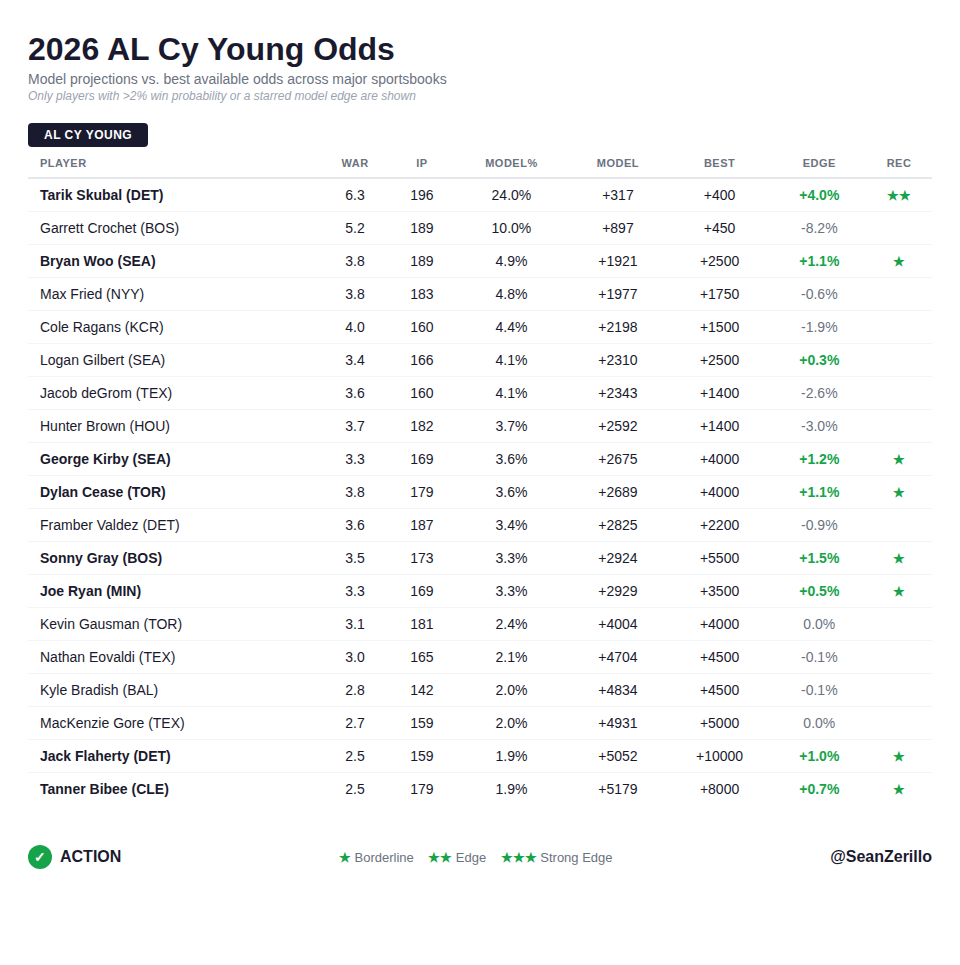
My model gave Tarik Skubal and Paul Skenes the same chances of retaining their hardware in 2026, but Skubal has both the higher average projections and the more actionable odds in the betting market. He ranks first by every model input for the AL, including skew (+1.59), which means his upside outcomes are well above his median.
Garrett Crochet exhibits negative skew and high volatility (5.04), leading to a wide, left-leaning distribution — that is, his downside outcomes are more likely than his upside outcomes. We'll see how his arm responds after a career-high 205 innings in 2025, a 50-inning bump from 2024.
I can make a case for all three Mariners: Logan Gilbert, Bryan Woo, and George Kirby. I already bet Gilbert and Woo in the strikeout leader and milestone markets, and have Kirby as a longshot wins leader, but all offer positive value to upend Skubal as the AL's top hurler.
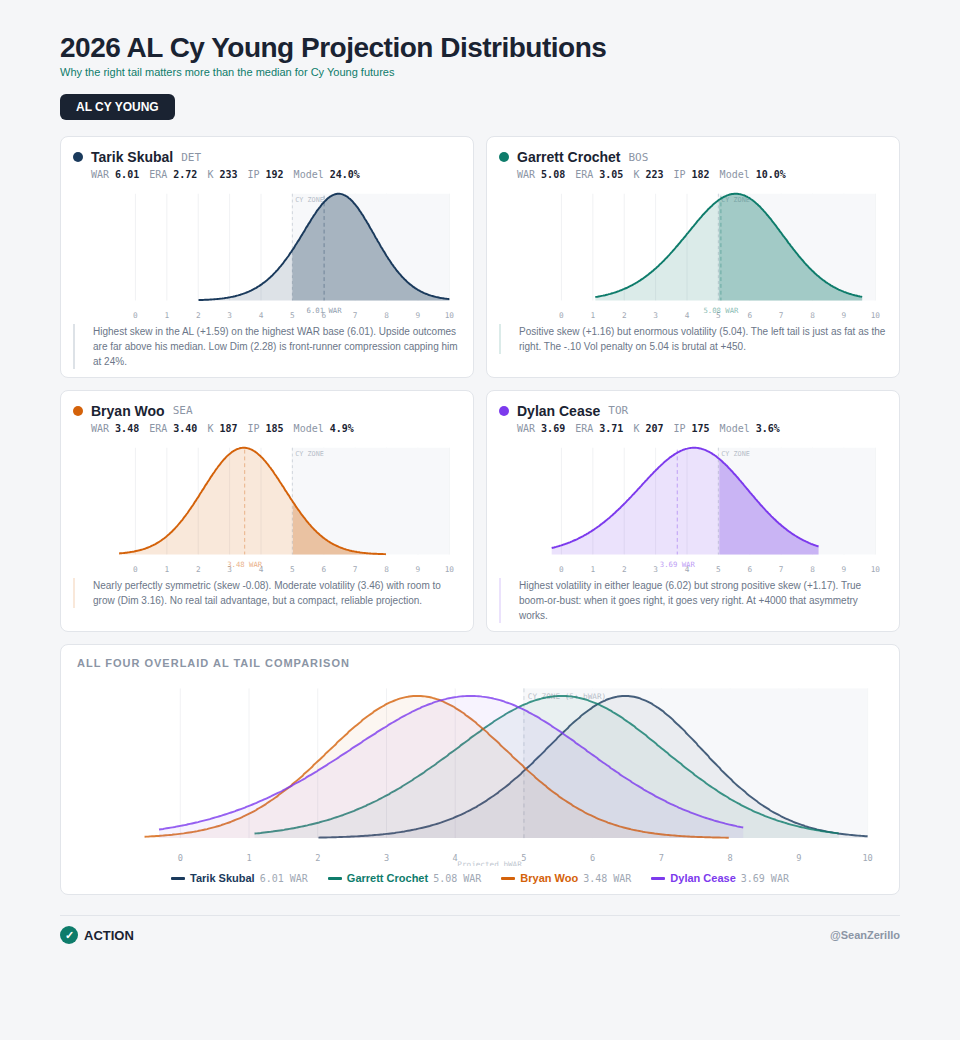
Woo's graph is almost perfectly symmetric, but a higher volatility rating overcomes his negative skew. Conversely, Kirby has the lowest volatility rating in the AL, but a positive skew, leading to a tighter, but still right-leaning graph.
Dylan Cease projects for the second-highest strikeout total in the AL, and will be pivoting from a below-average to an elite defensive team. He needs a bit of positive BABIP (.320 in 2025, .295 career) and ERA variance to get into contention (4.55 ERA, 3.45 xERA, 3.56 xFIP in 2025). Cease has the highest volatility rating in either league (6.02) but also a strong positive skew (+1.2), which is the boom-or-bust profile you want at longshot odds.
Here are my projected NL Cy Young contenders for the upcoming season, along with their listed odds in the betting market and my sim ranking, which analyzes the field using weighted projection data:
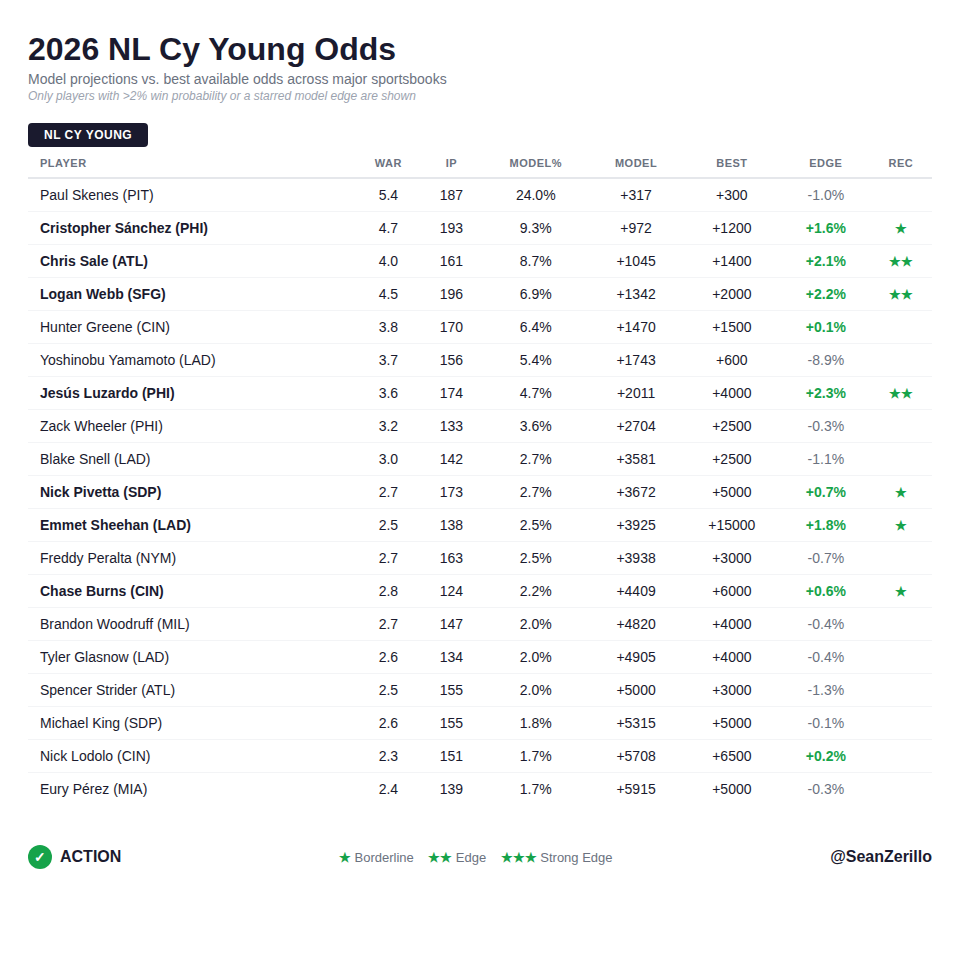
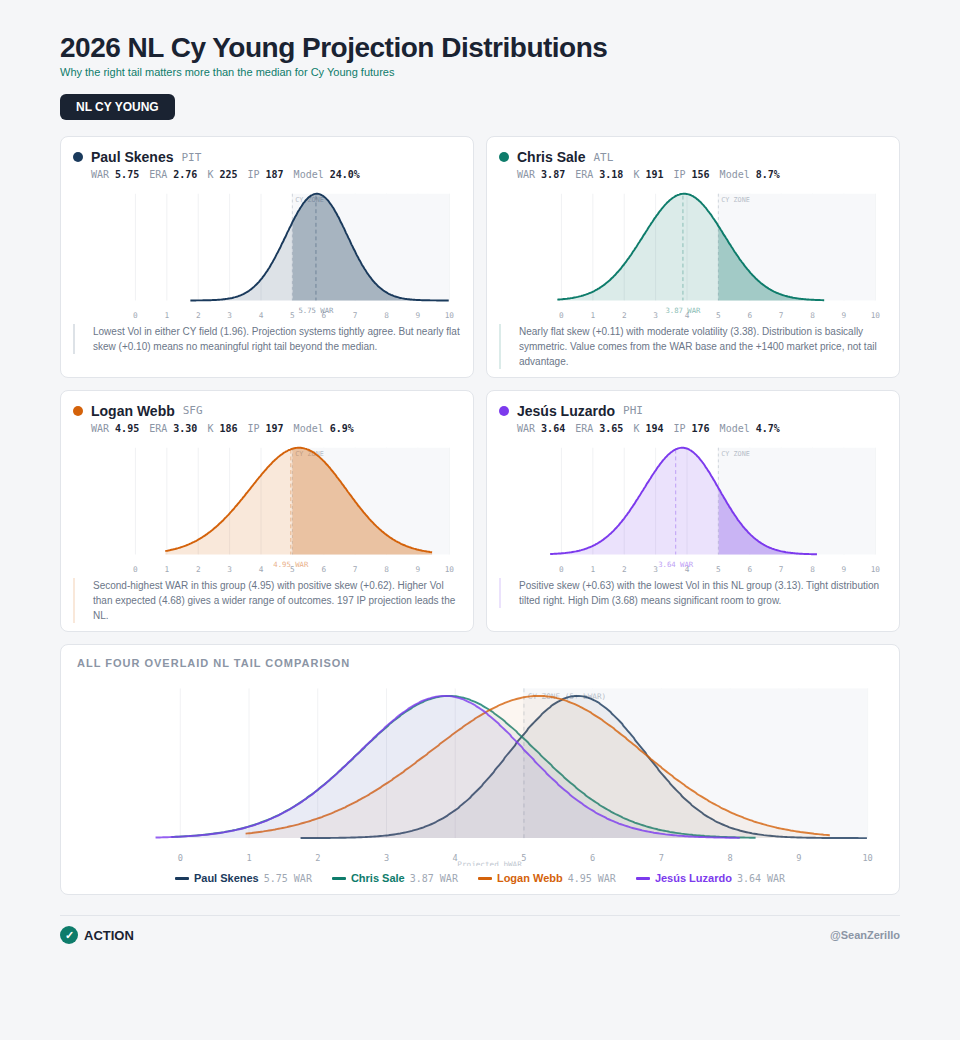
Skenes is the best pitcher in the NL and was a unanimous selection in 2025, but the market is charging a premium for his services. He offers the tightest volatility projection (1.96) in either field, as every projection system agrees on what he's going to do within a margin of error. That's great for confidence in the median projection (and his floor). Still, there's little probability in his extremes, as confirmed by a near-zero skew (0.10), which creates an almost perfectly symmetric distribution of outcomes.
Cristopher Sánchez was my top betting selection in 2025, and remains so for 2026. His positive skew (+0.85) is second-highest in the NL behind Logan Webb, but he also projects second in both WAR and Innings Pitched, providing a high median projection. Sánchez's teammate, Jesus Luzardo, also has a positive skew (+0.63) and significant upside potential.
Chris Sale has a relatively symmetric distribution. His value comes more from the average WAR projection, but he's about to turn 37 and has a lengthy injury history. Despite the two-star recommendation, I'm leaning toward passing. Since 2017, Sale has only crossed that 170-inning Cy Young threshold once (in 2024 during his Cy Young campaign). His body seems to be breaking down after 25 starts.
Webb's volatility (4.68) is shockingly high for a guy perceived as a boring workhorse, and he also has a positive skew (+0.62). I believe in his strikeout milestone upside, and hitting those benchmarks would boost his WAR total.
Emmett Sheehan tossed exactly 100 innings between the minors, majors, and postseason in 2025. The highest 2026 projection (152 innings from Steamer) doesn't think he'll generate the workload to win this award. He's extremely talented, but I tend to agree, as Sheehan also has the lowest volatility rating in the NL field.
Chase Burns (111 combined IP in 2025) also probably will not meet the innings threshold to generate enough WAR to put himself into contention to win, especially considering how hard he throws and with the elbow strain he suffered last season. I strongly prefer his 190+ strikeout milestone odds.
MLB Cy Young Bets
- AL Cy Young: Tarik Skubal (+400, 0.4u), Parx
- AL Cy Young: Bryan Woo (+2500, 0.05u), Fanatics
- AL Cy Young: Dylan Cease (+4000, 0.05u), Parx
- AL Cy Young: George Kirby (+4000, 0.05u), DraftKings
- NL Cy Young: Cristopher Sánchez (+1200, 0.1u), Fanatics
- NL Cy Young: Logan Webb (+2000, 0.1u), FanDuel
- NL Cy Young: Jesus Luzardo (+4000, 0.1u), HardRock

MLB Award Odds: Rookie of the Year Analysis
Update (3/22): I re-ran my Rookie of the Year projections prior to opening day, following an injury to one top AL contender (Trey Yesavage) and with clearer playing time projections for the remainder of the field in both leagues.
JJ Wetherholt remains my projected NL leader, but his chances have improved closer to 25% with Konnor Griffin getting sent down for additional seasoning.
Nolan McLean also leapfrogged Griffin, and I now make his odds closer to +350, so both selections are +EV compared to the best available odds (+600 and +425, respectively), but there is a bigger edge on Wetherholt, and position players (with reduced injury risks and playing time restrictions) are generally safer investments in these markets. McLean may have the more impressive end-of-season pitching line compared to more modest counting stats for Wetherholt (closer to 12-15 HR and SB than 20-20), but the infielder will likely clear the pitcher in WAR.
In the AL, I now make Kevin McGonigle the top selection (updated projection +350) following a strong spring (and the Yesavage injury), which will likely earn him the Tigers' leadoff spot on opening day.
Both Wetherholt and McGonigle have excellent plate discipline and hit tools, but McGonigle packs substantially more power in his 5'9" frame. McGonigle also projects as a better player than Kazuma Okamoto if both are given equivalent playing time (3.6 to 2.8 WAR per 600 PA), and McGonigle's major league role seems far more certain than it did two weeks ago. Okamoto is also a potential +EV bet (updated projection +545, listed +900) after the Yesavage injury, but the edge is both bigger on McGonigle, and I project him as the likeliest winner (I'd make them both closer to +450 if McGonigle goes down for two weeks due to service time implications).
Unlike MVP and Cy Young, Rookie of the Year voting is harder to predict from projections alone because rookies, unlike established stars, have such varied and unpredictable playing time.
Therefore, the updated rookie model focuses on talent ceiling multiplied by opportunity (playing-time probability) rather than simply correlating projections with expected votes.
Final WAR totals correlate strongly with both rookie hitters and pitchers. fWAR (r = .730 for hitters and .680 for pitchers) and bWAR (r = .660 for hitters and .680 for pitchers) account for around 50% of the vote-share variance for both hitters and pitchers.
For rookie pitchers, ERA (r = -.233) and WHIP (r = -.160) are surprisingly weak predictors. Voters reward volume: wins (r = .548) and strikeouts (r = .547) both correlate two-times stronger. Playing time is the strongest non-WAR factor for rookie hitters and pitchers.
Before the 2024 season, a clear trend had emerged in Rookie of the Year (ROY) voting: typically rewarding the rookie hitter with the highest WAR total.
Eighteen of the 24 ROY winners (75%) between 2012-2023 finished atop the rookie leaderboard in their respective league in fWAR, with an average ranking of 1.46 among the 24 award recipients (only skewed by the pandemic-shortened season in 2020). And we returned to form in 2025, as Nick Kurtz (4.6 fWAR) and Drake Baldwin (3.1) earned top rookie honors while leading their leagues in fWAR.
However, a pair of pitchers (Paul Skenes, second in NL WAR;Luis Gil, eighth in AL WAR and third among AL pitchers) skewed the sample while earning top rookie honors in 2024, among a loaded class of debutants in both leagues.
Skenes obviously had a historic rookie season, but Gil's selection was a bit more controversial and came down to a difference in vote share. If Colton Cowser (who led the AL with 4 WAR) had been ranked first on the two relief-pitcher-led ballots (For Mason Miller and Cade Smith, each of whom surpassed Gil in WAR), Cowser would have won the award as the WAR leader. Ultimately, it was an outlier result.
Here are my projected leaders among AL rookies for the upcoming season, along with their listed odds in the betting market and my sim ranking, which analyzes the field using projection data. I also included a consensus industry prospect ranking compiled by my colleague, Collin Whitchurch:
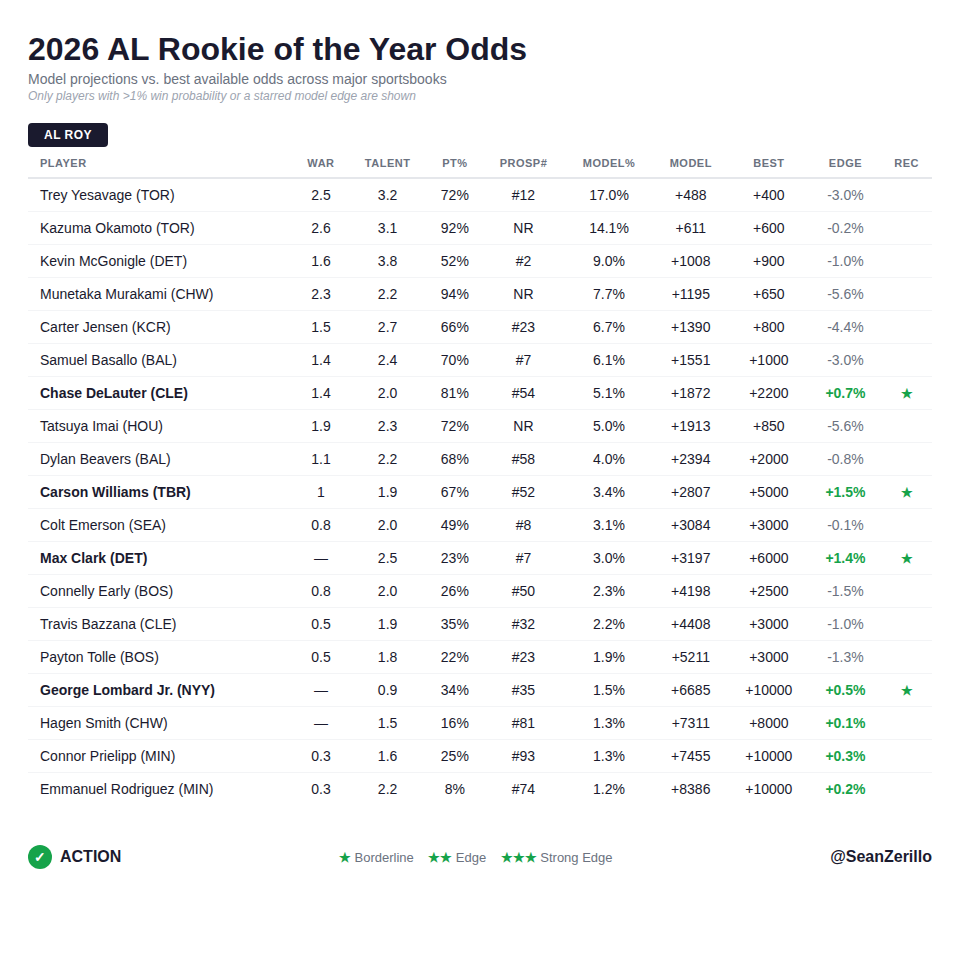
The AL field looks deep and talented, as Trey Yesavage, Kazuma Okamoto, Munetaka Murakami, and Tasuya Imai (as part of a six-man rotation) should all have full playing time from the jump.
Carter Jensen and Samuel Bassalo are excellent hitters who will split time at DH and catcher. Top prospect (for some people) Kevin McGongile and former top-ten picks Colt Emerson and Travis Bazzana should also hit the majors in relatively short order.
Neither show value as of now, but I'll wait to see if McGonigle's (or Emerson's) price floats up closer to the super-two deadline, before either hits the majors. I doubt either sees an MLB field until May.
I'd take the same approach with Max Clark, who will be up by September 1, but may not arrive until the second half for the Tigers.
I locked in a ticket on Carson Williams at a big number when he was still slated as the Rays' opening day shortstop. Williams has posted three consecutive 20-20 seasons in the minors, averaging 29.6 homers and 36.6 steals per 162 games played. He's a former first-round pick and dynamic talent, so it's hard to believe that the organization wouldn't give Williams every chance possible to displace Taylor Walls and his career .584 OPS and 70 wRC+.
Among the projected opening day regulars, Chase DeLauter caught my attention, slated to bat sixth and play center field for the Guardians. The No. 16 pick in the 2022 draft, DeLauter has struggled with injuries in his minor league career, but he's always had a solid hit tool with above-average power, and he could provide some much-needed pop to the Cleveland lineup.
Here are my projected leaders among NL rookies for the upcoming season, along with their listed odds in the betting market and my sim ranking, which analyzes the field using projection data. I also included a consensus industry prospect ranking compiled by my colleague, Collin Whitchurch:
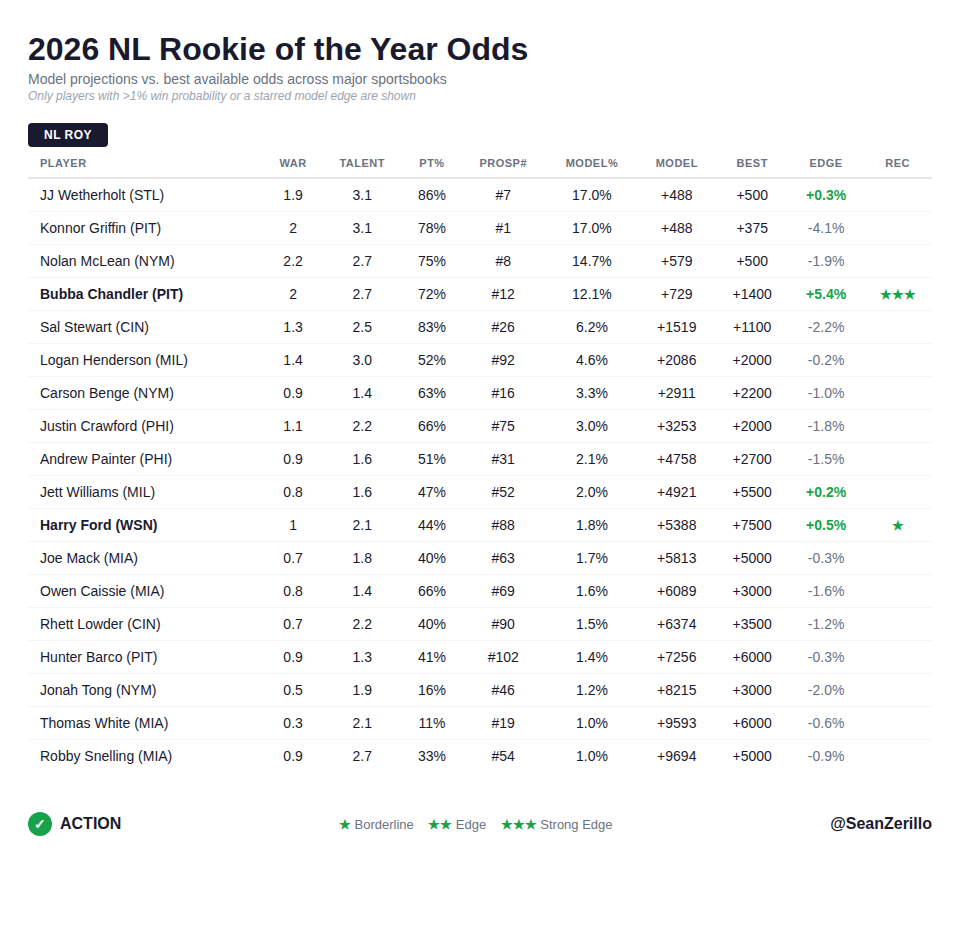
Konnor Griffin still seems likely to begin the year in the minors, which should give JJ Wetherholt a playing time advantage from the outset. I like the Cardinals' second-baseman as the NL favorite, but wouldn't take anything worse than +500.
Among the top arms, I project Nolan McClean and Bubba Chandler fairly similarly from an awards perspective, and prefer the value on the latter.
McClean only projects as better by about two-tenths to one-quarter of a run on an ERA, and two-tenths of a win in the WAR column, and if you equate their playing time expectations, the talent gap essentially vanishes. As a Mets fan, I'm confident that McClean is the better pitcher, but the Pirates also held Chandler back last season, which may have downgraded him in the public's eyes.
I'm not going to be as rigid with my model selection for the top Rookie as I would be in the other awards categories. If there's a prospect you are much higher on than the market, feel free to take a shot.
Two I will personally and proudly express my support for in the Rookie of the Year category are current top Mets' hitting prospect, Carson Benge, and our former top prospect, Jett Williams.
That said, both may get boxed out of opening-day playing time. Williams, who was the key piece in the Freddy Peralta trade, will need to surpass Joey Ortiz at shortstop in Milwaukee, while Benge is fighting off Mike Tauchman for the Mets' right-field job. Still, both offer a patient plate approach that should excel in the majors.
MLB Rookie of the Year Bets
- AL ROY: Chase DeLauter (+2500, 0.1u), DraftKings
- AL ROY: Carson Williams (+6600, 0.05u) Parx
- AL ROY: Kevin McGonigle (+600, 0.4u), HardRock
- NL ROY: Bubba Chandler (+1400, 0.1u), DraftKings
- NL ROY: Jett Williams (+5500, 0.05u), FanDuel
- NL ROY: Carson Benge (+2500, 0.1u), HardRock
- NL ROY: JJ Wetherholt (+600, 0.25u), ScoreBet

MLB Award Futures: Manager of the Year Analysis
I was excited to handicap Manager of the Year because it leverages the team projections I have already built into a new market.
I found the following factors correlate most strongly with vote share variance in Manager of the Year voting;
- Overperformance: Listed win total vs. final wins. While I doubt voters are looking at preseason win totals when casting their votes, they can probably accurately assess preseason expectations and team performance relative to those expectations. I'll use my preseason win total projection as a substitute for the final wins assumption. However, teams generally need to finish over .500 for a manager to garner consideration for this category.
- Total Wins and Win Rank: Raw win total projection. Voters still give credit to managers of good teams, even without overperformance. Moreover, voters evaluate where the team's win total ranks in their respective league.
- Division Win % and Playoff Win: Captures narrative momentum for Cinderellas.
Here are my projected top AL Manager of the Year candidates for the 2026 season, alongside their listed odds in the betting market and my sim ranking, which analyzes the field based on projection data:
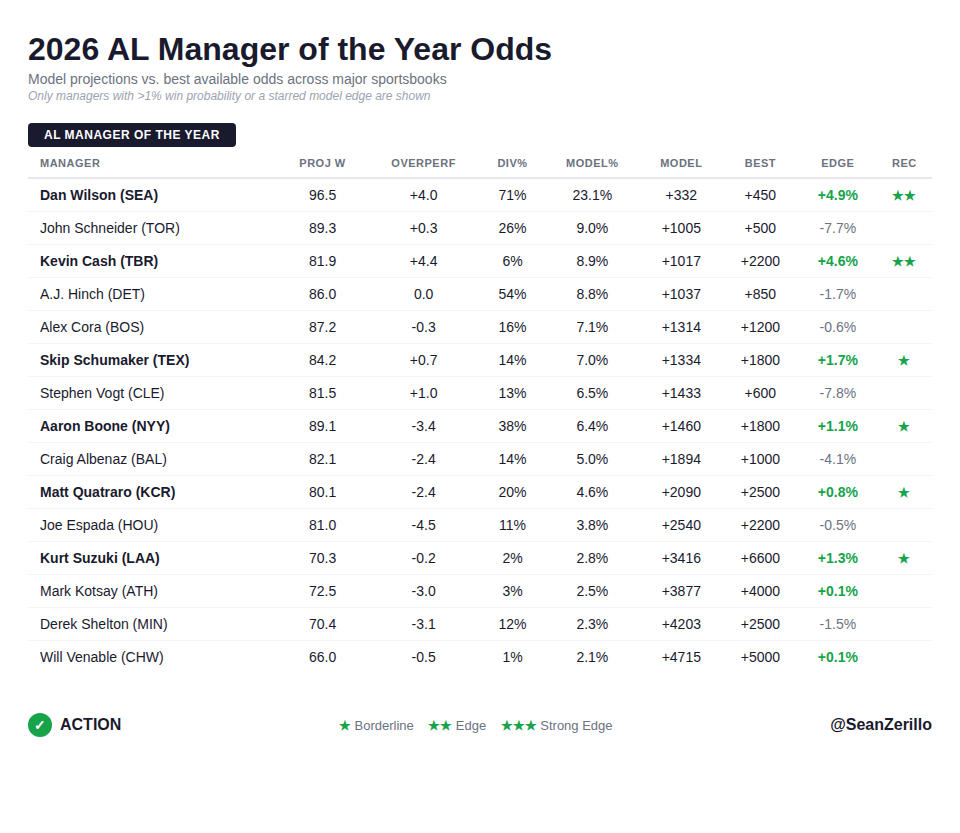
The top AL manager edges generally align with my team futures. I'm likely highest on Seattle and Tampa Bay relative to the market, and their managers are my two most significant edges.
Betting on Dan Wilson is essentially betting on the Mariners to secure the No. 1 seed in the AL, and you can get odds of +500 on that bet at other books. So long as the Mariners finish with the best record in the AL, I'd expect Wilson to get the nod in his second season.
Kevin Cash would almost certainly win the award if the Rays win the AL East (listed +3000), but he should have a strong chance of winning if the Rays make the wild card (listed +190) with all the AL East talent surrounding them.
Skip Schumaker probably gets to the winner's circle in his first year in Texas with an AL West title. That said, I'm not certain whether a wild-card appearance would be enough for a team with relatively high expectations.
Matt Quatraro finished second in 2024 (behind division champion Stephen Vogt) after a remarkable, 30-win improvement over the prior season. He's not winning without a division title of his own.
Here are my projected top NL Manager of the Year candidates for the 2026 season, alongside their listed odds in the betting market and my sim ranking, which analyzes the field based on projection data:
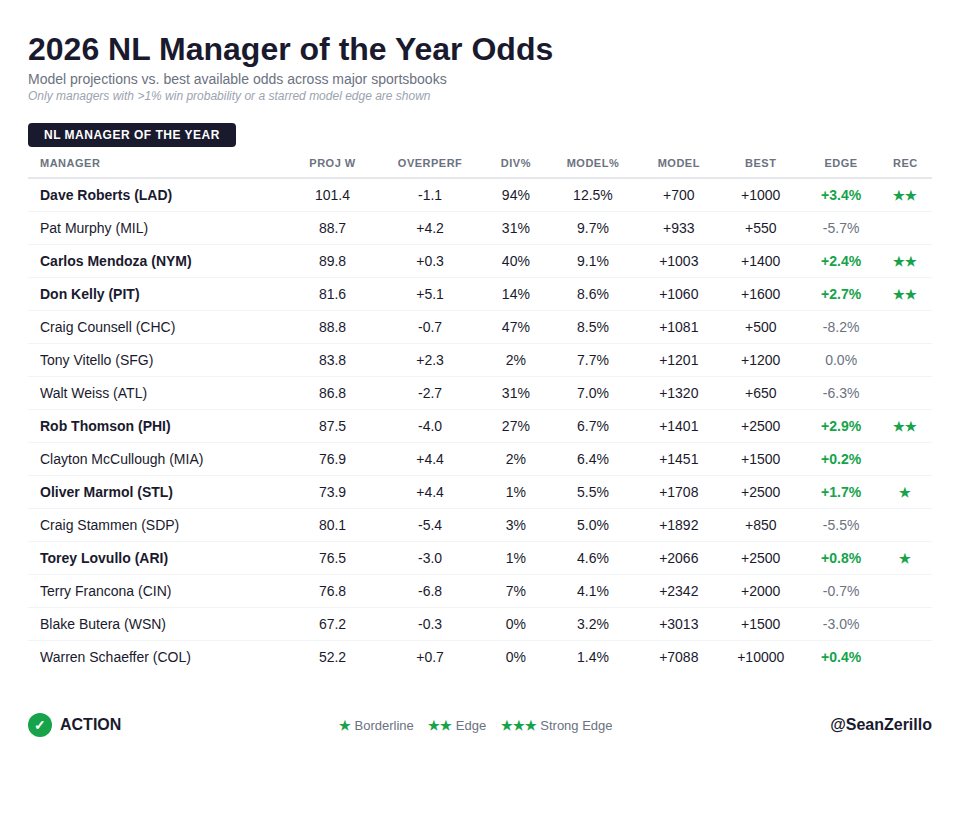
Dave Roberts was voted NL manager in 2016 in his first year at the helm, and he had earned at least a downballot vote every year until getting shutout in 2025 (finishing second in 2017 and 2022, sixth in 2018, fourth in 2019, fifth in 2020, 2021, and 2023, and seventh in 2024).
The Dodgers have not surpassed their preseason win total since 2022 (111 wins), when the Mets' Buck Showalter (eight first-place votes) finished ahead of Roberts (eight first-place votes) in an extremely close vote (Brian Snitker received seven first-place votes). In 2021, Roberts and the Dodgers won 106 games, but finished in second place behind the 107-win Giants.
Perhaps there is quietly a media backlash against Roberts and the Dodgers, and maybe voters will refuse to reward a manager whose team wins 100 games, even if all of the other contenders in the same league fail to clear 90.
If they don't reward him, perhaps he gets outvoted by a Mets manager for the second time in four years.
I favor New York to win the NL East, and clinching that division for just the third time this century could be enough for Carlos Mendoza.
The Pirates project as the biggest overachievers in the NL, however, and there's no way that Don Kelly's best manager odds should be higher than the Pirates' division price (listed +600), let alone near tripled. The Pirates have not won the NL Central since 1992 or appeared in a playoff game since 2015, and they are +325 to make the playoffs — that could be all Kelly needs to get the nod.
Rob Thomson is a solid value bet if you like the Phillies, after finishing third in 2025. Still, I'm not going to place that bet when it directly contradicts my Phillies' win total under bet.
MLB Manager of the Year Bets
- AL MOY: Dan Wilson (+450, 0.15u), bet365
- AL MOY: Kevin Cash (+2200, 0.1u), bet365
- NL MOY: Dave Roberts (+1000, 0.1u), bet365
- NL MOY: Carlos Mendoza (+1400, 0.1u), bet365
- NL MOY: Don Kelly (+1600, 0.1u), bet365

Zerillo's 2026 MLB Award Futures Bets
Cy Young Award
- AL Cy Young: Tarik Skubal (+400, 0.4u), Parx
- AL Cy Young: Bryan Woo (+2500, 0.05u), Fanatics
- AL Cy Young: Dylan Cease (+4000, 0.05u), Parx
- AL Cy Young: George Kirby (+4000, 0.05u), DraftKings
- NL Cy Young: Cristopher Sánchez (+1200, 0.1u), Fanatics
- NL Cy Young: Logan Webb (+2000, 0.1u), FanDuel
- NL Cy Young: Jesus Luzardo (+4000, 0.1u), HardRock
Manager of the Year
- AL MOY: Dan Wilson (+450, 0.15u), bet365
- AL MOY: Kevin Cash (+2200, 0.1u), bet365
- NL MOY: Dave Roberts (+1000, 0.1u), bet365
- NL MOY: Carlos Mendoza (+1400, 0.1u), bet365
- NL MOY: Don Kelly (+1600, 0.1u), bet365
Most Valuable Player
- AL MVP: Julio Rodríguez (+1500, 0.1u), Fanatics
- AL MVP: Gunnar Henderson (+2250, 0.1u), ScoreBet
- AL MVP: Yordan Álvarez (+3500, 0.05u), Fanatics
- NL MVP: Juan Soto (+800, 0.2u), HardRock
- NL MVP: Bryce Harper (+5000, 0.05u), Parx
Rookie of the Year
- AL ROY: Chase DeLauter (+2500, 0.1u), DraftKings
- AL ROY: Carson Williams (+6600, 0.05u) Parx
- AL ROY: Kevin McGonigle (+600, 0.4u), HardRock
- NL ROY: Bubba Chandler (+1400, 0.1u), DraftKings
- NL ROY: Jett Williams (+5500, 0.05u), FanDuel
- NL ROY: Carson Benge (+2500, 0.1u), HardRock
- NL ROY: JJ Wetherholt (+600, 0.25u), ScoreBet
Additionally, users can wager on these markets via prediction markets, which are available in all 50 U.S. states. While Kalshi has been the driving prediction market app in the U.S., Polymarket is making a splash thanks to its recent multi-year partnership with MLB. Of course, be sure to compare Kalshi vs. Polymarket markets before making your picks.


