


Calcutta auctions are still quite niche, but if you get invited to one for the NCAA Tournament, you might end up getting roped in even if you're not a college basketball expert. They're dynamic and evolve quickly, and present a game theory challenge like few other pools, brackets or contests can. And you probably one get a chance to do one per year.
So I always like to join them, even if it feels like a lot to handle if you're not dialed into college hoops, like me. So I've done a few things for those scrambling to prep for Tuesday and Wednesday night auctions:
- Built a spreadsheet to help you track auction values in real-time and show fair team values and edges based on what teams have sold for so far. If you want to run your own pool, we have another spreadsheet here.
- Used Sean Koerner's bracket projections to map out the true odds for each team to reach each round, who is much more qualified than I to do that exercise.
- Given some general tips on Calcutta auctions below.
- I have not given you specific teams to buy, because I'm the furthest thing from a college basketball expert. Please refer to our Big Bets on Campus bracket reaction podcast for that.
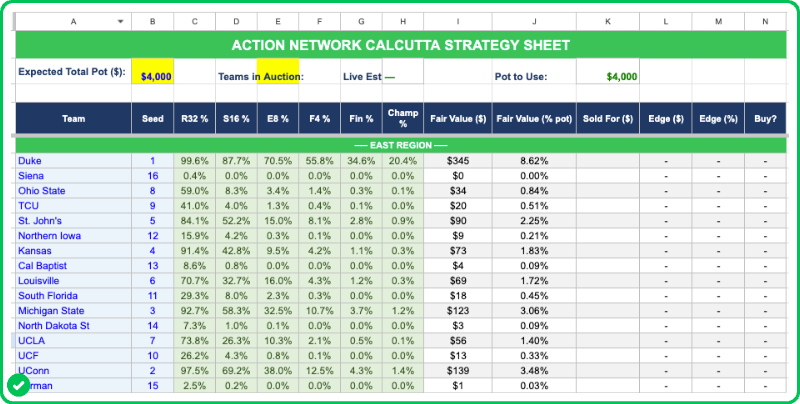
The Spreadsheet
A few things on the spreadsheet template before we get to the tips. I realize everyone's auction is a little different, and has some different rules, but I couldn't account for all that in this template. So if your auction does have different rules, it may not be best to follow my fair values and edges as gospel.
I've also kept every team separate, so if you want to "bundle" them as No. 13-16 seeds or anything like that, you'll have to manually add those teams together by percentage to reach each round.
Here's how to use the sheet:
- Enter what you think your total pot will be in cell B2.
- Enter each team and what it sold for in the Auction Log tab when the auction begins.
- As teams are populated in Auction Log, it will show what the "fair value" should be based on the expected pot size, and what that team sold for. So if you want to see what fair value for the next team up should be, just add it to Auction Log as the next team.
- After 10 teams, the sheet will use the auto-calculation for pot size exclusively and abandon your pre-entered pot size. So you may see some big changes in fair value and edges at that point if your pot estimation was off from how the auction is actually shaping up.
- You can change the percentages of payouts for each round in column Q of the Strategy tab to match your pool, but I couldn't account for any bonuses (like some pools paying out for lowest-scoring team, which ups the value of the bad teams just a bit).
- All the play-in teams are combined as one team. So if you're buying N.C. State, you're also buying Texas. That's how most auctions do it, but if yours doesn't, those teams will be overvalued.
Calcutta Strategy Tips
1. The Two Ways to Make Money
There are basically two ways to make big profit in these auctions, given how the NCAA Tournament typically plays out:
- A No. 1 or No. 2 seed winning the national title
- A No. 8 seed or higher reaching the Sweet 16 or Elite Eight (where they typically exit)
That's sort of it. I have historical data below to support it.
No. 4 and 5 seeds in particular have been bad buys, because they rarely make the Final Four. They are priced in a tier that requires 2+ wins to break even, and a third win to be profitable, which just isn't happening that often.
2. Snag the Early Teams
It will feel wrong, and it will feel uncomfortable, but I promise you'll want to get a few teams early because they'll end up being the best bargains on the board.
The prices tend to anchor to the first comparative teams off the board. And as other players update their spreadsheets to determine what the fair value of the pot is, the prices will start to fall in line with "expected value" a bit more. I also think people tend to "anchor" their prices to other comparable teams, and don't want to let others get a deal. So if Arizona goes for $1,000, you don't want to let Duke go for anything less than maybe $1,100, and probably more, so naturally people will bid Duke up beyond Arizona. We have Duke just north of 20% to win the national title and Arizona at around 17%.
In the Action Network staff Calcutta on Monday, the best values on the board came within the first 10 teams auctioned off.
Early teams being good values will be especially true if teams are auctioned off in seed order, or by region, since the prices get anchored to the early bids even further.
2. No. 1 Seeds Have Been the Best Buys
There's no universal Calcutta auction price database, so I'm just using a few years worth of data from our Action Network staff pool and applying it to every NCAA Tournament since 1985, to see if any seeds in particular have under- or over-performed based on what we've seen them go for in our auctions.
What I found is that No. 1 seeds have been among the best investments, second in ROI only to No. 7 seeds, with No. 8 seeds coming in third.
No. 11 seeds have been historically bad, but strong since the advent of the First Four, which has produced a few cinderella runs with five Sweet 16 teams since 2011 (two of which made the Final Four, VCU in 2011 and UCLA in 2021).
I think people get psychologically thrown off by the "No. 1 seed wall" when buying the No. 8 seeds, thinking they can only win one game and then will get bounced. But when they do advance beyond the first weekend and topple the No. 1 seed, they've provided huge returns.
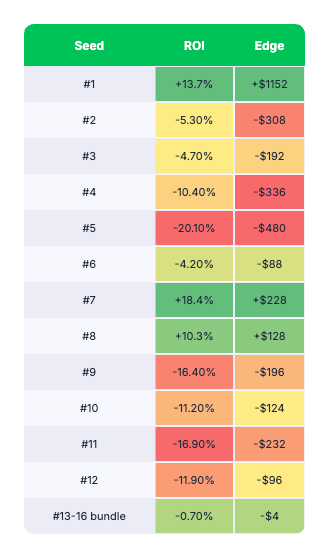
If you're wondering why so many seeds are negative ROI it's because most of the dollar value flows through the No. 1 seeds — so it's less "10 bad seeds and 3 good ones" and more "one really underpriced asset that the rest of the field subsidizes a little bit each."
3. No. 4-5 Seeds Are the Worst Buys
I feel like my default Calcutta mindset is that No. 7-16 seeds I'm hoping will win just one game, and 1-5 seeds I'm buying with the intention of them winning the whole tournament. But that's not really how you've gotten paid.
The No. 4 and 5 seeds are much closer to the 7-10 seeds in expected wins than the No. 1 and 2 seeds, but they're priced more like top teams. The 4-5 seeds are often going for 2.5x what a 7-10 seed goes for, but just aren't that different in expected wins from the lower teams.
Just based on historical data, a No. 5 seed only wins 1.14 games on average — a No. 8 seed is at .71. But again, the price difference between those two is going to be huge, probably 2x.
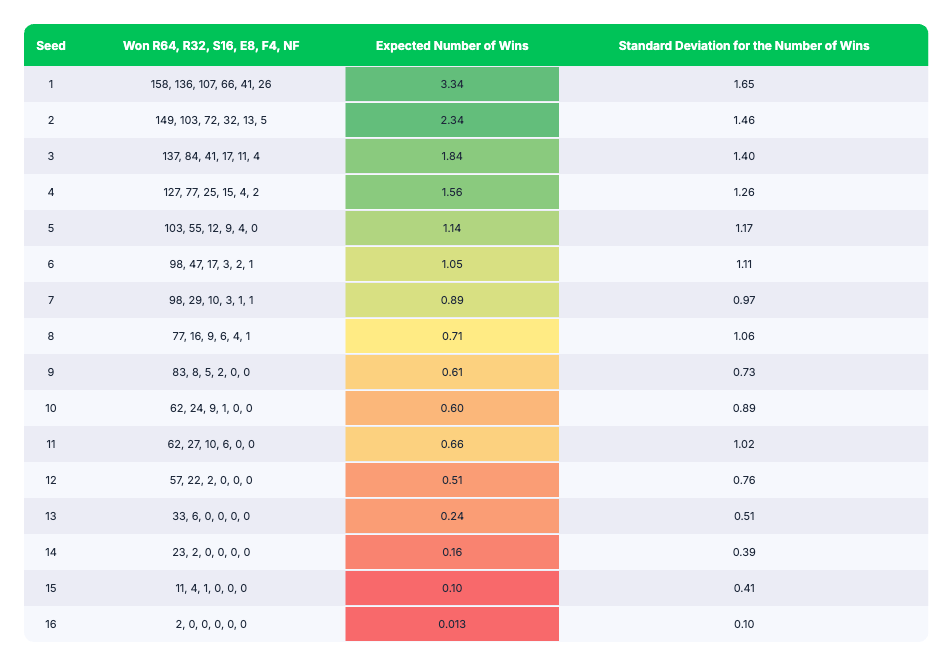
There are of course some outlier years, like UConn winning the national title as the No. 4 seed in 2023, but the chalk holds more often than you think in the NCAA Tournament. If you're going to spend, spend up on a No. 1 seed.
And if you want to play the longshot game, pepper 7-11 seeds, because you'll need to hit the right one.
4. Guessing the Value of the Pot Upfront
You can't judge what a fair value of a team is if you don't know what the total pot will be (which is sort of the whole point). But you have to do your best to determine this number:
I think about a few things:
- What was last year's pot
- If it's your first year, you've probably gambled with these people before. What is your typical fantasy football buy-in? What are they betting on sports?
- Has anyone's financial situation dramatically changed in the last year
- Has the commissioner put any price controls or pool changes in place to either raise or lower pricing.
Again, it's a real tricky puzzle. It's why these auctions are so fun.
5. Beware of "Regional Cornering"
I'm sorry I don't have a better name for this. But you probably don't want to spend too much on teams that are too close to each other in their brackets.
Per my expected value sheet, Duke is worth about 8.6% of the total pot. So in a $10,000 pot, that's $862. But if you're also buying Ohio State or TCU, the No. 8 and 9 seeds in Duke's region, you're killing your expected value because both can't advance from the first weekend.
This is a slight over-simplification, but you have to be aware of where you're buying teams in the bracket and how that's affecting your possible return. It's not like a golf auction where everyone you buy could finish 1-5 if things broke exactly right. Someone has to get knocked out during every game.
I do think there's something to fading a specific top seed if that's a direction you want to go, but these team-specific examples are outside my scope.
If you're fully out on Florida for example, you can buy one of Iowa-Clemson (which would be their second round opponent), then go big on Houston as the No. 2 seed in that region.


