


Welcome back to the 2026 edition of my bracket breakdown!
Before we dive into this year, let’s quickly recap last season. It certainly felt like one of my worst brackets for the first couple of rounds. Sure enough, and a reminder, as always, I ended up having the correct champ in Florida, and my bracket finished in the 78th percentile.
Not quite good enough to take down most pools, but if a few more early games had broken my way, it could have been my third top-95th percentile bracket over the last six years.
It’s also a reminder that it’s not possible to post a top-95th percentile bracket every year, but I’ll gladly take a 33% hit rate over the last three tournaments.
It’s also important not to view March Madness brackets like some kind of get-rich-quick scheme. These are mainly supposed to be fun. Sure, we’re trying to get every game right, but that doesn’t mean we need to be perfect.
And that brings me to my overall approach if you’re new to this guide.
When filling out a bracket, there are really two different approaches.
One approach is simply taking the team that has the best chance to win each matchup. There’s nothing wrong with that. In fact, it maximizes your chances of getting as many games correct as possible, which obviously matters.
At the end of the day, you don’t get points for “having the right idea” or the “right process.” You only get points if the team you pick actually wins. So, yes, I absolutely want to be taking the team I project to win more often than not.
So, why isn’t that approach optimal if your goal is to win a bracket pool?
Because most people do the exact same thing.
The public generally has a solid sense of which teams are better, and the seeding makes it easy even for someone who barely follows college basketball to make reasonable picks.
On top of that, we all know part of the charm of March Madness is that things rarely go exactly according to plan. Upsets happen, and plenty of them.
Some people try to exploit that by loading up on upsets. The thinking is that if they hit on a few of them, they gain a massive edge in their pool. While that can work, I think people often overestimate how impactful those picks really are.
Sure, correctly picking a 14-seed over a 3-seed feels amazing, especially if only 10% of the pool had it. But that first-round upset only gives you one extra point on Yahoo! and 10 points on ESPN.
Now compare that to correctly picking the national champion, which is worth 32 points on Yahoo! and 320 points on ESPN.
Getting the champ right covers up a lot of mistakes elsewhere in your bracket.
In reality, if you want to win most bracket pools, you usually need to get the champion correct. The rest of your bracket is really about differentiating yourself from the people who also picked that same champion.
One of the best ways I’ve found to build a bracket is by blending both approaches.
You still need to pick teams that are likely to win. I include my expected win percentage for every matchup along with each team’s probability of advancing through every round. Those projections drive most of my decisions.
However, there are certain spots where I’ll go against my own win probability. When I do that, it’s not random. I’m comparing my projections to the pick percentage of all Yahoo! users.
Now, Yahoo! pick percentages won’t perfectly match your own bracket pool. It’s simply a way to get a sense of how the public is leaning. You still need to adjust mentally for your specific pool.
If I’m in a pool with a lot of sharp bettors who understand markets and bracket strategy, my normal approach might actually be too chalky.
Pool size matters, too. The smaller the pool, the more likely I am to simply pick the team I think is most likely to win. In massive pools, I’m more willing to take calculated risks.
You should also account for local bias. If you’re in a pool where 70% of the participants live in Florida and are Florida fans, the percentage of brackets picking Florida to win it all is probably far higher than the numbers I’m using. That’s something you should adjust for.
For each matchup and round, I also show what I call a Leverage Score.
The leverage score is simply the probability I have for a team advancing to the next round minus the Yahoo! pick percentage for that outcome.
For example, let’s say I have Kentucky with a 59% chance to beat Santa Clara in the first round. If 69% of Yahoo! brackets pick Kentucky and 32% pick Santa Clara, that means Santa Clara’s leverage score would be:
- 41% − 32% = +9%
That means I’m showing Santa Clara with a 9% higher chance of advancing than the percentage of brackets picking them.
Those are the spots I’m typically looking to attack.
That doesn’t mean I always pick the team with the higher leverage score. If I only have a team advancing 8% of the time, but the public has them at 3%, that still means the outcome is extremely unlikely.
The goal is to blend likely outcomes with smart leverage spots.
And it goes without saying that none of this guarantees anything.
If I pick a team with a 42% chance to win but only 30% of brackets have them advancing, that means I’m still losing that point 58% of the time. If the favorite wins, I’m not going to sit there shocked that my pick lost.
But it’s a process play I’ll make almost every time because, in the long run, I expect picks like that to be +EV.
Again, we’re not trying to be perfect here. No one’s bracket will be perfect.
The goal is simply to put your bracket in the best position to win. Over the last six seasons, two of my main brackets have finished in the 95th percentile, and overall, they’ve generated +EV relative to buy-ins.
That’s the goal.
Well, that and enjoying the chaos of March Madness.
Now, let’s dive into each region.
I’m going to do it a bit differently this year. Instead of walking through every hypothetical matchup, I’ll discuss each team below my initial bracket for each region. I think it will make it easier to give my high-level thoughts on how I view and handle each team, along with the strategy behind it and the various paths I might pivot to for my final bracket.
A reminder that this is essentially me walking through my initial bracket on Monday morning. As I go through this process, I may stumble onto other ways to set things up and end up changing a few picks along the way. My final bracket will be updated here Thursday morning.
Also, keep in mind that filling out a bracket isn’t the only way I’m investing in the tournament. Over the next few days, and throughout March Madness, I’ll be betting sides, totals and props as well.
The prop tool is currently live with PRO Projections, powered by Nick Giffen and myself. We’ll also have our prop show this Wednesday, so be sure to tune in.
For those curious, my lifetime college basketball betting record in the Action App is 290-232-3 for +30.67u with a +5.3% ROI. If you want alerts whenever I post a bet, be sure to follow me in the app. When I post props, the odds tend to move fast.
With that said, let’s dive into the bracket.
Download Sean's bracket creator to create your own bracket, see the expected spreads/win%/leverage score for each potential matchup, leverage charts and team ratings.
2026 NCAA Tournament Bracket Picks
East Region
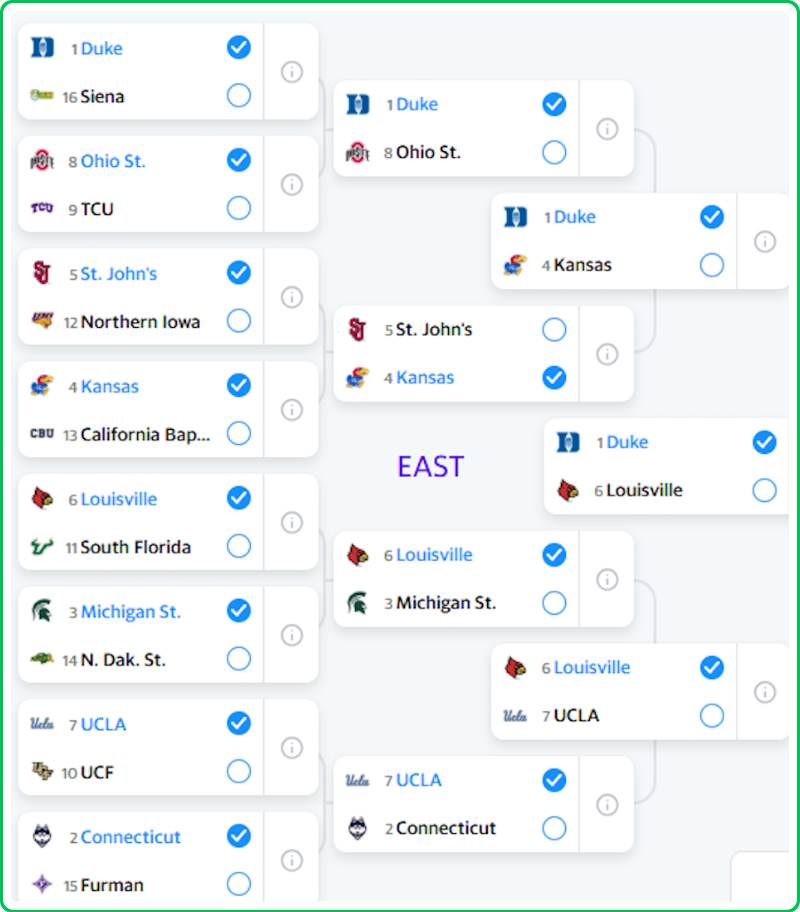
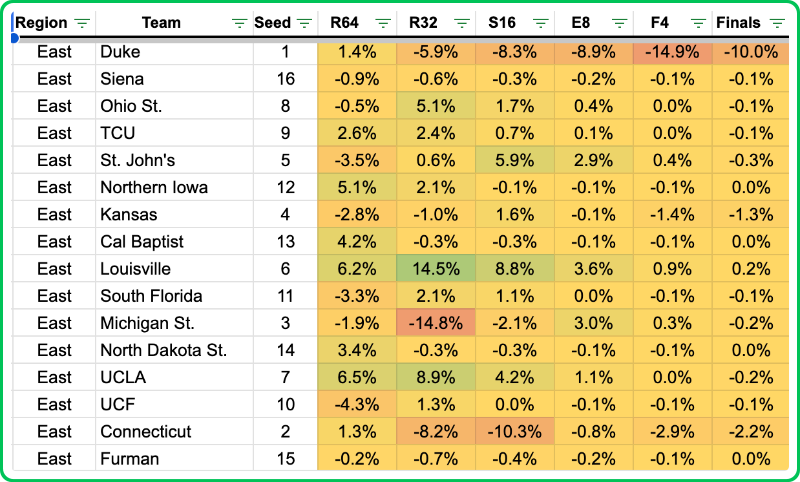
Above is my initial bracket for this region. Below is the leverage chart, I'll be referencing that you can use to set up your own as well. Beyond that, I'll discuss each team more in depth and how I'm approaching them in their region.

1. Duke Blue Devils
Duke enters the bracket as the clear favorite to win it all, currently sitting at 21% on Kalshi.
I’m very close to that number myself. The Blue Devils are the top-rated team in my power ratings, and I have them with a 20.8% chance to win it all. However, the public is backing them heavily, with 30% of brackets having them cut down the nets.
At the end of the day, getting the champion right is all that matters.
Even if you think a team is a bit chalky to win it all, you can absolutely still take them to win it all. You just need to make sure to be a bit more aggressive with the rest of your bracket if you pick Duke.
My initial bracket has them making the finals and losing. That feels like the happy medium where I’m not following the chalk with them winning it all, but I’m still giving them a deep run because I do think they are the team to beat. Having them get upset early would probably be way too aggressive.
Duke is dealing with a few injury situations.
Patrick Ngongba might be able to return for the opening round, while Caleb Foster’s only chance of returning would be late in the tournament if Duke makes a deep run, as he’s recovering from a foot injury.
So, Duke may not be at full strength early on but could be at full strength by the Final Four.
That gives it an extremely high ceiling. It should have no issue making a deep run, but its draw in the East didn’t do it many favors early. The East has the strongest 8-seed in Ohio State and arguably the strongest 5-seed in St. John’s, which means Duke could get tested earlier than some of the other 1-seeds.
However, the 2-4 seeds in this region are weaker compared to other regions, which gives Duke a bit of an advantage later on when it matters most.
So, my Duke strategy is to send it to the national championship and have it lose there. I’m eating a lot of negative leverage based on my chart, but I think it’s warranted here, and I’ll be more aggressive in other regions.

2. UConn Huskies
Dan Hurley’s team is arguably the weakest 2-seed in the tournament. While they should have no issue getting past Furman, I do have them getting upset in the Round of 32 against UCLA.
Users are taking them 77% to advance to the Sweet 16, but if they face UCLA here, I’d expect the spread to be around UConn -5. That implies roughly a 66% win probability for UConn, which is close to my projection.
However, UCLA has been trending up recently, and I like how it matches up here. The Bruins do an excellent job of protecting the ball, while UConn’s biggest weakness is sending opponents to the free-throw line at a high rate.
UCLA also happens to be an excellent free-throw shooting team.
I think UCLA could sneak past UConn here, and the public may be slightly overrating UConn in this spot.


