

And then there were four.
We're officially down to Arizona, Michigan, UConn and Illinois in the 2026 NCAA Tournament, and those four will take the court in Indianapolis on Saturday at the site of the Final Four.
Below, you'll find my favorite Final Four predictions, including some key thoughts and a full betting card.
Illinois vs. UConn


In my bracket, I picked Arizona to cut down the nets before the tournament, and I'm sticking with that prediction.
I also picked the Illini to make the championship game, but to come up short in a rematch of one of the best NCAA Tournament games of all-time (when Illinois made a miraculous comeback to beat the Wildcats in overtime by one in the 2005 Elite 8).
I'm also sticking with that prediction.
(My other two Final Four picks aren't important at this time.)
These two teams met earlier this season in Madison Square Garden, which resulted in a relatively easy UConn win.
However, I don't really take anything away from that November meeting. Mihailo Petrovic played more minutes than Keaton Wagler, and Jaylin Stewart logged 24 minutes in a start for UConn (with Braylon Mullins having only 10 off the bench).
Both teams are astronomically different than what they were at that time.
Illinois has turned into an offensive juggernaut thanks to the emergence of Wagler and a host of players that fit perfectly around the freshman guard on the offensive end. Meanwhile, UConn still runs some of the best offensive sets in the country.
The Illini defense certainly isn't elite, but they can limit looks at the rim (first percentile frequency) and they foul at the lowest rate in the country by a decent margin. With that in mind, I don't expect many free points for the Huskies.
Fortunately for UConn, which has had turnover issues this season, Illinois' passive defense ranks last in the country in that department.
Additionally, Illinois has struggled to defend off ball screens in the half-court (20th-percentile efficiency with a 92nd-percentile frequency), which should be music to the ears of the UConn offense, which owns a 99th percentile off-screen rate, per Synergy.
However, I'd imagine we see some zone looks from the Illini to disrupt some of the elite actions the Huskies run on that end of the floor.
Tarris Reed Jr., who's playing at an incredibly high level at the moment, will likely get his (assuming he can stay out of foul trouble), but the rest of the supporting case can be very inconsistent on a game-to-game basis.
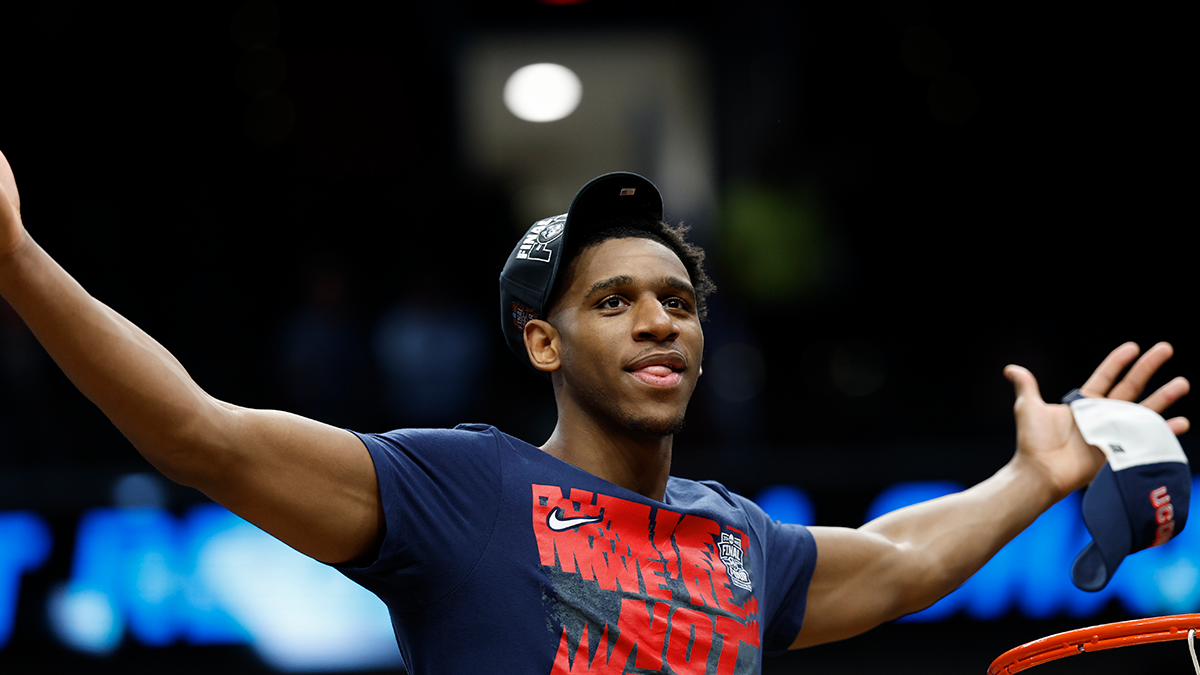
Maybe Mullins carries over some momentum from that game-winning shot against Duke, but he had been struggling for weeks leading up to that heave, making just 10 of his last 58 (17.2%) before that memorable bucket.
The same goes for Solo Ball, who's had issues from the outside this season, especially of late.
If those two can both find their groove from the perimeter, that would really boost UConn's chances, but that's tough to rely on based on what we've seen for quite some time.
And in order to advance to the title game, I think UConn will likely need to connect on a decent amount of its 3-point looks. In their eight losses this season, the Illini gave up an average of just under 11 triples per game, with only Michigan and Michigan State failing to reach double-digit makes.
And I'm not sure I trust the UConn shooters enough at the moment to shoot well enough to keep up with an electric Illinois offense that has so many different ways to score.
Wagler may find it tough to score at a high clip in this particular matchup, but the downhill driving ability of David Mirkovic and Andrej Stojakovic should come in handy (I'd look at both players over points in the prop market).
In addition, the bigs who can step out and shoot from the perimeter are a matchup problem.
Illinois also never turns the ball over (10th) and can dominate a game on the offensive glass (third nationally), especially against a UConn defense that can be a bit susceptible to second-chance opportunities. I do expect the Illini to win the all-important shot volume battle.
I anticipate the Illini grabbing enough offensive boards to scramble the UConn defense, which should lead to some open looks from the outside.
Additionally, UConn's defense excels in limiting transition chances, but this is an Illini offense that doesn't really look to run (second-percentile transition frequency) and is more than happy to operate in the half-court. where they're elite in every aspect.
The Huskies have also totaled an impressive 29 steals through four tournament games, but that will be difficult to replicate against the Illini, who have navigated disruptive defenses extremely well so far in the dance.
On paper, Illinois has the clearly superior team. Keep in mind it's only lost once since Dec. 1 in a game that wasn't decided on a buzzer beater (Nebraska) or overtime (four OT losses to tourney teams). And guess what? That loss came against Michigan.
Meanwhile, UConn came into the tourney having lost four of its last 11 games, which included a pair of bad defeats to non-tourney teams in Marquette and Creighton (at home).
And while Illinois has cruised to four double-digit victories to get to the Final Four, the Huskies struggled a bit in their first-round matchup with Furman. Then they benefited from a shorthanded UCLA squad before almost blowing a 20-point lead to Michigan State.
Finally, they needed a miraculous comeback from 19 down to take out Duke, so it's been far from smooth sailing for them.
I personally make the Illini slightly less than a four-point favorite, which is pretty in line with other projections:
- KenPom: Illinois 74, UConn 70
- Haslametrics: Illinois 73, UConn 68
- Bart Torvik: Illinois 72, UConn 69
The question you have to ask yourself is how much the Dan Hurley tourney tax is actually worth. The guy is just an absolute demon in March, as evidenced by an insane 14-0 ATS mark in the second round or later.
While admittedly a bit fearful of the Hurley wizardry, I do show enough value to back the Illini here, and I'll hunt a cheap moneyline price throughout the week.
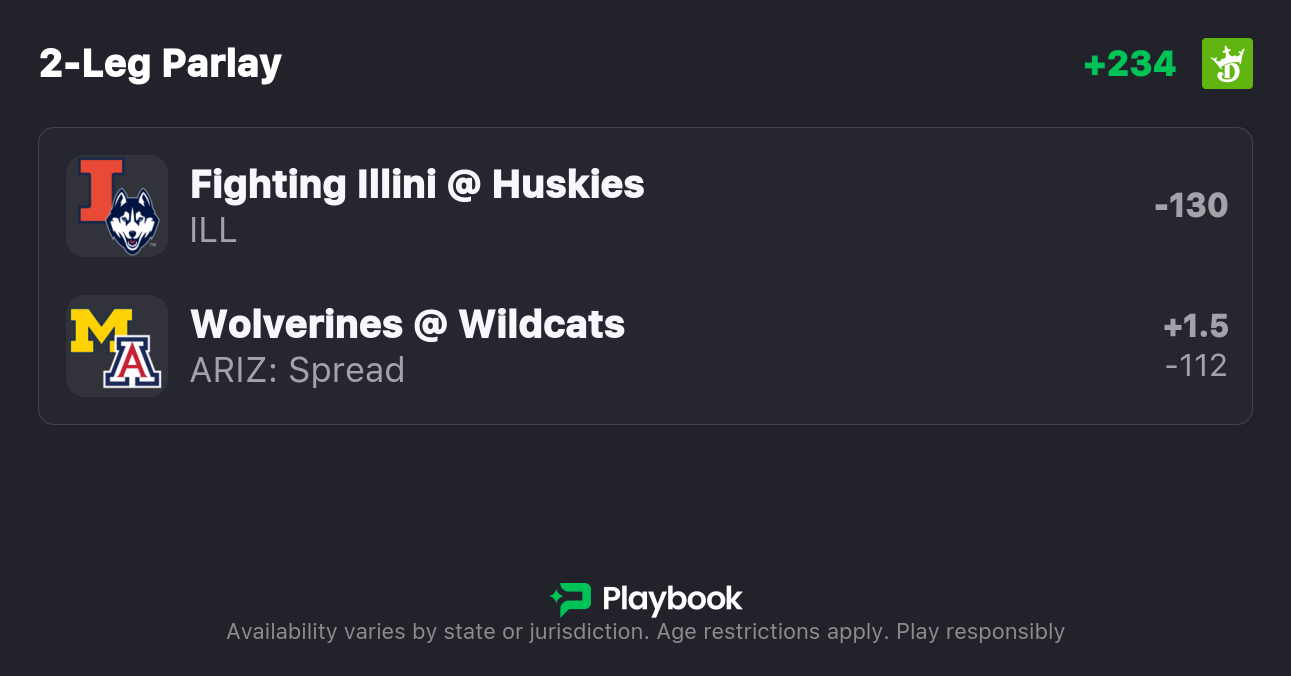
Pick: Illinois ML -130
Michigan vs. Arizona


What a matchup we have to end the night in Indy on Saturday. I don't think many would disagree that these are the two best teams in the country, with the winner being a likely two-possession favorite in the national title.
I could wax poetic about each roster, but you'll probably get tired of hearing about both by tip.
Therefore, I wanted to focus most of this writeup on how these teams match up on the court.
Before I dive into the Xs and Os, I did bet Arizona +1.5.
For starters, I actually make the Wildcats very small favorites. I can easily see why some would favor the Wolverines (Haslametrics projects Michigan by 2.15 points, for example) due to some of their insanely lopsided victories over quality competition. However, my numbers disagree.
Additionally, I think the Wildcats have a few potential matchup advantages on both ends of the court.
With that said, Michigan certainly has a higher ceiling due to its higher rate of 3-point attempts, especially compared to Arizona, which ranks 363rd in the country in that department — ahead of only Tarleton State and Texas State.
If the Wolverines continue to shoot 45% from beyond the arc in this tournament, it'll be difficult for anyone to keep pace.
However, that will be much more difficult against an Arizona defense that can match Michigan's elite size in the post without sending much help (one of the few that can do so).
The Wolverines are a very good 3-point shooting team, but I don't consider them to be super elite. They're just able to generate so many open looks since most opponents simply can't deal with their size. That will likely not be the case against Arizona.
Per Synergy, Michigan ranks in the 96th percentile in catch-and-shoot jumper frequency (about 36% of its total field goal attempts) with a terrific 93rd-percentile efficiency.
As you might imagine, it ranks in the 90th percentile in generating uncontested looks on those jumpers, where it scores at a ridiculously elite 1.34 points per possession (99th percentile). However, when those looks are guarded, that drops to 0.93 points per possession (38th percentile).
Well, Arizona's well-oiled drop coverage ranks ninth nationally in limiting catch-and-shoot opportunities (second-percentile frequency with a 94th-percentile efficiency, including a 99th-percentile efficiency when guarded).
I'm banking on potential Michigan looming 3-point regression, in large part due to the matchup.
I think 40% is the magic number for Michigan. It's almost unbeatable when it reaches that mark from beyond the arc.
For what it's worth, in Michigan's three losses this season, it shot a combined 21-of-74 from distance (28.4%), failing to get to 33% in each.
Arizona only allowed five opponents all season to clear 40% from deep. Those all still resulted in victories, but the Wolverines are in a different class than even the top of the Big 12.
For reference, per Bart Torvik, the Wolverines shot 40.7% from 3 in 10 games against top-20 competition (8-2 record), while Arizona held top-20 foes to just 32.5% (9-1 record).
Sometimes that's all these games come down to, but I trust the Arizona perimeter defense in this particular matchup, which leads me to my next potential matchup edge.
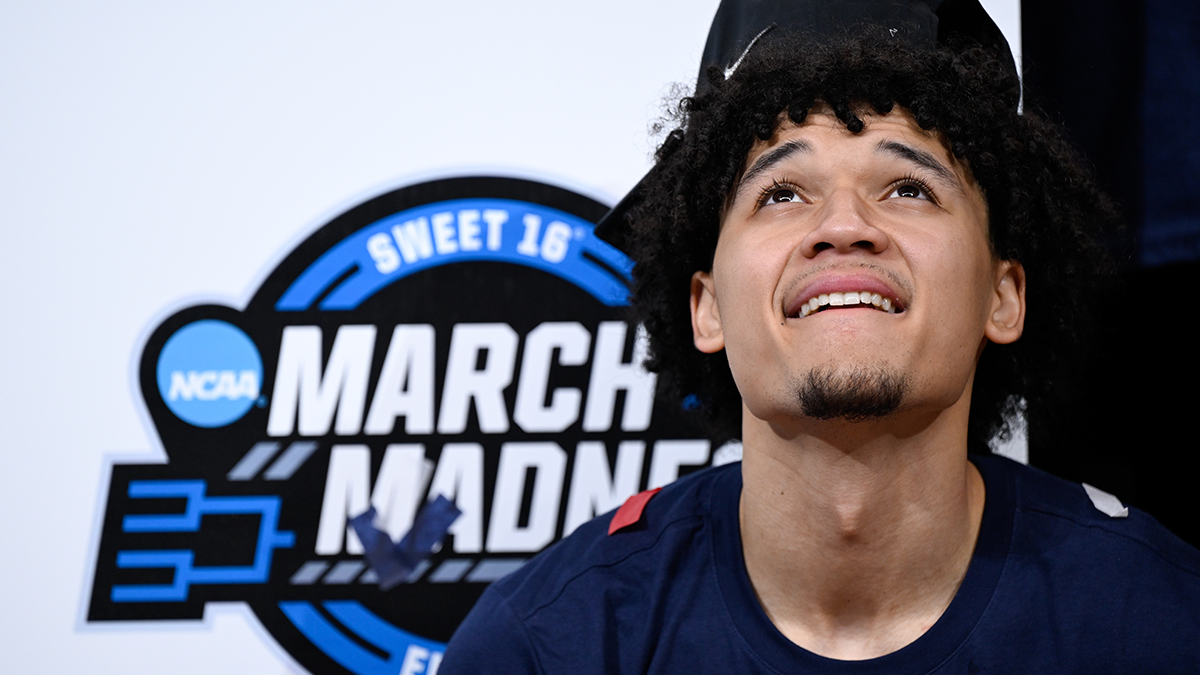
If Michigan is indeed a bit colder from the outside, that should lead to some easy Arizona buckets in transition off long rebounds.
Now, these are two elite transition offenses (and defenses). Just take a look at the season-long metrics:
Arizona:
- Offense: 79th-percentile frequency; 94th-percentile efficiency
- Defense: 30th-percentile frequency; 99th-percentile efficiency
Michigan:
- Offense: 88th-percentile frequency; 69th-percentile efficiency
- Defense: 19th-percentile frequency; 93rd-percentile efficiency
However, my hypothesis is the Michigan transition defense is a tad overrated, especially in terms of limiting those opportunities.
Why, you might ask? Well, its schedule has included a very high percentage of teams that simply don't get out in transition (partly due to the nature of most teams in the Big Ten), while the opposite is true for Arizona.
On the season, Michigan's opponents have a median transition frequency percentile ranking of 37th compared to 66th for Arizona, which has completely neutered three transition-heavy offenses in this tournament already.
Plus, we did see Michigan State (the one transition-reliant Big Ten team) cook Michigan in that area twice during the regular season. The Spartans scored 1.389 and 1.133 points per possession in 25 and 17 transition possessions, respectively.
For reference, from a defensive perspective, those outputs would rank 320th and last in the country.
In conclusion, in a battle of two offenses that can carve up opposing defenses in the open court, I trust the Arizona transition defense a tad more based on the total body of work.
Plus, as I mentioned previously, the Wildcats have one of the lowest 3-point rates in the entire country, which naturally translates into fewer transition opportunities the other way off long misses.
As a result, Arizona might be able to get a few more easy buckets in the open court, which could make all the difference in what should be a very competitive game throughout.
With that said, I don't think this game will be played in a completely wide open manner from start to finish. It would behoove the Wildcats to slow things down in general, similar to what Duke did to Michigan in D.C.
As a result, this will likely boil down to which offense can better execute in the half-court. Assuming Michigan isn't pouring in 3s again, I actually give a slight edge to Arizona in that battle.
The Wildcats' offense features a heavy dose of pick-and-roll (82nd-percentile frequency, 85th-percentile efficiency) and a high rate of working through the post (92nd-percentile frequency, 91st-percentile efficiency).
Can that formula work against Michigan? Well, the Wolverines have struggled some against pick-and-roll ball handlers (85th-percentile frequency; 35th-percentile efficiency) and their pure post-up defense doesn't grade out as elite as you might think (69th percentile efficiency).
Thus, there should be some opportunities for Tommy Lloyd's bunch to find success in its normal offense.
Now, it's almost impossible to score at the rim on the Wolverines (first-percentile frequency; 97th-percentile efficiency). The same holds true for Arizona's defense, which ranks in the fourth percentile in frequency and in the 98th percentile in efficiency.
Consequently, these offenses will be forced to find success in the mid-range (both defenses rank in the top-15 nationally in highest percentage of opponent mid-range jumpers attempted) by making some tough, contested looks.
Well, Arizona is certainly much more comfortable operating in that space. On the season, the Wildcats rank 19th in mid-range field goal percentage. While the Wolverines have been nearly as efficient, it's not a shot they fancy.
These are two rim-attacking offenses (both 87th-percentile frequency) that have dominated almost every opponent on their schedule in that area all season.
However, they each may have finally met their match in what should be a bloody low-post battle where fouls could certainly come into play (let's hope the officials let them play).
Therefore, if Arizona can limit Michigan in transition and make life more difficult than usual from the perimeter — without having to help as much as almost every other team in the country — I believe the Wildcats have a few more paths to consistent half-court offense.
The shot volume battle should be close to a wash or slightly titled in Arizona's favor, especially if Michigan is sloppy with the ball (which can plague Dusty May's squad at times even against a defense that doesn't turn teams over at an elite rate like Arizona). I also think the Wildcats can have a bit more success on the offensive glass against a Michigan team that ranked seventh in the Big 10 in defensive rebounding rate. Although, I don't think the Wildcats will get to the line at the rate they usually do (7th nationally) against a Wolverine defense that ranks 13th in that department.

Michigan does have a cheat code in Yaxel Lendeborg, who has an absurd +641 plus/minus (the most of any player in five seasons). He's a matchup nightmare that can take over a game in so many different ways.
However, if there's one perimeter defender that could potentially give him a little bit of trouble, it might just be freshman Ivan Kharchenkov, who certainly won't be intimated by the future pro or the stage after battling professionals overseas.
Lastly, if we call the frontcourt battle a wash, I give the slight backcourt edge to Arizona. There's still the potential for a disastrous Elliot Cadeau outing, but I'm not sure there's another guard in the country who you'd rather have with the rock than Jaden Bradley if it's close down the stretch.
Speaking of which, I don't think Michigan will have as easy of a time going on huge scoring runs to extend out to a double-digit lead, as it has done countless times this season.
Arizona, which has allowed the fewest kill shots in the country, is just so hard to put away. The Wildcats have a total of zero garbage time possessions in a loss this season.
If you didn't already know, they've only lost twice all season: once in overtime to a fully healthy Texas Tech team and the other on Big Monday at Kansas (which is basically an auto loss for any team this century) in a game it led by double-digits in the second half.
While Michigan has the higher ceiling due to its higher 3-point rate, Arizona has the higher floor, as evidenced by its respective Haslametrics consistency rankings (Arizona eighth, Michigan 300th).
Bottom line, these are two monsters (who even rank No. 1 and No. 2 in neutral court games this season) playing one of the anticipated Final Four games of our lifetimes.
The margins are obviously thin, but I give Arizona a slight nod in a couple of key areas, assuming the Wolverines come back down to earth a bit from the 3-point line. I took the 1.5 points in what should be a doozy.
I know I already said lastly, but if you're curious, Michigan and Arizona actually had six common opponents this season. They went a combined 12-1 in those games (Michigan split with Purdue) and each outscored those opponents by 100-plus points.
Here's a look at those results:
- Purdue: Arizona 79-64 neutral; Michigan W 91-80 on road, L 80-72 neutral
- Alabama: Michigan W 90-77 neutral, Arizona W 96-75 semi-away
- TCU: Michigan W 67-63 away, Arizona W 86-73 away
- UCLA: Arizona W 69-65 semi-away, W 86-56 home
- Auburn: Arizona W 97-68 home, Michigan 102-72 neutral
- San Diego State: Michigan 94-54 neutral, Arizona 68-45 semi-home
Pick: Arizona +1.5