


An AI chatbot can explain polling data and build a convincing case for an election outcome. But can it turn election predictions into profitable trades—and protect its balance when those predictions go wrong?
A DayTrading.com experiment put that question to the test. Researchers gave four AI models $10,000 each in virtual funds to trade using live prices from Kalshi’s prediction markets. According to the report, the models lost an average of about 14% to 16% of their starting funds. Two finished ahead, while two suffered steep losses.
The most revealing result, however, was not the final ranking. It was what happened as election results arrived: none of the four models changed its positions during election night, despite repeated prompts to review them.

How the AI Chatbot Experiment Worked
DayTrading.com tested models it identified as GPT-6 Astra, Gemini 4 Argon, Grok 4.7, and Claude Opus 5.5. Each received the same virtual starting balance and used high-reasoning settings.
The experiment followed three stages:
- The models made their initial selections on November 2.
- They could revise those selections at 3 p.m. on Election Day.
- After East Coast polls closed, they were prompted every five minutes to review their positions.
These were simulated trades based on live market prices, not $40,000 in actual wagers. That distinction matters when describing both the experiment and its results.
On prediction markets, traders buy contracts tied to events, such as whether a party will win a Senate race. A winning contract pays $1, while its purchase price affects the trader’s potential profit. Correctly predicting the winner is therefore only part of the challenge. The price paid matters, too.
Which AI Chatbot Had the Best Election Predictions?
Grok finished first in the reported results, followed by Claude. Gemini and GPT recorded losses. Claude’s return remained a range because the report treated the Alaska Senate outcome as unresolved.
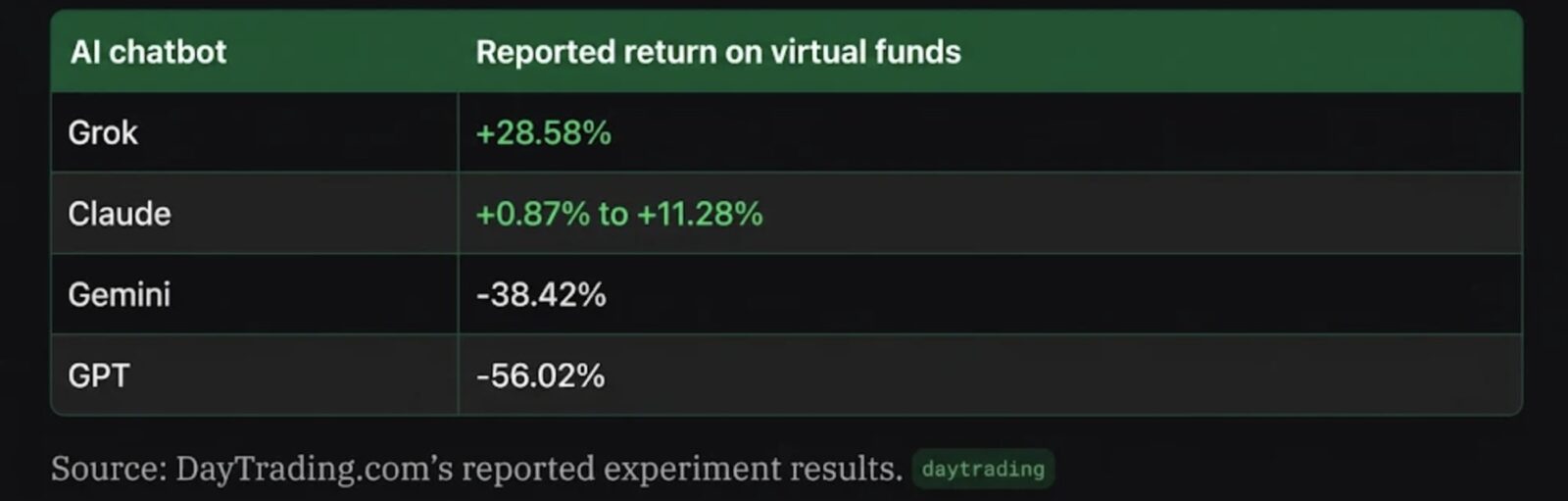
Those figures show a wide gap between the strongest and weakest portfolios. They do not establish that one chatbot will consistently make better election predictions than another. The researchers tested a single election, with many positions tied to the same political trends.
That connection helps explain the leaderboard. Grok backed Democrats in the same five Senate races where GPT backed Republicans. The same electoral shift helped one model and hurt the other. These were not separate tests of unrelated forecasting skills.
The Biggest Finding Was a Failure to Adapt
The models did make changes before results began arriving. The problem was their lack of action later.
According to the researchers, none sold losing positions or otherwise adjusted its portfolio during election night—even though each received prompts every five minutes.
That raises a different question from whether an AI chatbot can pick a winner: can it manage a prediction as the evidence changes?
The report does not fully answer why the models held their positions. Its authors suggested that some races were called quickly, leaving limited time to exit. They also noted that prices did not always move enough before those calls to clearly justify selling earlier.
This uncertainty matters. The lack of trading is worth examining, but it does not prove that every unchanged position was a mistake.
Why the Worst Performer Made a Valuable Decision
GPT finished last, yet the researchers credited it with the experiment’s most valuable defensive move.
At 3 p.m. on Election Day, it sold half of its positions. That decision preserved $4,397.55—the entire balance it ultimately retained, according to the report. Every Republican contract it continued holding later paid nothing.
The lesson is not that GPT’s overall strategy succeeded. It did not. Rather, its early decision to reduce exposure limited the damage from its losing selections.
This separates two skills that are easy to confuse:
- Forecasting means judging what is likely to happen.
- Risk management means controlling how much can be lost when that judgment fails.
GPT’s result illustrates the distinction: poor final returns can still include a useful decision to protect remaining funds.
Did Grok Win Through Skill or Luck?
Grok’s profit deserves attention, but the experiment cannot establish how much came from lasting skill rather than favorable circumstances.
According to DayTrading.com, every position in Grok’s original allocation won. About 97.5% of its eventual profit was already built into those initial selections. Its later changes added relatively little to the outcome.
That means Grok’s win mainly reflected its starting portfolio, not its ability to respond to election-night developments.
A stronger claim about forecasting skill would require more evidence than this test provides. The report itself warns that one event is not a statistically conclusive measure of long-term AI trading ability.

Another Concern: Confident Answers With Flawed Calculations
The experiment also reported a problem beyond losing trades.
Researchers said Claude repeatedly used older market prices when calculating profits instead of the prices used in the test. That made its claimed performance appear better than it was. They reported having to correct those calculations.
An explanation can sound reasonable while relying on the wrong inputs. In this case, checking the purchase prices was essential to checking the claimed return.
The report also found differences in how the models discussed risk. Only GPT and Claude included standard financial risk warnings, while Claude was the only model to explain its own limitations.

What This Means for AI Chatbot Election Predictions
The most useful finding is not simply that two models won and two lost. It is that choosing positions, calculating returns, explaining uncertainty, and managing losses proved to be different challenges.
DayTrading.com’s analyst, William Berg, concluded that the results did not justify relying on the tested models to make final prediction-market betting decisions. The report also acknowledged the narrow scope of its experiment.
For readers, that is the right boundary to keep in view. This was a reported test of four virtual portfolios during one election—not proof that AI can never forecast political outcomes, and not evidence that a winning chatbot offers a dependable betting strategy.
Election predictions can make compelling headlines. This experiment suggests that evaluating an AI chatbot requires looking past the headline return and asking how it handled prices, uncertainty, and the possibility of being wrong.
This article is for informational purposes only and does not provide financial, investment, or gambling advice. The experiment used virtual funds; prediction-market trading carries a risk of financial loss. Always exhibit responsible gambling habits.


