


Pennsylvania lawmakers have proposed major changes to online casinos and sports betting. House Bill 2879 would limit casino wagers, restrict deposits, ban microbets, and place tighter controls on gambling promotions. It would also expand the state’s approach to preventing and treating gambling-related harm.
The most important detail for players is that HB 2879 is a proposal, not an existing law. The legislature’s bill page lists its latest action as referral to the House Gaming Oversight Committee, with no votes or committee meetings listed.
Here is what the Pennsylvania online gambling bill could mean for players and operators.

What Is Pennsylvania HB 2879?
Pennsylvania HB 2879 would add a chapter on online gambling public health and consumer protection to Title 35, the state’s Health and Safety laws. Its rules would cover licensed online casino gambling and online sports wagering.
Democratic Rep. Tarik Khan is the bill’s prime sponsor. Republican Rep. Jamie Flick is a co-sponsor, along with eight Democratic representatives. The legislation was introduced on October 21, 2026.
The proposal goes beyond asking players to gamble responsibly. It would require operators to change how their platforms accept money, offer bets, advertise, and monitor player activity.

Microbets and Certain Same-Game Parlays Would Be Banned
One of the biggest proposed Pennsylvania sports betting restrictions concerns microbets.
A microbet is a live wager on a single play or action during a sporting event. Betting on the outcome of the next pitch is one example. HB 2879 would prohibit operators from offering or accepting these wagers.
The bill would also prohibit proposition bets involving multiple occurrences, nonoccurrences, or outcomes within one sporting event. That language targets same-game parlays involving proposition bets, which combine predictions about events within the same game. It should not be read as a blanket ban on every type of sports wager or every parlay.
These restrictions reflect the bill’s broader focus on the speed and frequency of online betting. Its legislative findings identify rapid, repeated wagering as an area of concern.
Online Casino Wagers Would Have Per-Play Caps
HB 2879 would set age-based limits on individual online casino wagers:
- Ages 21–25 $2
- Over age 25 $5
These amounts apply to each play of an interactive casino game—not to every sports bet.
The bill would also prohibit casino games that reveal an outcome in less than 15 seconds. Autoplay features, which place repeated wagers without a fresh action from the player, would be banned as well.
Together, those rules would reduce both the amount players could stake on a single casino play and the speed at which they could place repeated wagers.
Mandatory Loss Limits Would Trigger Lockouts
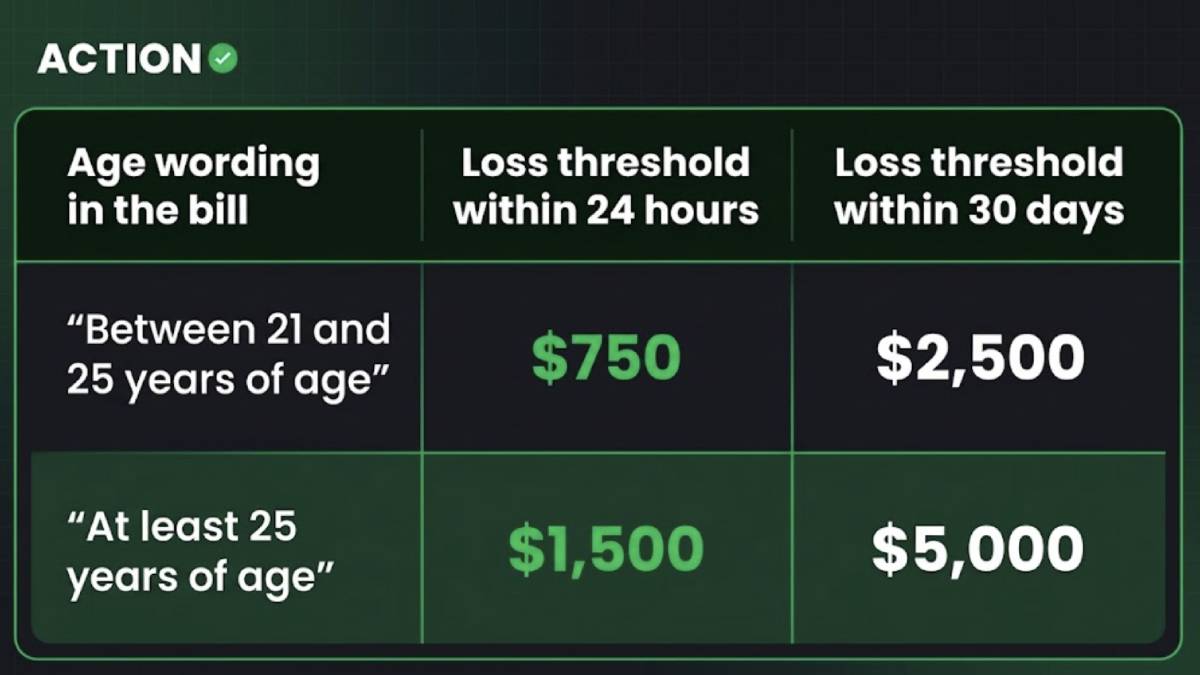
Players would have to set daily and monthly monetary loss limits before placing their first online wager.
Platforms would then block additional wagering when a player reached an applicable limit. Players could lower their limits immediately, but increases would require a cooling-off period established by the Department of Drug and Alcohol Programs.
The proposal also sets fixed loss thresholds:
A Two-Hour Daily Time Limit Would Apply
HB 2879 would require players to establish daily and monthly limits on the time they spend signed into their gambling accounts. The daily default would be two hours within a 24-hour period.
However, the text goes further than a typical default setting: it says platforms could not let players select a limit above that two-hour default. Players could choose a lower limit, but raising a previously selected limit would require a 72-hour cooling-off period and another affirmative action afterward.
Accounts would also have to sign out after 15 minutes of continuous inactivity.
Deposits and Payment Methods Would Face New Restrictions
The Pennsylvania online gambling bill would limit operators to accepting two deposits from or on behalf of an individual within a 24-hour period.
Before accepting deposits exceeding $5,000 over any 180-day period, an operator would need to complete an affordability assessment. That assessment could use authorized income or asset verification, documents voluntarily provided by the player, or another approved method. Financial information collected for the assessment could not be used for marketing.
The proposal would also:
- Limit payment for wagers to ACH debits, wires of readily available funds, or physical checks.
- Prohibit direct or indirect funding of wagers through credit cards or government assistance cards.
- Restrict gambling gift cards that could be purchased with those prohibited funding sources.
- Generally require a 15-minute wait between a deposit and a wager, with an exception for an initial wager after account creation.
The $5,000 figure is an assessment trigger, not an automatic deposit ban. Additional deposits would depend on whether the player passed the required review.
Sign-Up Bonuses, VIP Programs, and Advertising Would Change
HB 2879 would prohibit financial incentives for opening an account or making an initial deposit. It would also ban incentives tied to deposits into existing accounts.
VIP and loyalty programs that encourage higher gambling activity, deposits, or losses would face prohibitions. Programs that assign hosts to players are also among the practices targeted by the proposal.
Other restrictions would address how operators reach customers:
- Push notifications and text alerts could not solicit bets or deposits.
- AI and behavioral data could not target gambling inducements based on losses, vulnerability, or similar risk factors.
- Broadcast gambling advertisements would be prohibited between 8 a.m. and 10 p.m. and during live sports broadcasts.
- Physical and location-targeted advertising on or directly beside school and college campuses would be restricted.
The promotions provisions are more detailed than a simple ban on every possible customer offer. The text also describes limited, opt-in direct communications about certain incentives, subject to disclosure and delivery requirements.
Biometric Verification Would Become Part of Account Access
Players would have to provide biometric information, such as facial recognition data or fingerprints, when establishing an account. Biometric confirmation would also be required at each login, before an online sports wager exceeding $500, and periodically during a signed-in session.
The device provisions would limit each player to two associated devices and one active device at a time.
These requirements would make identity checks a recurring part of the online gambling experience, rather than a step completed only when opening an account.
Why the Bill Treats Gambling as a Public Health Issue
HB 2879 would establish an Online Problem Gambling Public Health Task Force within the Department of Drug and Alcohol Programs. Its purpose would be to review research and recommend ways to address online gambling-related harm.
The proposal also includes a 0.75% assessment on online casino and sports wagering revenue to support problem gambling prevention, treatment, research, and related programs.
The legislation draws on a Joint State Government Commission study commissioned through an earlier resolution introduced by Khan. Among the findings cited in the bill is research showing that a small share of online gambling customers accounted for a large share of spending.
Those findings explain the focus on high-intensity play and VIP programs. They do not mean that every high-spending customer has a gambling disorder.
Is Pennsylvania HB 2879 Law Yet?
No. As of October 29, 2026, HB 2879 remains a bill referred to the House Gaming Oversight Committee. The official status page lists no votes or committee meetings.
Reporting places the end of the current legislative session on November 30, leaving a short window for action. That timing is important, but it does not establish whether the bill will pass or what a final version might contain.
For players, the distinction is straightforward: the wager caps, deposit rules, promotional restrictions, and biometric requirements described here are proposed changes. They should not be confused with rules already in effect.


