


Talk about making an immediate impact.
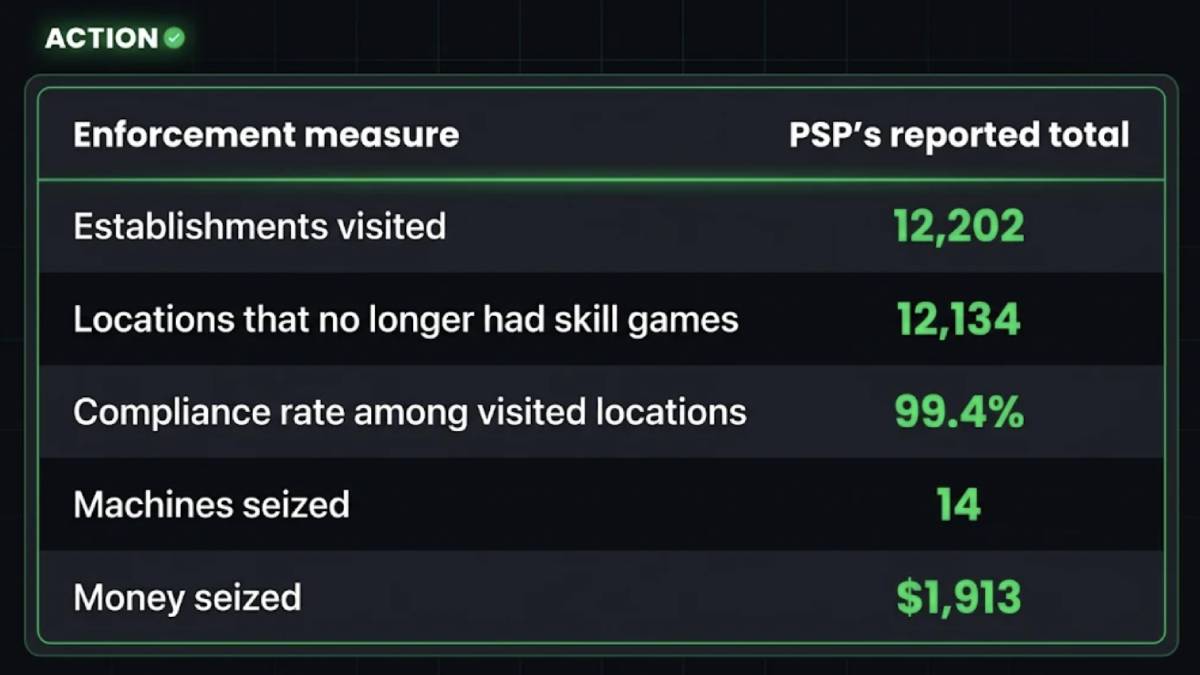
Pennsylvania skill games have largely disappeared from the businesses visited by state police since enforcement began on October 14, 2026. The Pennsylvania State Police reported that 12,134 of the 12,202 establishments checked no longer had the machines—a compliance rate of 99.4%.
For business owners, the update sends a clear message: enforcement is underway, and changing how a machine accepts payment does not automatically make it legal. PSP is also investigating devices promoted as cashless games or sweepstakes alternatives.

What Did State Police Find?
PSP’s latest report gives a snapshot of compliance more than three weeks after enforcement started. Its findings include:
- Estabishments Visited
- Locations That No Longer Had Skill Games
- Compliance Rate
- Machines Seized
- Money Seized
These figures describe the locations police checked.
They do not establish a statewide count of remaining machines or show that every business has been inspected. PSP says investigations into locations that have not voluntarily removed their games remain active.
Why Did Enforcement of Skill Games in PA Begin?
The enforcement effort followed a Pennsylvania Supreme Court ruling that classified the disputed skill games as illegal slot machines. The court provided a 120-day safe harbor period that protected businesses from prosecution while lawmakers had an opportunity to act.
That period ended in October without lawmakers passing skill-game legislation before the deadline. PSP began enforcement on October 14, 2026.
The key issue is legal authorization. PSP says the court’s ruling allows these types of gambling devices only where state lawmakers have expressly authorized them, within appropriately licensed premises. Calling a machine a “skill game” does not, by itself, place it outside gambling laws.
Are Cashless or Sweepstakes Machines Allowed?
A machine does not become legal simply because it stops taking paper money. PSP says officers have found devices carrying signs that describe them as legal because they use cashless payments or operate like sweepstakes. The agency warns that these descriptions do not settle whether a device violates state law.
According to PSP, payment methods covered by its warning include:
- Credit and debit cards.
- Mobile payment services.
- Cash apps.
Other forms of compensation used to play qualifying gambling devices.
The agency also says that offering free credits or free play does not make a game lawful when players can then continue playing with their own money. Its warning extends to certain video displays that direct players to simulated gambling through QR codes or phone apps.
For businesses considering replacement machines, the distinction is important: a different label or payment system does not necessarily change the device’s legal status. PSP says no manufacturer or operator sought its input on the legality of the alternative devices described in the update before placing them in businesses.
Does the Amount of Skill Change the Rules?
PSP says the court decision reaches beyond the name “skill games.”
According to the agency, the ruling affects covered devices whose outcomes depend on chance, skill, or a combination of both. It also applies regardless of whether a game uses a random number generator or a fixed pool of outcomes.
That means a seller’s claim that players can influence the result does not, on its own, establish that a machine may legally operate in an unlicensed location. The device must still meet the requirements of Pennsylvania law.
What Could Businesses and Distributors Face?
PSP warns that continued operation of prohibited devices can lead to criminal charges. Enforcement may also include seizure and forfeiture of the machines, related equipment, and proceeds connected to their operation.
The agency strongly recommends that businesses hosting the devices discuss immediate removal with the distributors or vendors that own them. Its warning applies to both the establishments hosting the machines and the companies supplying or operating them.
Businesses should not treat a vendor’s promise of legality as the same thing as state authorization. PSP’s update specifically challenges claims that alternative payment methods or sweepstakes branding make these devices lawful.

What Comes Next for Pennsylvania Skill Games?
The high compliance rate has not ended enforcement. PSP says it continues to investigate locations that have not removed their machines, while also addressing attempts to operate similar devices under different descriptions.
Lawmakers have debated proposals to tax and regulate skill games in PA, but no skill-game legislation passed before the October enforcement deadline, according to City & State Pennsylvania. Those proposals should not be confused with permission to operate under current law.
For now, the November update documents widespread removal at inspected locations—and continued legal risks for businesses that keep unauthorized gambling devices in operation.


