


Amidst the gleaming lights and bustling excitement of Rhode Island's two Bally's-operated casinos, February presented a modest dip in casino revenues.
According to the latest numbers from the Rhode Island Lottery, February, which is typically a quieter period in the gaming calendar, echoed a pattern of slight declines and underscored the competitive pressures from neighboring states.
It's also the second straight month with a decrease. Numbers were down at the end of 2025, too.
Let's get a detailed breakdown.

Rhode Island Casino Revenue
The combined revenue from Rhode Island’s two casinos—Bally’s Twin River in Lincoln and Bally’s Tiverton—totaled $46.9 million, marking a 4.7% decrease compared to the same period last year. As a significant economic contributor, these numbers provide insights into broader market trends:
- Slots (Video Lottery Terminals/VLTs): Contributing $37.7 million, slots experienced a 5.2% decline year-over-year, highlighting their volatility yet dominant share of the revenue.
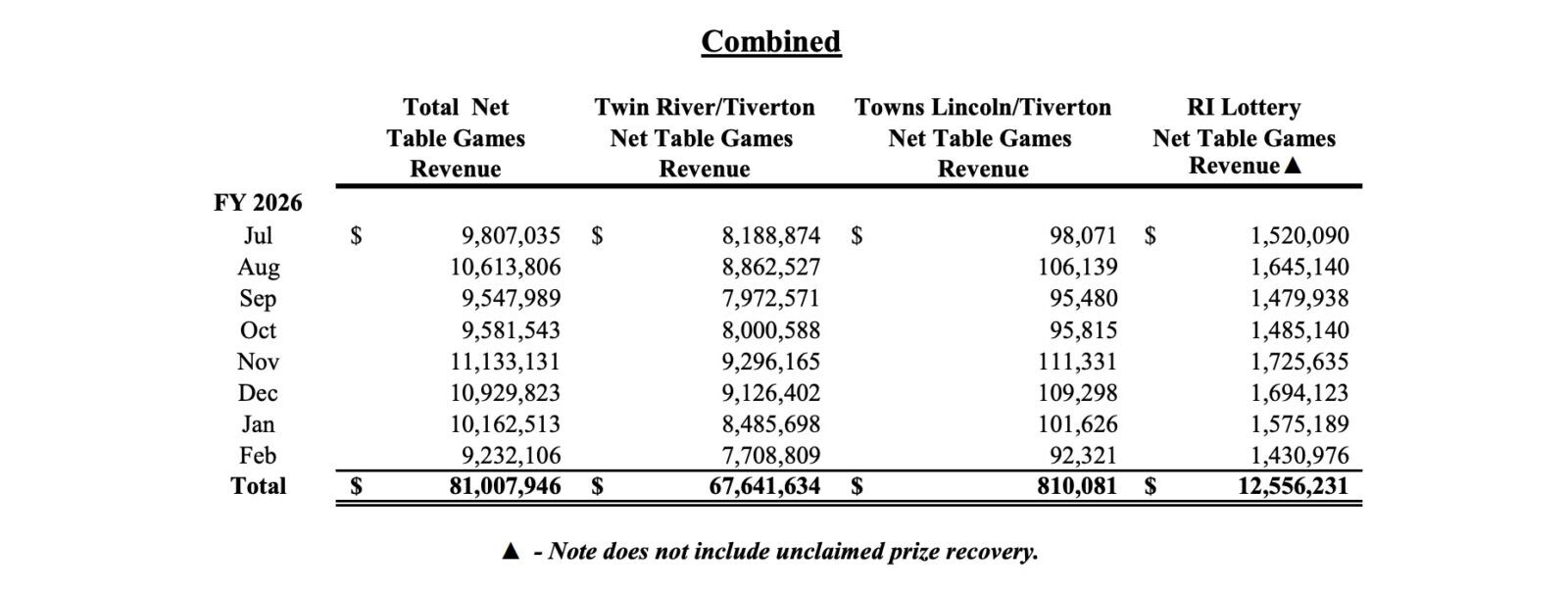
- Table Games: Despite their smaller share, table games earned $9.2 million, showing a more modest decline of 2.7%.
Breakdown by Casino
Both of Rhode Island's casino locations showed varied performance, reflecting the distinct dynamics of each venue:
Bally’s Twin River: As the larger facility, it achieved $35.8 million in revenue, a 5% decline from the previous year. Slots were again in the spotlight, contributing $28.4 million (down 5.2%), while table games managed $7.4 million (a 4.5% drop).
Bally’s Tiverton: Generating $11.2 million in revenue, Tiverton saw a lesser decline of 3.8%. Interestingly, while slot revenue decreased by 5.4%, table games were a bright spot, increasing by 5.3% to $1.8 million, demonstrating resilience amidst broader challenges.

Rhode Island Casino Revenue Stable
Over recent years, Rhode Island’s casino revenue has remained relatively stable yet faces headwinds:
- Stable Annual Revenue: Full-year land-based casino revenue for 2025 was approximately $646.3 million, remaining flat compared to 2024.
- Regional Competition: Casinos in Massachusetts (e.g., Encore Boston Harbor) and Connecticut's tribal resorts (Foxwoods and Mohegan Sun) continue to create competitive pressures.
- Digital Expansion: The state’s exploration into digital avenues, such as the launch of iGaming via Bally Bet in 2024, aids in revenue diversification despite the competitive market.
Recent Trends and Future Outlook
The February figures reinforce a seasonal pattern observed in early 2026, marked by a 7.5% revenue drop compared to January’s $50.7 million. This trend aligns with expected post-holiday declines common in the early months:
- February 2026: $46.9 million (down 4.7% YoY)
- Slots/VLTs: $37.7M (down 5.2%)
- Table games: $9.2M (down 2.7%)
- Twin River: $35.8M (down 5%)
- Tiverton: $11.2M (down 3.8%, but table games up 5.3%)
- January 2026: $50.7 million (down 6.3% YoY) — Higher than February, but steeper YoY decline.
- VLTs: $40.5M (down 4%)
- Table games: $10.2M (down 14.3%)
- Twin River: $38.3M (down 7.2%)
- Tiverton: $12.4M (down 3.3%)
February was down 7.5% lower than January, which is typical seasonality—January often benefits from post-holiday momentum, while February is shorter (even in a leap year) and can feel quieter after New Year's.
- Seasonality: The casino industry traditionally sees stronger performances in summer and fall due to tourism and events, contrasting with milder winter and early-year months like January and February.
- VLTs vs. Table Games: Despite driving overall revenue declines, VLTs remain dominant, representing roughly 80% of total revenue. Conversely, table games, while smaller, continue to exemplify potential areas for growth, particularly at venues like Bally’s Tiverton.
iGaming in Rhode Island Shows an Increase
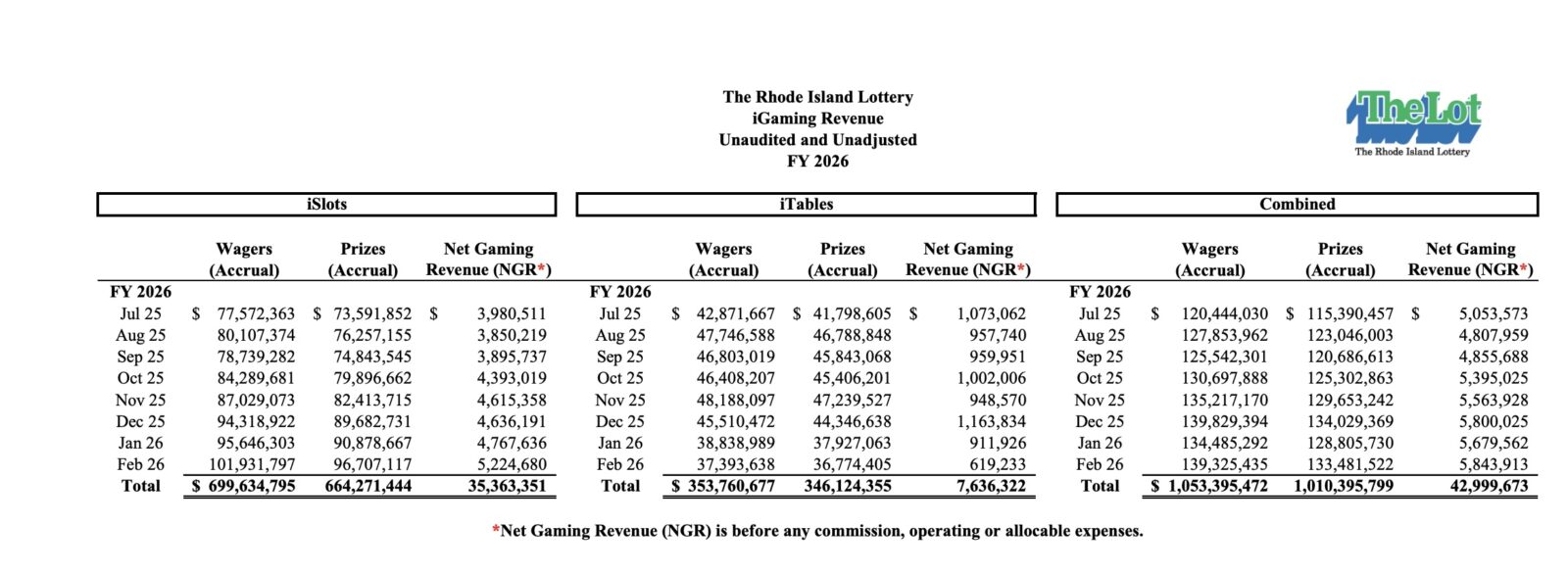
Rhode Island's online gaming industry is growing well. With more people placing bets and steady earnings, this trend shows the industry's increasing popularity and positive effect on the local economy.
December 2025:
- Total Wagers increased to $139,829,394
- Total Prizes increased to $134,029,369
- NGR increased to $5,800,025
January 2026:
- Total Wagers decreased to $134,485,292
- Total Prizes decreased to $128,805,730
- NGR slightly decreased to $5,679,562
February 2026:
- Total Wagers increased to $139,325,435
- Total Prizes increased to $133,481,522
- NGR increased to $5,843,913
Overall Trends
Wagers Growth: There is a general upward trend in the total wagers from July 2025 to February 2026, with some fluctuations. The figures demonstrate steady growth, particularly noticeable from July through December.
Prizes Offered: The total prizes awarded also follow a similar pattern to wagers, increasing almost every month with minor variations.
Net Gaming Revenue (NGR): The NGR shows a consistent upward trend over the year, indicating that despite fluctuations in individual months, overall profitability increased throughout the year.
Key Observations
Growth Patterns: Both wagers and prizes generally increase over this period, reaching their peaks in December 2025, a common trend possibly influenced by holiday seasons. NGR follows a similar positive trend except for a dip in January 2026, before rising again in February 2026.
Market Stability: The NGR remains relatively stable, pointing towards a stable market situation, with no major dips throughout the year.
End of Year Boost: December sees a marked increase in both total wagers and NGR, suggesting seasonal factors or promotions could be boosting revenue during this period.
These trends reflect a healthy and growing iGaming market in Rhode Island for FY 2026, with consistent increases in wagers and prizes contributing to an increasing NGR.
Rhode Island Casino Revenue Shows Resilience
February's revenue report reflects not only the ongoing challenges within Rhode Island's mature casino market but also the resilience and adaptation in response to competitive and economic factors.
With continued expansion into digital spaces and potential strategic maneuvers, Rhode Island’s gaming landscape remains a critical puzzle piece in the broader New England regional gaming industry.
As the industry navigates through these competitive waters, close observation of these trends will be essential for understanding future dynamics.


