


Pack ripping has moved from the storefront to your phone.
"Pack ripping" or "card ripping" is when you open packs of cards repeatedly — Pokémon, baseball, basketball, you name it — in the hopes of pulling one valuable card. The concept has been around forever, but the digital versions have some big differences:
- You can open packs digitally (though the cards exist physically in the company's vault).
- You can immediately sell back card at a profit or loss, and open another pack.
- Or you can have the card shipped to you.
It's no longer a niche corner of the market, and these digital pack rips have removed the normal friction of buying and selling cards quickly. The five largest crypto-based rip platforms took in $284.3 million in pack spending in July, per Blockworks. There are more than 50 apps offering pack rips right now, including brands in the real-money sports gaming space like Fanatics, FanDuel, PrizePicks and Underdog.
Here's how a rip works, what it costs you on average and what to know before you open them.
What Is Digital Pack Ripping?
Pack ripping is continually opening packs of trading cards in the hope of pulling one valuable card worth more than what you paid for the pack.
Nowadays, ripping usually refers to a digital rip, where you you buy a virtual pack online, an animation reveals a real, graded card the company holds in a vault, and you decide whether to ship it to yourself, keep ownership of it in the company's vault, or sell it back (usually at a small loss).
Here's what it looks like on ClutchPacks. I spent $25 on this pack, and got a Dak Prescott card I could sell back for $21.15 after fees.
Collectors have been ripping packs at card shops for decades, and pack-opening videos have been a YouTube staple for years in both sports cards and Pokémon. Live breaks came next, with a host opening a sealed box on a stream and shipping the hits to buyers.
Digital rips remove the wait, meaning there's no box to open and no package to track. The result is instant, and so is the option to cash out and sell the cards back, likely so you can rip again in hopes of getting a more valuable card.
Most digital packs contain a single card that has already been graded by a company like PSA, BGS or CGC, and not a full "pack" of 10-12 cards.
How Does a Digital Rip Work?
Every platform displays it a little differently, but the mechanics are usually the same.
- The platform buys and vaults cards. It sources graded cards, stores them in an insured vault and creates a digital record for each one. On crypto platforms, that record is a token on a blockchain. They're not "digital" cards like NBA Top Shot.
- It builds a pack. Each pack has a price. I bought a bunch of $25 packs on ClutchPacks.
- You pay and open the pack. An animation plays and shows you what card you got.
- You decide what to do with it. You can sell it back right away (often a slight loss, but sometimes for more than you paid), keep it in the vault or ship it to yourself for a fee.
- The card goes back in the machine. A sold-back card is repacked and can be pulled again by someone else.
One detail matters more than it seems: the platform sets the card's value, usually based on recent sales. That number drives both the odds table you see and the buyback you're offered.
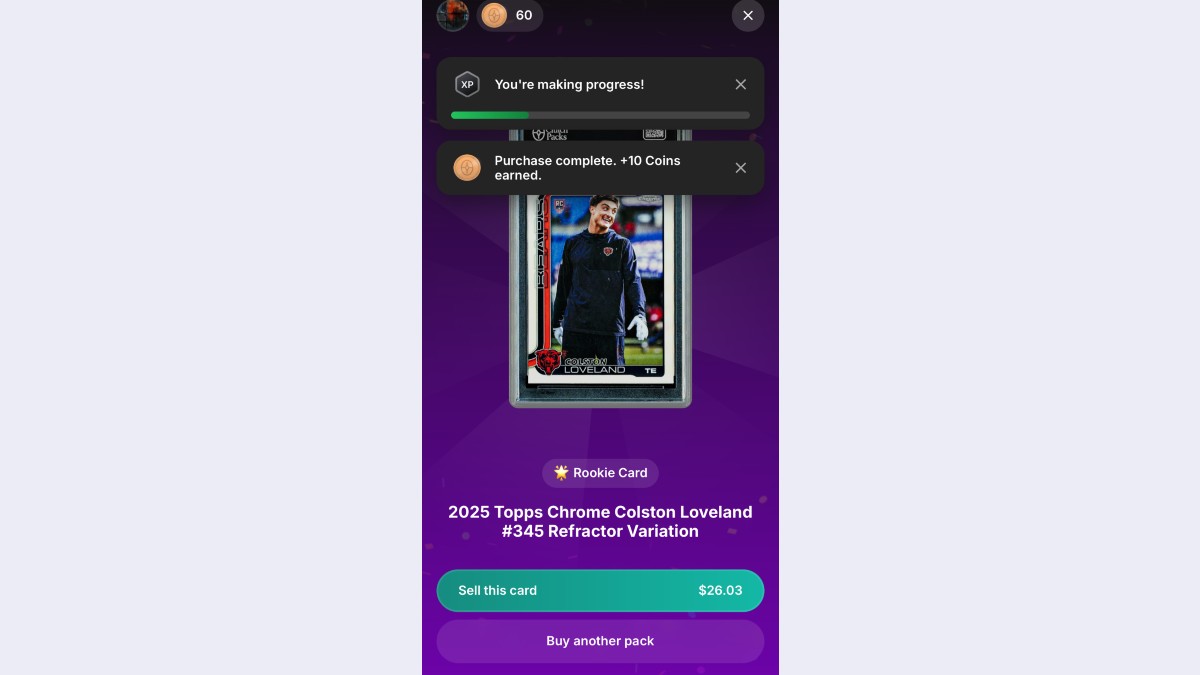
Here's one card I pulled worth a tiny bit more than the cost of the pack — a Colston Loveland worth about $26 after fees.
What's the Difference Between Rips, Breaks and Repacks?
The three terms get used interchangeably, but they're different products.
| Product | What You Buy | What's Opened | Sell Back Instantly? |
|---|---|---|---|
| Digital rip | One instant reveal from a vault | Already-graded single cards | Yes |
| Live break | A spot (a team or slot) in a box opened on a livestream | Factory-sealed boxes | No |
| Repack | A pack a seller assembled from individual cards | Mixed singles, sometimes sealed packs | Sometimes |
How Much Does a Rip Cost You on Average?
Every pack is priced above the average value of what's inside. That gap is the house edge, and it works a lot like the vig on a bet. But most people expect to lose on most rips, and hope to hit one big card to make up for all the losses.
Expected value (EV) is the average value of the card you'll get, weighted by the odds of each outcome. The house edge is the gap between the pack price and that EV, as a percentage of the price.
Some sites publish enough to do the math, while others don't.
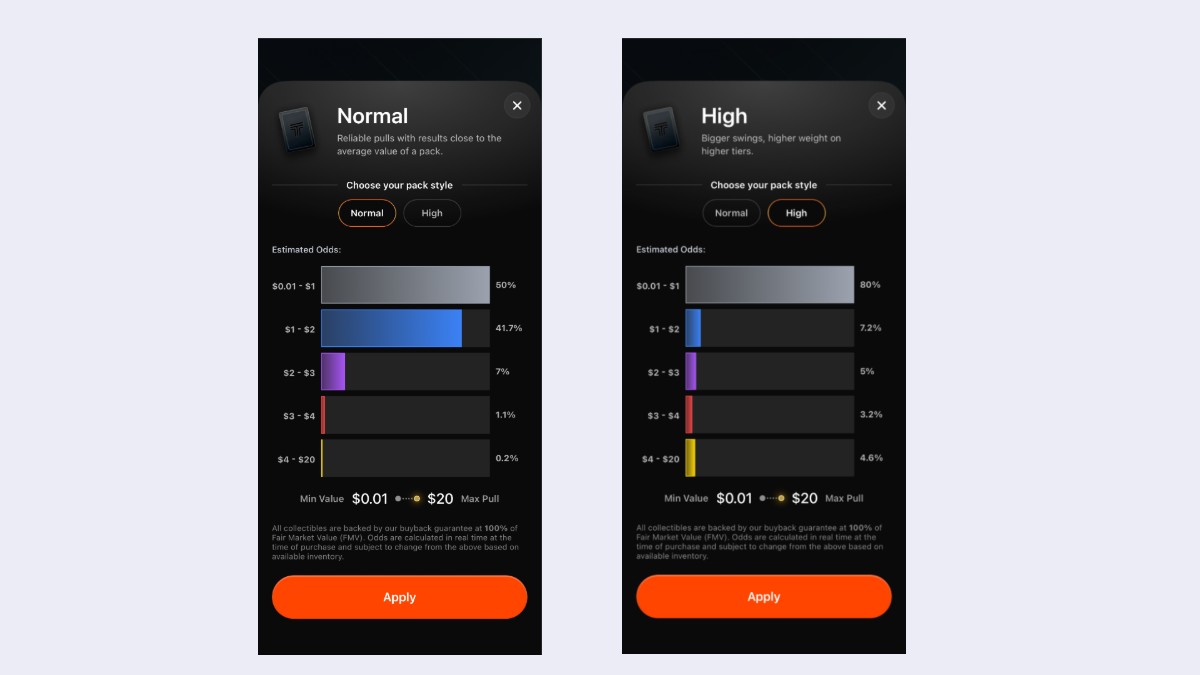
Triumph is one app where you can choose which kind of rip you're getting — Normal (which flattens the odds and gives you a better chance to recoup your money or make a small profit, but not a big chance to hit big) or High (which gives you a better chance at a big score but a lower floor).
How Do Buybacks Work?
Most people open a pack, break even or lose a little money, then sell the card back and try again. If you sell the card back, you take a second haircut. Instant buybacks usually pay 85% to 90% of the platform's value, and some pay in site credit instead of cash.
- Pack price: $50
- Average card value: $45
- Buyback at 84% net: $37.80
- What you keep if you always sell back: about 76 cents per dollar
Across entire platforms, returns look better because some users keep cards and big hits pay out. Collector Crypt, the largest crypto platform, returned 94.1% of third-quarter 2026 pack spending through buybacks and redemptions, per Datawallet. Across the five largest crypto platforms in July 2026, it was about 88%, per Blockworks.
Cash vs. credit matters too. Credit can only be spent on the platform, which usually means on more packs.
Do Most Rips Lose Money?
EV is an average, and that average is carried by rare, huge hits. The rip you'll get most often, the median, sits well below it.
The same published $50 pack shows a 62% chance of a card worth $25 to $45 and only a 0.2% chance of one worth $200 to $1,000. Most of the time you lose a little. Once in a long while you win a lot. That's the product working as designed.
Who Sells Digital Rips?
The companies selling rips fall into three broad groups.
- Collectibles companies: Grading, vaulting and marketplace businesses have added digital packs this year. Arena Club, co-founded by Derek Jeter, is the best-known example.
- Crypto platforms: Cards are tokenized on a blockchain, so every purchase and buyback is recorded publicly. Collector Crypt and Courtyard are the biggest, and Courtyard told Barron's it is on pace for $2 billion in annual sales.
- Sportsbooks and fantasy apps: Fanatics runs Instant Rips, FanDuel is testing rips for rewards members through Arena Club, and Underdog is preparing "Underdog Rips."
Crypto took over because tokenized cards change hands instantly without shipping, and the blockchain leaves a public record of every pack and buyback. The trade-offs are custody, tie-ins to speculative tokens and fewer consumer protections.
Who Actually Rips?
Like sportsbooks, rip platforms run on a small group of heavy spenders. On Collector Crypt, 548 wallets that each spent more than $100,000 accounted for 83% of third-quarter 2026 sales, per Datawallet.
Most casual users don't stick around. Twelve months after their first rip, 9.8% of Collector Crypt users and 2% of Courtyard users were still playing, per Blockworks.
How Do You Rip Responsibly?
- Set a budget. Treat rips as entertainment, not an investment.
- Read the odds table. Understand your probabilities and what you're getting into with each rip.
- Know the buyback. Check the percentage, whether it's cash or credit and how long you have to decide.
- Check fees early. Look up shipping, withdrawal and cash-out costs before you need them.
- Know who you're dealing with. Look for a named operating company and where it's based.
- Expect most packs to lose. The big hit is the exception, and the pricing depends on it.


