


Do you want to win your Masters pool? Win. Not just come in 11th of 100. Actually win.
Then you have to be comfortable with finishing dead last, because if you follow my advice, you sometimes will. 2026 will be a weird year in Masters pools, because there's no player in a dominant run of form on the PGA TOUR, and some lingering injury or form questions for many of the top players.
There are many ways to set up a Masters pool, but a typical pool involves "Tiers" in which you pick one golfer from each tier, and their total scores will be added up to create your team's overall score. If you're doing a snake draft, most of this advice won't apply.
Our typical recommendation for mass-entry pools this — similar to the NCAA Tournament brackets or NFL survivor pools where everyone can use the same teams/players — involves ignoring the most popular selections and trying to find comparable players who will be far less selected, creating leverage over the field.
In most tiers pools, you pick 8ish players, and the top 6ish scores will be counted while the other two are thrown out. The tiers approach prevents everyone from taking the same top six star golfers and instead forces you to go further down the board with your selections, diversifying the lineups.
We'll use EasyOfficePools' standard tiers that use betting odds to sort the tiers, picking one player from the top five tiers and three players from the "everyone else" tier. Let's assume there are 100 people in the pool, and the top four finishers get paid.
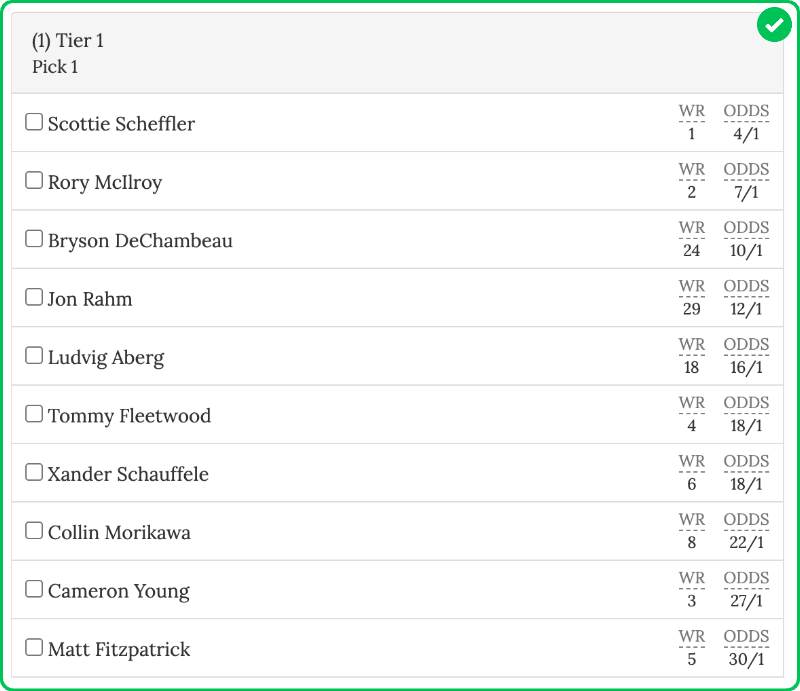
Tier 1 will look something like this. If you want to skip the strategy and go right to the player analysis, use the green table of contents button on the right of the page.
1. Actually Try to Win
Seems obvious, right?
You need to differentiate your lineup if you want to win. And most often, that means making stomach-churning decisions like fading the best players in the world completely, or taking players way out of form who nobody is even considering using. And sure, sometimes my lineups will completely flop. But last pays the same as 10th — nothing.
If 80% of the pool uses Scottie Scheffler and he ends up winning, he was still the best play in hindsight. But when he doesn't win (a large percentage of the time in golf), you can get a huge advantage over those 80% of entries if you pivot to someone in his tier who finishes ahead of him.
This concept will inform the rest of my strategy. I don't mind finishing last two years in a row if I can have a chance to win the third year. That pays much more than three straight 40th-place finishes. Big pools are hard to win, but when it breaks right, differentiating your lineup can pay off. The bigger the pool, the more creative you need to get.
Don't just take bad players or the worst player in each tier — take comparable players who will be far less used.
That will give you lineups with leverage. If you do take Scheffler, make sure the rest of your picks are unpopular so you can create a unique lineup. If you fade Scheffler, you can pick more popular players in other tiers.
2. Just Pick Good Golfers
A few years ago at FantasyLabs, we analyzed millions of DFS lineups and found that floor is much more important than ceiling in golf DFS, because the only thing that correlates with DFS success is making the cut. If you stay in the tournament, you raise your ceiling.
The abundance of modern sports statistics can distract us. Who has the most upside? Who has win equity? Who putts the best on specific grass? Who are the best iron players with wedges from 85-105 yards?
Golf is an inherently random game in a given round or week. Don't take putting, the most random part, and narrow the sample to just a certain type of grass. Just take the good players who hit the ball far and put it close to the hole. In the long run, those players will win out.
The takeaway from that article that stuck with me most: "Just try to make as many 6/6 lineups as you can and hope that at least one of them has everyone score high."
You don't have to pick players in Tiers 5 and 6 who you think will win the tournament; they're in those tiers because they won't win. So, take good players. Don't worry so much about "winning upside."
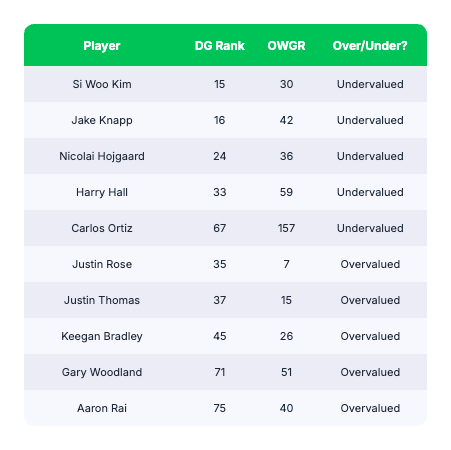
Anyway, I like to use DataGolf's rankings as a measure of ability, because the Official World Golf Rankings are quite flawed in predictive ability. Here are a few guys who rank higher in their global rankings than you might expect who you should consider using:
3. Get Contrarian & Find Leverage
Alright, here's where we get creative. You need to figure out who everyone will pick and avoid those players.
Leverage is the idea that you can create value by choosing lower-owned players who have a comparable chance to play well as a similar, higher-owned player. If 50% of the pool uses Scheffler and he does well, 50% of your pool will move up in the standings when he does well. You're not gaining ground. But if you're the only person who uses Cameron Young in the same tier and he plays well, you're moving up the standings alone if he plays well.
With 100 people in your pool, would you rather be:
- One of 30 people with Min Woo Lee (2.8% chance to win)
- One of five people who used Patrick Cantlay (2.5% chance to win)
To me, the answer is clear. The chances of them winning aren't that different, but what you're gaining on the field if Cantlay does well is massive.
Here are the top players in our FantasyLabs DFS models in leverage score, which compares projected ownership to upside. It's DFS, so it's a bit different, but I think it gives you a decent idea of the guys that no one wants to use, and players who will be popular this week.
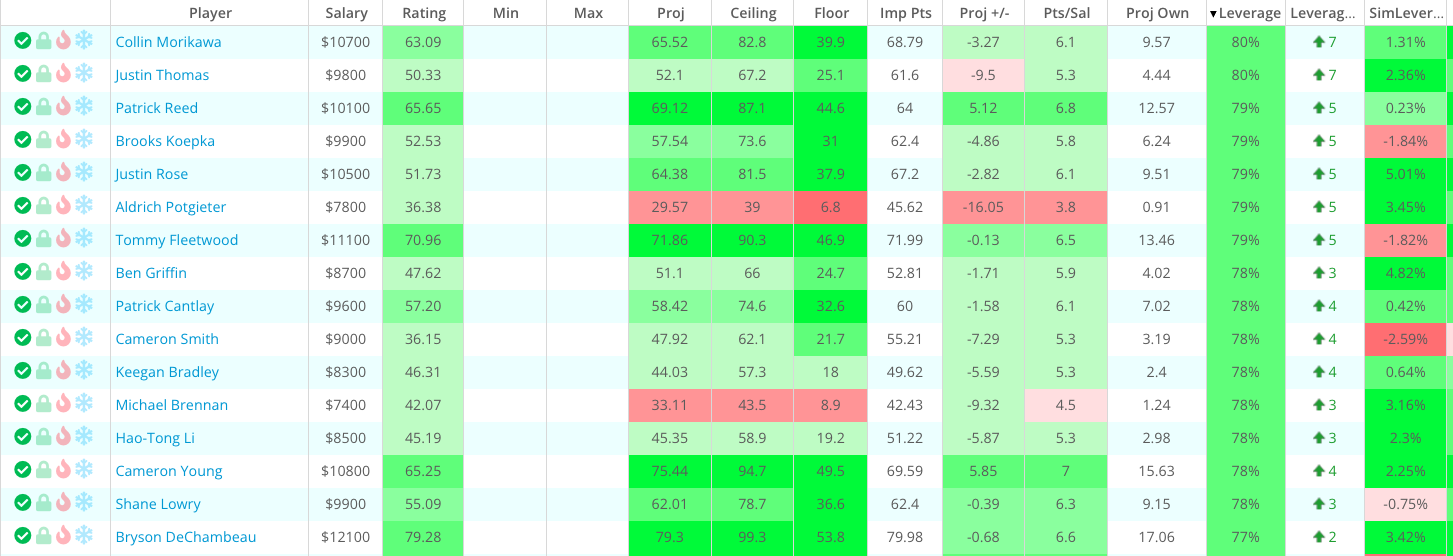
It's mostly players who are:
- Hurt or coming back from injury (Justin Thomas, Collin Morikawa)
- Guys everyone hates (Patrick Reed)
- Boring guys (Tommy Fleetwood, Ben Griffin, Patrick Cantlay)
- Players out of form (Shane Lowry, Keegan Bradley)
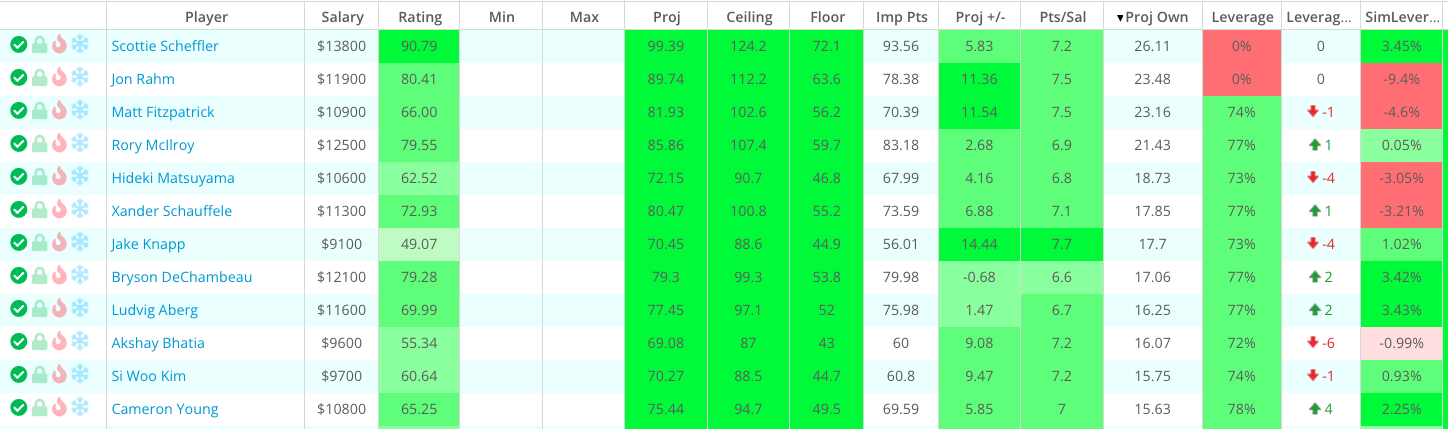
And here are the players with the highest ownership projections. It's mostly players in great form who have won this year, or been at the top of leaderboards consistently.
3b. Why Leverage is So Important
When you use the same player as everyone else, it doesn't really help you because the other entries also move up in the standings when that player does well.
Remember, you're just trying to beat the other entries; it doesn't really matter what the numeric scores are.
This visual represents leaderboard movement when Jon Rahm, owned by just two of the top 10 entries, birdies a hole, versus when Scheffler does.
If you've ever been in contention in a tiers golf pool like this, you know the changes in standings slow to a crawl on Sunday when some of your players complete their rounds and your top guys are also used by the entries you're battling for first.
If you're in third with Rahm, but the two entries in front of you also picked him, Rahm playing well doesn't really help you. You need someone else your opponents don't have so you can move up while their position remains the same.
The hard part is you don't know who will be the most-owned golfers in these pools. It's not like the NCAA Tournament, where Yahoo! and ESPN will actually tell you.
So we have to make some assumptions. We do DFS ownership projections at FantasyLabs, which can give you some idea. Tyler Tamboline on X does a good thread highlighting the most recommended players in the industry you'll probably want to avoid.
As I'll detail in the next section, the closing odds at mainstream sportsbooks will dictate the ownership for many tiers.
4. Use Odds to Your Advantage
Most people don't follow golf closely enough to separate top 20 players like Min Woo Lee from Russell Henley, let alone Tom McKibbon from Michael Brennan, so they let the betting market do it for them by just taking the players in each tier with the best odds at their favorite sportsbooks. That's actually a good approach in a vacuum.
But if you can get a 2% Tyrell Hatton vs. an 18% Shane Lowry and their chances of finishing top 10 are basically the same, you should take Lowry.
Here's how each tier looked in a pool I did in 2025. Scroll through the tiers, and you'll see that the ownership is very closely correlated with the closing odds. In some tiers, it's almost directly in line.
You should also not use the betting odds that your pool site gives you. They're often stale and don't update throughout the week as the betting market changes. In my tiers section below, I've included odds as of Tuesday night from Pinnacle that you can compare with Easy Office Pool's odds.
5. 'Ignore' Course History
Course history does actually matter at Augusta National, more than anywhere else, but I think people tend to overrate it in the context of these pools, and those players end up being way over-owned.
Would you rather have:
- An aging player who has played well at the Masters at times in the past but isn't playing well right now, who is 25% owned?
- A rising star who is simply a much better golfer but hasn't contended at Augusta and is 10% owned?
I'm often choosing the second option, especially because the "Augusta guys" will be over-selected relative to their value.
6. Be a Hater
A few years ago, I recommended using LIV golfers because 1) many golf fans turned on them, and 2) they had all been in pretty poor form entering the Masters or hadn't played much. They had three of the top 6 finishers that year.
I also always recommend using golfers that people dislike, because you may get some small ownership advantages from that dislike alone, despite their ability being the same as a comparable player — Patrick Cantlay, Patrick Reed, slow players like Brian Harman, etc.
The tide has shifted back on LIV players in these pools, and they get used plenty, but the point remains. There's just so little separating many of these players, but our favorite players tend to go over-owned.
7. Know Your Scoring & Pool Size
I may tweak my strategy based on how the scoring works. These are usually the three types:
Score to par: In a pool where all your players' scores are added up, I'm looking for players who offer some floor. You're still going to need the winner to win a big pool that scores like this, but you can't have missed cuts and you need the bottom half of your lineup to finish strong and post some Top 30s.
Total prize money: You really need upside in this scoring format, because the Masters winner is paid something like 15x more than 20th place. I'm more willing to gamble on players with some upside but with a slightly lower floor (Viktor Hovland and Patrick Reed become more interesting in this format, where Corey Conners is a little less interesting).
Finishing position/picking the winner: Other pools score by finishing position, which is similar to score to par, but with less variance.
Knowing pool size: There's not an exact science to this, but the bigger the pool, the more contrarian you need to get. Even if you took Florida in a 20-person NCAA Tournament pool last year, you probably didn't win.
Again, this doesn't mean you should take the worst player in ever tier. But you need to be extra considerate of how popular your players are if you're in a big pool. Make a few key pivots to players you think almost no one will use (like 1, and you can actually have a shot to win if those guys hit.
8. Multi-Lineup Strategy
In a big pool, you may want to enter multiple lineups. How should you split them up?
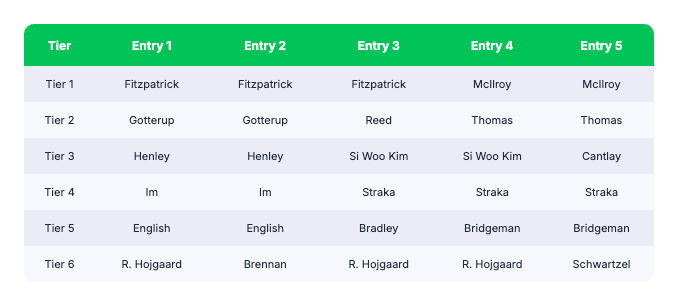
I prefer an approach that mixes a few core players, and then different pivots further down your lineup. Some people refer to it as the cascading method in DFS. If you have five completely different lineups, it's going to be hard to get one right enough. You're just kind of spraying and praying.
However, if you take a stand on a few guys, nail 2-3 core plays and mix up the rest of your lineups, it's likely you'll get at least one lineup into serious contention.
Here's an example of what five lineups might look like:
9. Tier-by-Tier Breakdown
Alright, let's dive into the actual tiers on EasyOfficePools. Again, your pool may be slightly different, so use the general concepts. I'm super interested in using Matthew Fitzpatrick in this tier setup, but may have no interest in another. Avoid what you believe will be the most popular plays (which largely correlate with their closing odds at DraftKings or FanDuel) in favor of comparable players who are being ignored. Don't just choose the worst player in each tier.
I'm going to make notes of three players in each tier — one I'd use for a small pool (where you have to be less differentiated), one I'd use for a big pool, and one honorable mention.
Tier 1
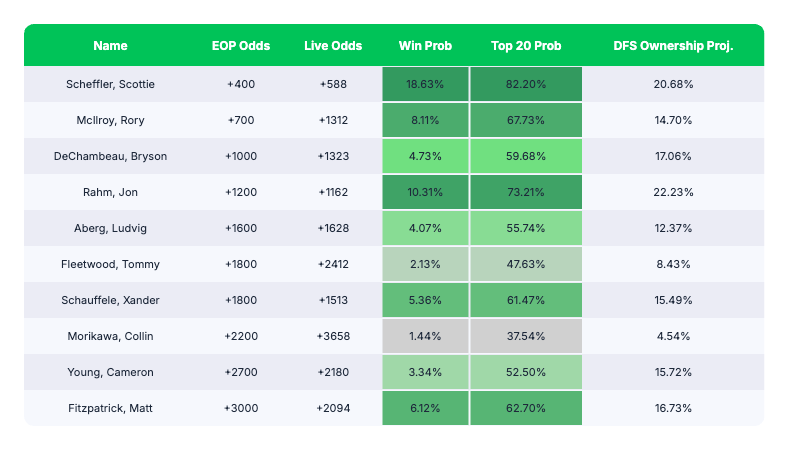
Small pool: Rory McIlroy. Rory withdrew from the Arnold Palmer with a back injury, but came back for the PLAYERS and led the field in strokes gained off the tee. The back injury is a non-factor, I think. I also think people will be fine not taking Rory because it felt like he left it all out on the fairway, so to speak, following last year's Masters win, and he's not had a great run of form to start 2026 — nothing like he had leading up to the Masters in 2025. If you haven't been following LIV this year, Jon Rahm is absolutely scorching hot, Scottie Scheffler is still the best player in the world, and they should eat a ton of ownership.
Big pool: Matthew Fitzpatrick. He's listed last here, but his odds to win are around 6%, according to our projections at Rotogrinders. That's behind only Scottie, Rahm, and Rory. He has everything you want from a Masters winner — major pedigree with his U.S. Open title, red-hot form (solo 2nd at the PLAYERS, won the Valspar) and his approach play and around the green game are both top 10 in the world right now. He's a player who will go way under-used in Tier 1, and way overused if he headlines Tier 2.
Honorable mention: While I'd avoid Jon Rahm considering what I project his ownership to be, I'm actually fine taking Scottie Scheffler. I think Rahm and Scottie will be similarly owned in the 30% range, but Rotogrinders has Scottie at 18% to win the tournament and Rahm at about 10%. Scottie's approach play has taken a dip this season from "Prime Tiger" level to just "elite," it's still the best in the world, and some people think he's out of form. DataGolf still has him almost .7 strokes per round better than Rahm, which is the same gap as Rahm to No. 15 Min Woo Lee.
Tier 2
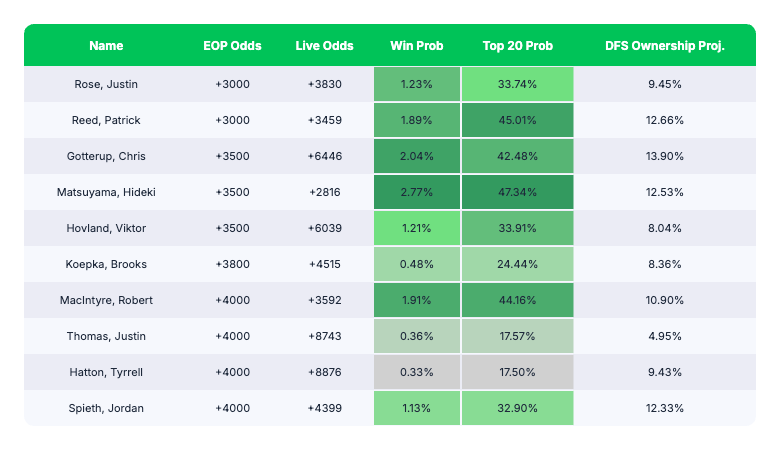
Small pool: Chris Gotterup. He's a debutant, so I think we're getting a bit of a discount on him, but he's in elite form and has proven he can compete and win against the best fields in the world. He's flashed elite play both off the tee and on approach this season, and has two wins. His odds have drifted quite a bit, which isn't a great sign, but it's a good sign he'll go under-owned.
Big pool: Nobody will use Justin Thomas. He turned in truly the worst tournament of his career in strokes gained in his first start back from back surgery at the Arnold Palmer. But he followed it up with a T8 at the PLAYERS that featured an elite iron week, and a T30 at the Valspar. You could get an absolute dud, but the upside is there.
Honorable mention: There are a lot of guys I want to use in this tier, but I think they'll all garner ownership — Patrick Reed and Robert MacIntyre in particular. Reed would probably be my favorite; it's hard to overstate how good he's been at Augusta with five top 10s in his last eight starts, including a solo 3rd last year. He's won twice on the DP World Tour this year after defecting from LIV, which is why I think people will want to use him more than they normally do.
Tier 3
Tier 3 is a good reminder to not use the odds the pool sites give you, because they're way different from the live markets. Ben Griffin is 55-1 on Easy Office Pools; he's 181-1 at Pinnacle. Min Woo Lee is at the bottom of this tier at 66-1; he's 38-1 in real-time.
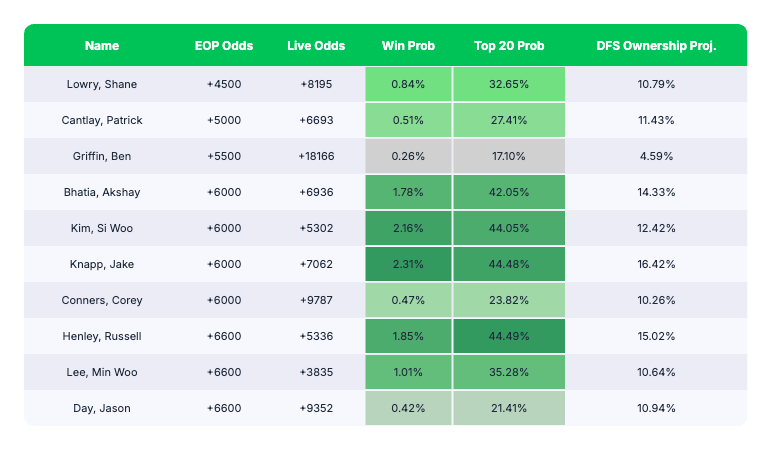
Small pool: Russell Henley. A model favorite, Henley isn't garnering much attention this week because he's pretty boring. It never feels like he can win a tournament of this caliber. And maybe he can't, but he's still a top 15 player in the world, and has a super high floor in most tournaments thanks to an elite all-around game (minus driving distance).
Big pool: Si Woo Kim. I'm a sucker for Si Woo, who has six finishes of 13th or better in nine starts this season. He has the 11th-best win probability of anyone in our RG models, but he's all the way in Tier 3. I think he'll be somewhat popular here, but I'm fine taking the chance in a tier that will likely be dominated by Min Woo Lee and Masters banana stand Corey Conners.
Honorable mention: Shane Lowry. Not everyone saw Lowry's soul leave his body as he blew a huge lead at the Cognizant Classic, but anyone who did might run to the hills away from him. Lowry usually plays well in Florida and becomes a popular play for the Masters, but I think he'll go way underused this year because of that collapse and subsequent poor play.
Tier 4
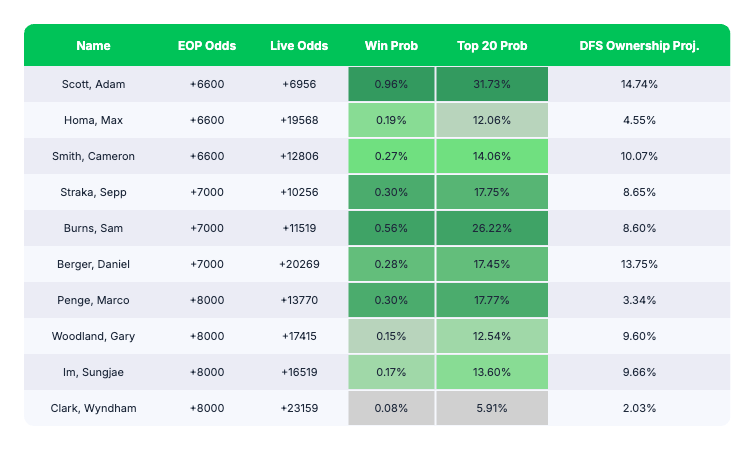
Small pool: Sepp Straka. He was a popular pick heading into the Masters last year but missed the cut. Though I don't think much has changed. He's got an all-around game, great iron play, and pedigree against elite fields.
Big pool: Sungjae Im. It feels like Sungjae has been off for about 24 months, but last year he entered the Masters with zero form and finished T5. He'll probably go way underused in most tiers, and he seems to have some real upside at Augusta, but he's still not talked about as an "Augusta guy."
Honorable mention: Wyndham Clark is everyone's new least favorite player on TOUR. Don't be scared.
Tier 5
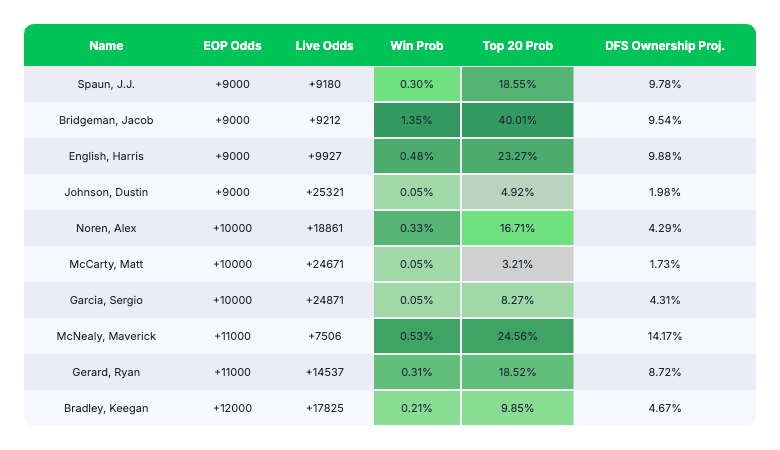
Small pool: Jacob Bridgeman. He's been an elite putter for his whole career and has paired it with really good approach play in 2026, leading to a top 20 in every start this season and a win against an elite field at the Genesis. He should probably be in Tier 3, based on his current form, but he's not a name and doesn't have any major championship pedigree. He has the highest win probability and top 20 probability of any player in this tier.
Big pool: Harris English. He'll never appear on the first page of the leaderboard, they won't show any of his shots on TV, and he'll finish T-17, like always. I'd be thrilled with that from Tier 5.
Honorable mention: Keegan Bradley. No form, lost the Ryder Cup as captain. Makes for a great leverage play here. I do like Maverick McNealy quite a bit, but he'll be the most popular player in this tier.
Tier 6
I didn't include every player here, since there are so many, but here are a few at the top. Most pools will have you select multiple players from this bottom tier.
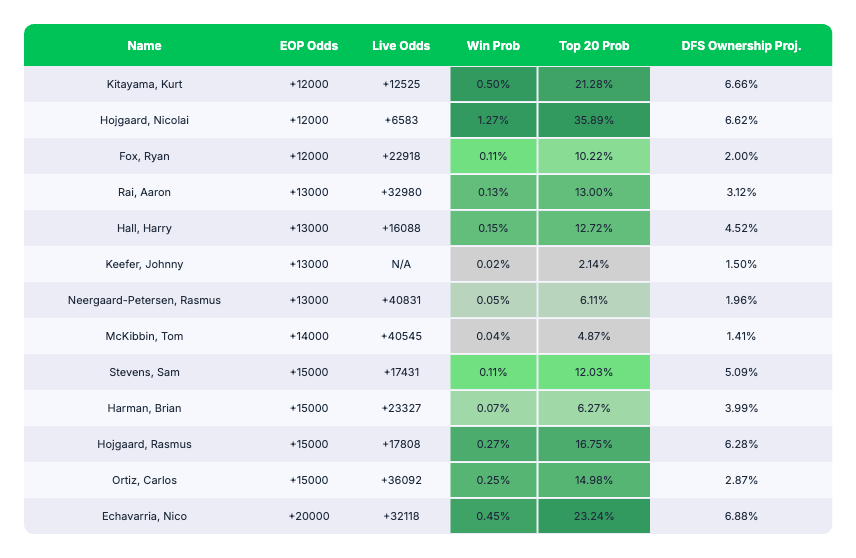
Some notes:
- Nicolai Hojgaard: We have him as a top 20 player in this field, but in this tier, he'll go way over-owned. With a different setup, he'd be much more interesting.
- Rasmus Hojgaard: He's the pivot. His form hasn't been nearly as good as his brother's, but Rasmus entered the year ahead of Nicolai in the DataGolf rankings, and he'll be way less owned.
- Ryan Fox: He qualified for the Signature Events this year so he hasn't played a ton, or appeared at the top of many leaderboards, but he's been as steady as ever. He's been top 40 in both his Masters appearances, all you need from this tier.
- Charl Schwartzel: I bet him to be top South African (there are only three in the field) at +230, and he's another player who will go way under the radar and can give you a 30th-place finish without being mentioned on TV once.
- Michael Brennan: This is digging way deep, but Brennan might be on of the best off-the-tee players on TOUR already. He can't chip or putt of course, which is why he's down here, but his approach play is TOUR-average and if the drives clicks this week, he could pop. And no one will use him.
- Tom McKibbon: He's cooled off after a strong back half of 2025 on both LIV and the DP World Tour, and he's virtually unknown to most American golf fans. At just 23, he's got distance and accuracy off the tee and I wouldn't be surprised to see him competing in majors within the next five years.


