

The Kansas City Royals (3-3) host the Milwaukee Brewers (5-1) on April 3, 2026. First pitch from Kauffman Stadium is scheduled for 7:45 p.m. EDT. The game will be broadcast on Apple TV+.
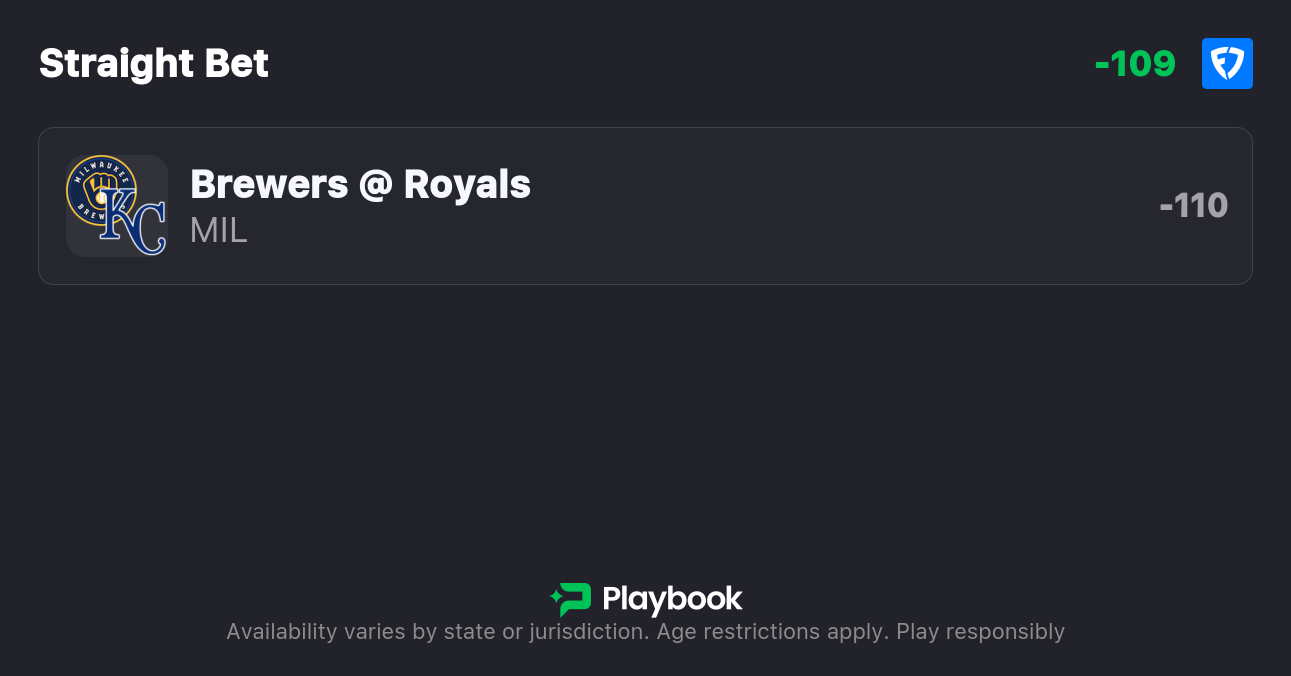
The Brewers are favored by -110118on the moneyline and by -1.5 (+130) on the run line. The Royals are +100 on the moneyline and +1.5 (-160) on the run line. The total is set at 9 runs (-114 / -106).
Find my MLB picks and Brewers vs Royals predictions below, as well as probable pitchers, weather report, and more.


Brewers vs Royals Prediction and Picks
- Brewers vs Royals Pick: Lean Brewers ML (+100 or Better)
Brewers vs Royals Odds, Run Line, and Over/Under
| Brewers Odds | ||
|---|---|---|
| Spread | Total | Moneyline |
-1.5 +130 | 9 -114o / -106u | -118 |
| Royals Odds | ||
|---|---|---|
| Spread | Total | Moneyline |
+1.5 -160 | 9 -114o / -106u | +100 |

- Brewers vs Royals spread: Brewers -1.5 (+130), Royals +1.5 (-160)
- Brewers vs Royals over/under: 9 (-114 / -106)
- Brewers vs Royals moneyline: Brewers -118, Royals +100
Brewers vs Royals Probable Pitchers
| Chad Patrick (RHP) | Stat | Luinder Avila (RHP) |
|---|---|---|
| 0-0 | W-L | Season Debut |
| 0.0 | fWAR (FanGraphs) | |
| 2.08 / 3.43 | ERA / xERA | |
| 4.99 / 4.37 | FIP / xFIP | |
| 1.38 | WHIP | |
| 15.8% | K-BB% | |
| 28.6% | GB% | |
| 95 | Stuff+ | |
| 116 | Location+ |
Brewers vs Royals MLB Betting Preview
Milwaukee Brewers Trends, Key Players
Chad Patrick throws fastballs. That's it.
Around 10% of the time, he throws something else, but the other 90% of the time, batters will see some version of a fastball, whether it’s a four-seam (21.9% in 2025), sinker (23.6%), or cutter (41.2%). He didn’t stray too far from that pattern in his first start of the season either.
He’s also not afraid to elevate any of those pitchers, including the sinker. In fact, he prefers to do so. This particular approach led him to an impressive 17.3 K-BB rate in a rookie season in which his 3.53 ERA matched his FIP and wasn’t too far below his SIERA (3.90) or xERA (3.88), with a 102 Pitching+.
The problem he did have was with left-handed batters (.321 wOBA), against whom his changeup (7.3% vs LHBs) wasn’t very effective (.366 wOBA overall).
Patrick didn’t make it quite through five innings in his first start of the season against the White Sox, but the underlying process and performance were in line with his norms, while he allowed a single run with a 119 Pitching+. PitchingBot is not nearly as much of a fan (5.04 Bot ERA in this start, 5.08 last year).
Patrick may face more lefties than righties in Kansas City, and three of them (Vinnie Pasquantino, Carter Jensen, and Isaac Collins) boast a 130 wRC+ against right-handed pitching since last year. That said, Jensen didn’t have a very large sample, while Collins is one of the most successful batters against cutters in the league since last year (5.0 wFC/C).
With the addition of Collins and further development of Jensen and Jac Caglianone, the expectation is for the Royals to improve upon their 97 team wRC+ against righties last year.
Bobby Witt Jr. produced +7 Base Running Runs last year, while the rest of the projected lineup combined for -10. He is by far their best base-stealing threat against a formidable pair in Patrick and William Contreras when it comes to defending the running game.
The Milwaukee bullpen projects for the second-best FIP (3.88) and ERA (3.77) in the majors via Fangraphs Depth Charts. They should be well rested with Thursday off.
The defense has generally been excellent, with few weak links, generating 27 Runs Prevented last year (third-best in MLB) and the projected lineup (Rotowire and MLBstartingnine.com) coming in at +25 Fielding Run Value.
Kansas City Royals Trends, Key Players
Editor's Note: Michael Wacha was scratched due to illness. Luinder Avila will start in his place.
Luinder Avila threw 14 innings across 13 appearances for the Royals at the big league level in 2025. Impressively, he struck out 16 of the 56 batters faced, but also walked six with his velocity (95.8 mph) playing up a full MPH from his minor league work as a starter.
Avila split time between the rotation (12 starts) and pen (five relief appearances) at the High-A and Triple-A level last season with a 28% strikeout rate and 10.2% walk rate that nearly perfectly matches his small sample major league performance.
His lone start at AAA this season lasted merely three innings and 52 innings, so we should expect to see a lot of the Kansas City bullpen in this one.
While he may lose something in a starting role, Avila displayed strong pitch modeling metrics (3.65 Bot ERA, 104 Pitching+) in major league relief last year and currently rates as the third-best prospect in the Kansas City system, according to Fangraphs.
Although with just a 45 Future Value grade, that probably says more about the state of the system than his prowess with all their recent prospect graduations.
Although he throws four pitches (fastball, sinker, curveball, changeup), it’s the curve that’s the best of the bunch, garnering both a 60 PitchingBot overall grade last season in relief and a 60/60 (current/future) grade in scouting reports.
As mentioned, I’m a bit skeptical that the Brewers will run their standard right-handed lineup out there, which includes six lefties. Gary Sanchez might make sense with a 149 wRC+ and .286 ISO in just 62 PAs against right-handed pitching since last year.
The Brewers are a very good base-running team with a +12 BRR spread throughout a projected lineup. It’s a full lineup effort with Sanchez and William Contreras the only two among the potential nine without at least +1 BRR last year.
Salvador Perez is just as effective as his counterpart in shutting down the running game (in a 75-inning sample of Jensen at the major league level, just two of four base stealers have been successful).
Fangraphs projects the Kansas City relief corps near the bottom of the league (4.15 FIP, 4.19 ERA), and they’ve already faced some adversity, losing expected closer Carlos Estevez to the IL. Having Lucas Erceg close shouldn’t be a problem, but having everyone else move up one spot might be.
The Kansas City defense was only two spots behind the Brewers last year (+23 Runs Prevented), and the projected lineup was similarly strong (+17 Fielding Run Value), though in this case, just three players (Witt, Garcia, Isbel) were responsible for 43 of those runs. That means the remaining projected starters were worth -26 Fielding Run Value.

Brewers vs Royals Pick, Betting analysis
I rate these two pitchers nearly evenly, both close to league average, and also project the lineups as nearly equal, with expected improvements from the Kansas City side.
Though they get there in different ways, these teams grade out equally strong defensively.
The edges in the bullpen and base running on Milwaukee’s side do create a small rift, with just a bit of it going back to Kansas City’s way for home field.
As such, I make the Brewers very minor road favorites. With the market currently sitting near pick without plus money on either side, I won’t fall on either side unless it moves too far in the home team’s direction.
Before discussing the total, we have to cover the environment, and I left it for last because it’s the most difficult part of this equation.
Three-year Statcast park factors recognize Kansas City as one of the most power-suppressing parks in the league, with just a 76 park home run factor, a bit better for RHBs (93) than LHBs (73) — part of that is because the wind frequently blows out to the left in this park.
Yet, it’s also a slightly positive run environment (102 Park Run Factor).
Savvy baseball fans know that power-friendly parks aren’t necessarily high-scoring environments (see Yankee and Dodger Stadiums, both near neutral overall run environments).
Coors Field isn’t the most positive run environment in the league because it’s the most power-friendly, either. It’s because it has the largest outfield, which Kauffman Stadium also USED to have.
I say "used to" because Kauffman was the only park that was moderated during the off-season. Walls from both right and left field were moved in about 10 feet, with the height dropping by about 1.5 feet. We certainly expect more home runs, but we can’t really tell what effect that will have on overall run scoring.
There’s a chance it could even lower BABIP and decrease run scoring, though I’m not arguing that’s likely.
Across three games, run totals of four, 22, and six give us no indication of anything.
If that’s not enough, we also have a strong potential for rain in the area, with industry sources (mlbweather.com and others) putting the chances of precipitation around 80% during game hours.
This is an early forecast on Thursday night and certainly could change, but not having a degree in meteorology, I don’t know how this will affect the game, if it even gets played at all.
The two factors combined (weather and park alternations) leave me far from confident in endorsing any kind of play on a total here, though the same forecasts call for winds in excess of 10 mph blowing out toward center or left, with temperatures in the low 70s.
With this forecast and the old park factors, I would project a total between 8.5 and 9.
Player props are also difficult to evaluate under these particular conditions, especially if we’re looking at a game that could be interrupted or end early.
Follow me on the app (Matt Trollo or RockyJade) in case anything changes.
Pick: Lean Brewers ML (+100 or Better)