


Fanatics Sportsbook's Long Ball Jackpot has actually been a jackpot through the first few days of the season.
The promo paid three users $16,700 on Saturday and 13 users $7,667 on Thursday, just for picking the player who hit the longest home run of the day in MLB.
Here's how it works:
- Opt in and bet a minimum of $5 on a player to hit a home run. You can only select one player.
- If your player hits the longest home run on the MLB slate, you split $50,000 in FanCash with everyone else who bet that player.
- But because the longest home run on a given day is pretty random and about 270 players are eligible on a 15-game slate, there have been some huge winners already.
- Home run distance is measured via MLB's StatCast, which captures "the flight of the path based on radar as far as the radar will allow us to track it" and "if the radar loses it, we project beyond it based on the physics." So, it's not a perfect measurement.
Three users won $16,700 on Saturday night thanks to TJ Rumfield. On Thursday, 13 people won $7,667 on Dominic Canzone (opening day had a $100,000 jackpot). On Sunday, no one had Nolan Gorman since he was a pinch-hitter, and the $50,000 rolls over to Monday.
So what can last season's data tell us about who usually hits the longest home run of the day? If you want to explore this data further, I vibe coded some tools that can help you with this promo.

Longest HRs Are Random
Unlike DraftKings King of the Court, which goes to the NBA player with the most points, rebounds, and assists on a given night, the Fanatics Jackpot is far more random.
Nikola Jokic often has around a 50% chance of winning King of the Court when he plays because you actually need to be really good to rack up tons of points, rebounds, and assists over a whole game. Meanwhile, Aaron Judge and Shohei Ohtani probably have a 1-2% chance to win the Fanatics Jackpot each night.
That's because they actually have to hit a home run (even for league-leader Kyle Schwarber last season, that was only 30% of games), and it has to be the longest, which is also kind of random. On a 15-game slate, there are usually 30-to-40 home runs.
Last season, there would have been 117 unique players to win across 183 days. Only four players won five-plus times, and no one more than eight times.
The big names are all at the top — Schwarber, Judge, Ohtani, Trout, etc— but they still didn't win very often.
It's a lottery, hence the name Jackpot. But you can win big if you get lucky.
While the players at the top mostly just hit a ton of home runs, the Exit Velocity Kings are also present — O'Neil Cruz, James Wood, Elly De La Cruz, etc. These guys didn't hit 40-plus home runs, but they can destroy the ball when they get hold of one.

How Far Do The Winners Hit It?
This will change throughout the season, especially as the weather gets warmer (and maybe as more quality pitchers get hurt and replaced by worse ones).
Still, last season, about 65% of the daily winners were at 440 feet or more. The other 35% ranged from 420 to 439 feet.
The thresholds change a bit depending on the slate size — with 15 games, you need 430-plus feet, but on smaller slates, you can get away with 410 to 429 feet.
Projecting The Payout
The key part of these promos is figuring out how many people will select each player. Fanatics has posted the selections for a handful of players.
- Because Fanatics is smaller than DraftKings, there aren't a crazy number of people playing this promo.
- Because anyone can hit a home run (and gets a few chances to do so), there are 270 usable players each night on a full, 15-game slate.
Here are the longest home runs of Saturday and Sunday, and the payouts if that player had won:
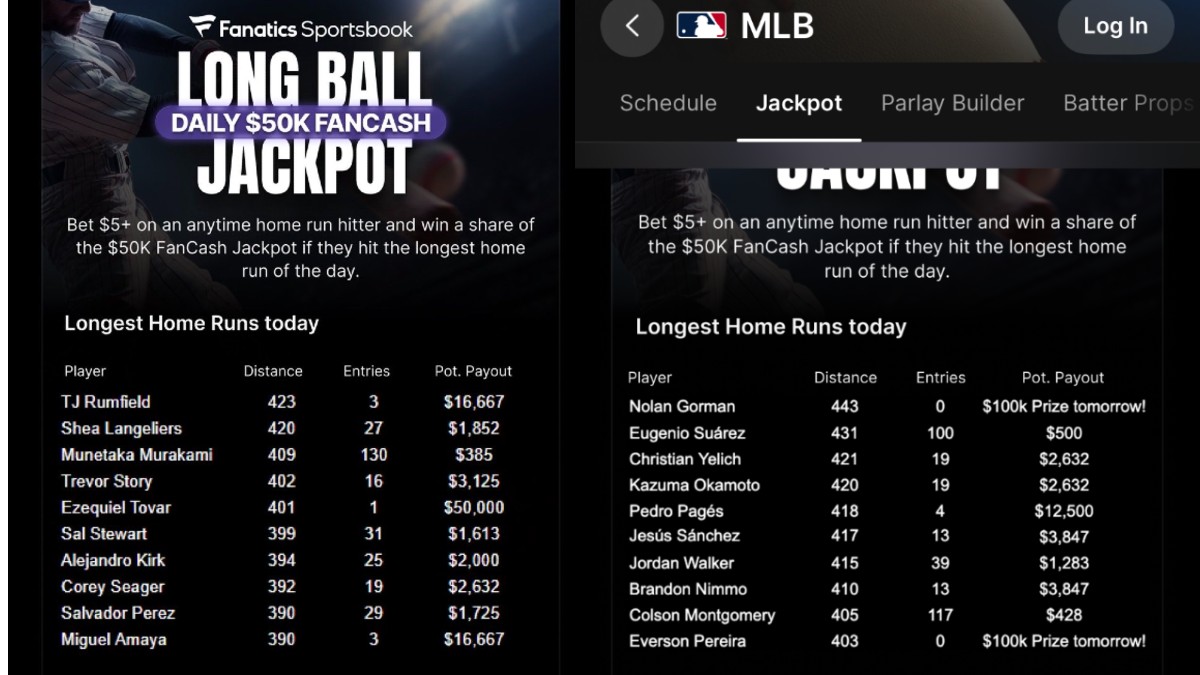
Even Eugenio Suarez, who hit 49 home runs last season, had just 100 users who would have split $500 in FanCash.
Fanatics doesn't release the full data, but I'll monitor it over the next few days to see if we can learn anything about player selection from what they're publishing.
DitkaBets, who does a good job covering these types of promos on Twitter, estimated that Aaron Judge would have paid only $30 in FanCash on Saturday. With a 1-2% chance to win, he's a terrible choice. As he points out, Jokic has around a 50% chance to win DraftKings' King of the Court on a given night, and he's paid out $43 in bonus bets.
The trouble is, there aren't really obvious choices beyond the favorites. With 270 total players to choose from (and probably 100 with a decent chance to homer), it is a bit of a lottery.
I'd subscribe to a few principles:
- Avoid the stars and players with the best odds to hit a home run (anywhere from +250 to +350).
- Avoid players who have been heavily recommended to hit home runs across Twitter that day.
- Find players in the +400 to +500 range (a 15-20% chance to homer) who have the right swing profile and are not being talked about much.
Saturday, for example, Munetaka Murakami and Shea Langeliers had almost identical odds to homer, but because Murakami was a popular home run prop recommended across the Internet, Langeliers had almost five times the expected value and potential payout on this promo.
Finding The Outliers
You want to find players who are swinging the right way — high exit velocity, and a launch angle between 25 and 30 degrees. This is the ideal long home run swing.
The problem is that this leads to many instances where the player pops up or swings and misses. So, without a much, much deeper statistical dive, we only really have a sample of player home runs at that "ideal" swing, which can be misleading.
And with StatCast data available only in MLB, trying to project purely from raw past data will leave out rookies, and anyone with huge power but a tiny sample might look like noise.
A few interesting players:
- Brandon Lowe, PIT: He homered three times on opening weekend, so maybe the cat will be out of the bag. But he's the first player on this list from 2025 data who isn't a consistent 40-plus homer guy or an anecdotal Exit Velocity King.
- Michael Harris, ATL: Harris is a consistent 15-to-20 home run guy, so he's not thought of as a masher. Still, half of his homers traveled over 420 feet last season, the highest rate of 420-plus foot home runs among players with at least 15 dingers.
- Hunter Goodman, COL: Goodman broke out with 31 homers last season, and 16% went 440-plus feet. He would have had only one Fanatics jackpot win, but his profile was good enough for a few more.
- Rookies & small sample size players with big power: As this promo becomes more popular, most people will sort by average home run distance, or find this article, and gravitate toward those players, because no one really knows who hits the furthest home runs outside the big stars. So it might actually benefit you, from an expected-value perspective, to find rookies who won't pop up on these leaderboards. Jac Caglianone (KC), Kazuma Okamoto (TOR), and Coby Mayo (BAL) are three guys with exceptional power grades as prospects and internationals.


