


Welcome to NFL Draft week!
We are going to break down the NFL Draft by looking at the different markets and movement on Kalshi for a multitude of different offerings — players, position, draft slot and more. Plus, we are going to give you the usual primer feel, with notes, stats and trends with some of the markets and some things to look for on draft night.
Before we start — it's important to know this is a live running article.
Updated NFL Draft odds, trends, and markets will all be added to the piece through the end of the first round of action on Thursday. Shout out to @VegasRefund on X/Twitter for NFL Draft sheets. Great info.
All data, stats and trends are updated as of Tuesday, April 21, at 2 p.m. ET.
2026 NFL Draft Primer: Odds, Prospects, Trends
Top 5 Time | Team Odds | GM Notes | Position | Big Sheet |

No. 1 Overall Pick
Fernando vs. Field
It looks obvious, but let's start at the top.
Fernando Mendoza has been the No. 1 pick since he made that throw downfield against the Buckeyes in the Big Ten Title game that locked up the Heisman — or maybe it was his run into the end zone that won the title against Miami that locked it up in January.
You have to go back to January 22nd to find the last time Mendoza was under 90% on Kalshi to be the No. 1 pick.
This book is closed.
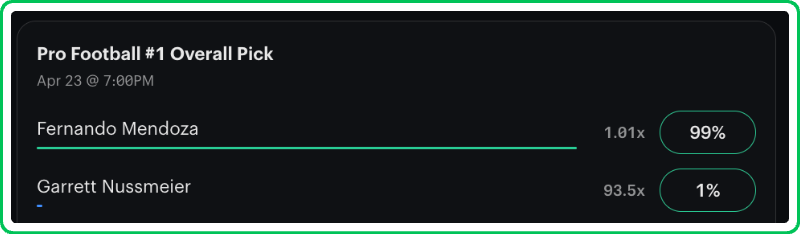
Mendoza threw 41 TDs with just 6 INTs last season on a 9.3 yards per attempt average. He is the 15th QB in the BCS era to throw for 40+ TDs and 6 INTs or fewer in a season.
Of those 15 QBs, six had under 9.5 yards per attempt with those numbers: Mendoza, Caleb Williams, Justin Fields, Geno Smith, Case Keenum and Omar Jacobs.
Those five QBs have combined to go 104-147 SU (41.4%) in the regular season so far in their careers, including 40-72 SU (35.7%) for the team that drafted them.
Back and Forth
Picking The Rusher
The No. 2 pick in the draft is where it gets interesting.
Ohio State LB Arvell Reese got as high as 76.6% on April 3 to be the 2nd overall pick, but mock drafts and news since then has pinpointed Texas Tech DE David Bailey as a player the Jets have their eye on — so for now, the race is tight, with Reese again in the lead.
This market has clearly tightened after Reese peaked earlier in the cycle, with Bailey gaining ground late.
The shift reflects growing confidence the Jets are leaning toward edge over linebacker, making this a true two-player race entering draft night.
The question with this pick is mostly the Jets.
According to either the Stuart, Johnson or Hill draft capital method, the Jets have the most capital in this draft with six picks inside the first 140 selections.
Inside the top-5 picks in the first round, the Jets have only selected two defensive players in their history: Quinnen Williams at No. 3 in 2019 and Dewayne Robertson at No. 4 in 2003. At No. 2 overall in 2026, it would be the highest defensive player drafted by the Jets ever.
On the other side of the Jets selection at No. 2 is the Arizona Cardinals at No. 3.
In 2023 and 2024, the Cardinals used a first-round pick on a defensive lineman in both years, with Walter Nolen last year and Darius Robinson in 2024. Cardinals GM Monti Ossenfort has selected seven players in the first two rounds while with the team — five were defensive players.
With uncertainty at No. 2, this market is naturally tied to what the Jets do, but there’s a growing lean toward defensive line given Arizona’s recent draft tendencies.
That said, the presence of offensive line names keeps this from being fully settled. This is a reactive market — expect movement immediately after the No. 2 pick is announced.

Best of the Rest
Top 5 Round Out
Let's round out the top 5, which is where the draft typically opens up, and the market reflects that with no clear runaway favorite.
Multiple positions remain in play, suggesting teams are still weighing best player available vs. need. Late movement here is likely to be sharp-driven, especially if a player unexpectedly falls from the top three.
Running back in the top five is always a market tension point, and Jeremiyah Love’s presence reflects both elite production and positional skepticism. If he continues to hold meaningful probability, it suggests at least one team in this range is seriously considering him. This is a classic leverage spot where one team’s philosophy can swing the entire market.
No RB has been selected in the top 5 since Saquon Barkley in 2018. Last year, Ashton Jeanty was selected 6th overall by the Raiders, the highest RB drafted since Barkley.
Love accumulated 17+ rushing TDs and 1,100+ rushing yards in consecutive seasons — he's just the second player to do that since the start of the 2020 season, joining Blake Corum in 2022-23. Going back a decade, here are the other players to accomplish that feat: Barkley, Travis Etienne, Devin Singletary and Lamar Jackson.
The question is where will the combine marvel, Sonny Styles, go?
Styles is a LB out of Ohio State, but really a modern defensive chess piece is a better position for Styles, who ran a 4.46 40-yard dash (best of all LBs), a 43.5 vertical jump (tied for 2nd-best of all combine participants) and a 134 in broad jump (T-3rd best of all players). Styles' 43.5 vert jump is the 2nd-best for a LB since 2000, behind Cameron Wake in 2005 for Penn State.
The interesting player is Caleb Downs — a safety taken inside the top-5 picks feels a bit rich for most GMs, especially since Jamal Adams in 2017 is the highest taken safety at No. 6 by the Jets. Since the Jets took Adams, the highest a safety has gone in the draft is Minkah Fitzpatrick at No. 11 in 2018 and then Kyle Hamilton at No. 14 in 2022.
The top-five inclusion market highlights how teams are valuing versatility and athleticism, with players like Styles gaining traction.
However, positions like safety historically face resistance this high, which keeps certain names capped despite strong profiles. This is where projection vs. positional value is most visible in the market.
Another name to watch out for here is Miami OT Francis Mauigoa. He was 4th of 98 players in pass block grade from PFF (at least 500 pass block snaps) last season.
Team Carousel
Where Players End Up
Let's take a look at some players down the draft board that Kalshi is offering markets on where that player will end up playing.
Let's start with the QBs.
The Jacoby Brissett situation has created real uncertainty in Arizona, as he’s skipping offseason work while pushing for a starter-level deal — raising questions about whether the Cardinals view him as a long-term answer.
That opens the door for a rookie QB, and Ty Simpson fits as a developmental option in a bridge scenario. In a weak QB class, teams without stability tend to take swings, making Arizona a logical landing spot.
If the Cardinals remain the favorite, it’s a signal they’re seriously evaluating a developmental path at quarterback.
The Aaron Rodgers situation continues to hang over Pittsburgh, with the team still in limbo at quarterback and previously reflected as the favorite in Carson Beck’s market. That has shifted in recent days, with the Steelers falling out of the top spot as Miami has surged into the lead.
Because of that uncertainty, Pittsburgh has explored contingency plans — including Beck — but the market now points more strongly toward the Dolphins.
Miami’s positioning makes sense with a reshaping QB room around Malik Willis and a need for long-term depth, and there’s an added layer with Beck’s ties to Miami. The movement suggests momentum has moved away from Pittsburgh and toward a more stable landing spot in Miami.
In college, Beck threw 1,390 pass attempts. Since 2000, we've seen 40 QBs drafted after the first round with that many college pass attempts, five of those 40 went on to make a Pro Bowl in their careers.

Out Wide
Wide Receivers
There are three WRs at the top of the 2026 NFL Draft when it comes to skill and profile: Carnell Tate, Makai Lemon and Jordyn Tyson.
At one time or another, all three have been considered potentially the top prospect for evaluators and draft predictors, but trying to predict which team they go to is a whole different story.
In three years of college, Carnell Tate never actually got to 1,000 total receiving yards and he peaked at 52 receptions with Ohio State — here are the WRs to go top-10 in the draft without a 1,000+yard season and their receptions peak at under 55 catches since 2000: 2026 Tate, 2021 Jaylen Waddle, 2009 Darrius Heyward-Bey and 2005 Troy Williamson.
Tate’s market reflects a wide range of outcomes, which aligns with his profile — high-end talent but limited production benchmarks. Teams near the top appear split on projection vs. résumé, keeping his landing spot fluid.
This is a market where volatility is expected up until draft night.
The Fred Biletnikoff Award for the nation's best WR has been given out since 1994 — 32 total seasons. Lemon's 1,156 receiving yards is the 2nd-fewest and fewest since 1994 and his 11 receiving TDs is tied for the 5th-fewest of the group: 2005 Mike Haas, 2001 Josh Reed, 1994 Bobby Engram, 1999 Troy Walters and 2000 Antonio Brown.
Lemon’s broad interest across teams is showing up in the market, with multiple viable landing spots in play.
When a player draws this level of league-wide attention, it often leads to unpredictable draft position outcomes. Expect this to remain one of the more spread-out markets without a clear consensus.
Tyson’s steadier production profile makes him one of the safer projections among the top receivers, and the market reflects a narrower range of outcomes.
Teams valuing consistency over upside could drive his position upward late. Compared to Tate and Lemon, this market feels more stable entering the draft.
This matchup market underscores how close the evaluation gap is between the two receivers.
When markets struggle to separate players, late movement is often driven by specific team fits rather than overall ranking. This is a spot where sharp money can move the line quickly with minimal new information.

Guy On Top
GM Central
Let's take a look at current NFL GM/decision-makers and some notes, trends and stats around their draft picks.
A few bullet points by team given their draft slot.

Cardinals
No. 3
Pick 3 — Arizona Cardinals | Monti Ossenfort (28 picks, small sample)
Ossenfort's small but meaningful sample is 60.7% defense — the highest defensive lean of any GM in Round 1 and CB at 28.6%, the highest CB rate in the entire dataset.
This is extremely consistent with the Cardinals' rumored targets. Bailey and Reese are both connected to Arizona at No. 3. His EDGE rate (10.7%) is solid. Either fits his defensive identity perfectly.

Giants
Nos. 5, 10
Pick 5 — New York Giants | Joe Schoen (31 picks, 3 years)
Schoen drafts CB at 25.8% — second highest in the entire dataset. He has zero safeties drafted in his career (0% S rate).
The board has Caleb Downs (S, Score 86.3, Tape 88.3) and Sonny Styles (LB, Score 86.7) as the top available players at this range.
Taking Downs would be the first safety of Schoen's career. Styles (LB) is more consistent with his defensive instincts. However — the Giants ceded personnel authority to head coach John Harbaugh, who has a Ravens background.
Harbaugh-era Ravens drafted safeties at a meaningful rate. This is the most interesting and least predictable pick of Round 1 as a result.

Chiefs
No. 9
Pick 9 — Kansas City Chiefs | Brett Veach (61 picks, since 2017)
Veach is the most EDGE-heavy drafter of any established GM at 14.8% — the highest EDGE rate in the dataset. He also drafts defense at 57.4% overall.
With KC missing the playoffs for the first time since 2014, there's urgency.
Bailey or Reese falling to 9 would be a perfect Veach pick. His S rate (9.8%) is also high — if the safety market hasn't cleared, Dillon Thieneman (board rank #1, Score 90.9) or Caleb Downs are realistic given Veach's secondary investment history.
Lions
No. 17
Pick 17 — Detroit Lions | Brad Holmes (36 picks, since 2021)
Holmes has the highest Pro Bowl rate (20%) of any GM with 3+ years of data. His defense-heavy approach (55.6% D) with EDGE (11.1%) and CB (16.7%) as top priorities fits the Lions' continued build.
At pick 17, with most top EDGE/CB talent likely gone, Monroe Freeling (OT) or a falling CB/EDGE gets the attention.
Holmes came from the Rams' scouting department — he prizes versatility and tape over athleticism testing, which tracks with how the Lions have drafted.

Add Them Up
Positional Totals
If trying to get an idea of how many of each position could go in the 1st round and what we've seen the last few seasons, here are the positional groups over the last six drafts since 2020. Updated totals listed for positional numbers are from BetMGM.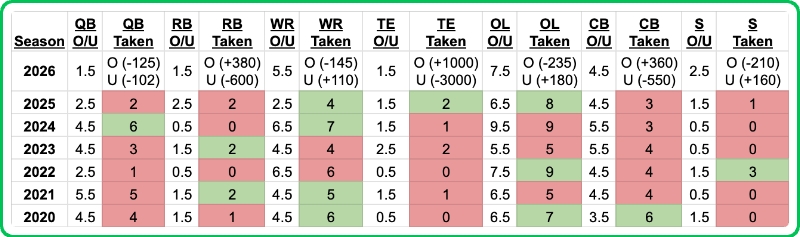
QBs
Quarterback O/U lines have been relatively efficient, with most years landing close to the number (2020, 2021, 2023) and only a couple of meaningful overs (2024).
The market tends to anchor tightly because QB demand is predictable.
For 2026, the 1.5 line implies 2 QBs, which aligns with typical outcomes unless a third name pushes into Round 1 late.
RBs
Running back has consistently trended under or right at the number, reflecting positional devaluation (multiple zeros and ones vs modest lines).
Even when the line is 1.5 or 2.5, teams rarely force RBs into Round 1. In 2026, the 1.5 line still leans under, unless a premium prospect or team need spikes late.
WRs
Wide receiver shows the most consistent over performance, with multiple years beating the number (2020, 2022, 2024, 2025). Teams continue to prioritize pass-catching talent, especially with deeper classes.
The 5.5 line for 2026 is aggressive but still in line with recent overs.
TEs
Tight end is highly volatile but generally leans under, with several zero or one outcomes despite moderate lines. Breakouts only happen when there’s a clear elite prospect tier.
The 1.5 line in 2026 suggests one likely first-round TE, with two requiring a stronger class.
OL
Offensive line consistently hits over or near the number, reflecting positional scarcity and premium value. Even with higher lines (6.5–9.5), teams regularly draft OL early.
The 7.5 line in 2026 fits historical demand and profiles as a slight over lean.
CB
Cornerback has been relatively stable, clustering around the number with slight under bias in recent years. Teams value the position, but depth often pushes some prospects into Round 2.
The 4.5 line for 2026 is well calibrated and likely lands 4–5.
S
Safety is the most consistent under position, with multiple years at zero despite lines around 0.5–2.5. Teams rarely prioritize safeties in Round 1 unless there’s a standout talent.
The 2.5 line in 2026 looks high, historically pointing toward the under.

Pick Your Favorite
Positional Matchups
On Kalshi, they have a few markets where they have players matched up against each other for draft position. Let's take a look at a few that is in the same vein as the chart above — we can start with the positions we haven't touched and the top for each.
Defensive Tackles
Kayden McDonald has separated as the clear favorite to be the first defensive tackle off the board, sitting well ahead of Peter Woods and the rest of the field.
The gap suggests strong conviction from the market, which aligns with teams prioritizing interior disruptors with McDonald’s profile early. Unless there’s a late shake-up, this looks like one of the more stable positional markets.
Offensive Lineman
Francis Mauigoa is the strong favorite to be the first offensive lineman drafted, holding a sizable edge over Spencer Fano.
Offensive line markets tend to reflect team needs more directly, and this kind of separation signals that teams view Mauigoa as the top tackle on the board.
With limited volatility here, it would likely take a surprise team preference to disrupt his position.
2nd QB Taken

The Big Sheet
By Position
Across the NFL Draft market, odds are fluid and sometimes downright chaotic. Given that, here are a few pieces of information if we trusted the rankings and stats in the "Big Sheet" above.
- Caleb Downs — First Safety Drafted. Downs was mocked to the Bengals at pick 10 by a number of outlets prior to Cincinnati trading the pick to the Giants. Dillon Thieneman is his chief competition for this prop. Here's the angle: the sheet ranks Downs significantly higher than Thieneman on tape (88.3 vs. 81.7) even though Thieneman has the better composite score. If you believe tape grade is the better predictor of draft position, Downs first safety drafted is the cleaner play over Thieneman.
- Dillon Thieneman – There may not be a more popular pick than Thieneman to the Vikings as a Harrison Smith replacement, and the Vikings are +190 to take a safety with their first pick. If you believe the data, Thieneman Under 18.5 is worth a look — and the Vikings safety bet at +190 is a nice supplementary play.
- Jeremiyah Love — Angle is him to go in the top 5. There are ample scenarios where Love goes top 5, including the Cardinals, Titans, or Giants. Teams trading down to accumulate assets with a more "ready" team might also take him.
- Spencer Fano — First OT drafted. Francis Mauigoa is the clear favorite to be the first offensive lineman drafted at -300 odds. But the sheet has Fano ranked #8 overall (Score: 85.8) vs. Mauigoa at #18 (Score: 81.7). That's a 4-point composite gap, which is substantial. Fano also has a 94.5 Data Score vs. Mauigoa's 82.7. The market loves Mauigoa because he's the big, imposing tackle with name recognition. The sheet says Fano is the better player. Fano first OT drafted at longer odds worth a stab.

30 For 30
The Matrix
Teams don't burn 30-visit slots on players they're lukewarm about. Every dot in this matrix represents a deliberate decision — a front office putting a prospect in a room, looking them in the eye, and asking hard questions.
Cross-reference the visit patterns against board rank vs. consensus rank and you start to see where the real draft-night action is going to happen.
Here's a look at where the visit data and the betting lines intersect.
- Carnell Tate → Giants/Chiefs
This one jumps out from the visit data hard. Tate's sheet shows seven 30 visits: Tennessee, NYG, Cleveland, Washington, NO, KC, and the Rams. The internal board has him at #34 overall but the consensus rank is #9-10 — there's a meaningful gap there, suggesting the model is lower on him than the market.
Here's the angle: Tate is priced at Under 7.5 at -180, meaning the market expects him inside the top 7. But the KC visit is notable — there are reports that Chiefs WR Rashee Rice expressed a desire to have Tate on the team, and the Chiefs could trade up to No. 5 to get him. Lineups KC is listed at +1000 to draft Tate. Given the confirmed visit and the Rice connection, that's a value play on a team that could easily trade up into that range.
- Kenyon Sadiq → Tampa Bay Buccaneers or Kansas City
The sheet shows Sadiq visited Cleveland, KC, Carolina, and Pittsburgh — four visits total. The internal board has him at #7 overall (Score: 86.2), which is notably higher than his consensus rank of 16-18.
The market has him with an over/under of 15.5 at -205 for the over Bleacher Nation, meaning books expect him to go after pick 15. But his visit to Kansas City is particularly interesting — KC picks at 9, and Sadiq would be a significant upgrade at TE for Patrick Mahomes. The sheet's internal grade sees him as a top-10 talent the market is sleeping on. Sadiq Under 15.5 at +155 is the direct bet, supported by both the KC visit and the model's conviction.
- Makai Lemon → NO Saints — Most Visited Player
Lemon has the joint-most visits in the entire sheet at 10 teams: NYJ, Tennessee, NYG, Cleveland, Washington, NO, KC, the Rams, Minnesota, and Pittsburgh. That's a WR with elite interest spread across the draft.
The internal board has him at #15 (Score: 82.3), roughly in line with consensus. The NO visit stands out because the Saints are mocked to take Lemon at pick 8 in multiple mock drafts.


