


If you want more Action Network content, be sure to add us as a preferred source on Google.
In Week 2, Carson Wentz came in for the Vikings after starting QB Kyler Murray suffered a concussion and was forced to miss the game.
Now, in Week 5, Ravens starting QB Lamar Jackson has an ankle injury that could reportedly sideline him for several weeks, thrusting backup QB Tyler Huntley into the starting lineup.
In the NFL, we see countless examples of a starting QB getting injured and needing to be replaced for either a single game, or extended time. The question is, "How do those quarterbacks perform and where can we take advantage as bettors?"
After tracking each quarterback over the last 10+ seasons using our Bet Labs database, we finally have some answers.
(All data is entering Week 5 of the 2026 regular season. Be sure to download the Action Network app for more analysis)
What We Know
Before we begin, we should take a second to try and define what exactly a "backup QB" is.
Between being benched, getting injured and numerous other reasons why a coach would switch QBs, some of the difficulty in quantifying a "backup" is simply the situation.
For example, let's look at the 2019 Jaguars.
- Nick Foles starts Week 1 and breaks his collarbone.
- Rookie Gardner Minshew gets the start in Week 2 — that qualifies as a backup.
- Minshew starts eight games (all as a backup) and then Foles returns for the Jaguars' 10th game.
- Foles starts games 10-12 and is benched for Minshew, who starts games 13-16 — those games do not qualify as a backup.
With that in mind, let's look at the data.
In the last decade, here is how backup QBs have performed straight up (SU) and against the spread (ATS) after starting a total of 600+ games across all 32 NFL teams. For the data below, we will look at backup QBs vs. QBs not in that position.
Backup QBs have struggled straight up (not a shock), but the number has drastically dropped recently over the last three years (-3.7%).
When it comes to totals, this season has seen a bit of a turn. In 2024 and 2025, overs were 70-52 (57.4%) when a backup QB faced a starter. This season so far, they are 9-2 to the under.
From a point spread perspective, where you start to see some value in backup QBs is when you dig into the numbers rather than looking at just the big picture.
Is there an advantage or disadvantage at home?
Over the last five years, backup QBs (vs. not) are 64-81 (44.1%) straight up and 77-66-2 (53.8%) against the spread at home, much better recently compared to road teams, who have won just 30% of games and covered just 47.5% in that span.
How tight are the margins home vs road for these backup QBs?
If you look over the last decade, backup QBs (vs. not), who are listed as underdogs, which is most of the time, help bettors out more at home vs. the road.
At home in a 6-pt teaser as an underdog, backup QBs win 69.4% of teasers (still below average). On the road, that number dips to just 67.1% in a 6-pt tease.
Related Articles
The Biggest Advantages
When it comes to backup QBs, here were the theories I was most interested in looking up:
- Should you bet or fade backup QBs early in the year?
- How about bigger favorites and underdogs? What about tight spreads?
- Can we decipher anything from line moves?
- What about a backup QB's first start of the year?
Let's dive in.
Do backup QBs struggle more earlier in the year?
In the last decade, we've seen 152 backup QBs face a starter within the first six games of the regular season. They are 59-93 SU (39%) and 79-73 ATS (52%, -0.3 margin).
In game 7 or later, they are 35.2% SU and 50.1% ATS (-1 margin).
So yes, a tad better, but marginal.
What are the numbers on big favorites and underdogs?
A backup QB has closed as a TD favorite or greater 19 times in the last decade. In those 19 games, the backup QBs are 14-5 straight up, but just 7-12 against the spread, including 11-3 to the under in the 14 home games.
Underdogs of a TD or more with a backup QB are 30-197 SU (12.1%) and 107-116-4 ATS (48%) in the last 10 years. When those QBs are at home, they've shown a slight edge at 14-65 SU (17.7%) and 42-37 ATS (53.2%) in that span.
Is there an advantage in tight spreads?
The answer is not really, but a good lesson to beware of.
Backup QBs with a tight spread (under a FG) are 66-62 ATS last decade, but just 30-37 ATS at home, similarly overvalued on their own turf.
How about line moves. Do they tell a story?
We've seen 77 games in the last decade where a team starting a backup QB (vs. a team not) saw their line move 7+ points against them between their lookahead line and their closing line (ex. +3 to +10).
Those backup QBs win 23% of games outright and cover 52.6% of the time.
But what is interesting is early and late in games.
In First Half: 46-31 ATS (59.7%); 44-32-1 (58%) to under
In Second Half: 31-43-3 ATS (41.9%); 36-39-2 (48%) to under
If we take a step further, allowing more teams into the pool, the value increases.
When the line moves more than a field goal away (3.5 or more) from a team with a backup QB over the last five seasons, those teams are 48-102 SU, but 82-67-1 ATS (55%). But when those teams play at home, that moves to 29-46 SU and 44-31 ATS (58.7%).
When the backup enters, can we profit on their first start?
As an example, let's look at the Saints from the 2021 season.
Jameis Winston started the first seven games. Enter Trevor Siemian for four games, followed by five games of Taysom Hill and one start from Ian Book.
How do QBs like Siemian, Hill, and Book perform in their first start as a backup in a given season?
In the last decade, there have been 199 total games where a backup QB made their first start of that season, subbing in for the starter.
As a theme so far from this piece: the home teams? Overvalued. The road teams? Bet them when you can.
League Wide
For a league-wide look, let's focus in by franchise.
- Over the last decade, the 49ers have played the most games with backup QBs with 57 in total, seven more than the Browns (50), who have the second-most and the Jets in third with 44 such games.
- On the other side of the spectrum, the Patriots have started just four backup QBs in the last 10 seasons, with the Chargers starting only five.
- Which teams have performed the best and worst against the spread with a backup QB?
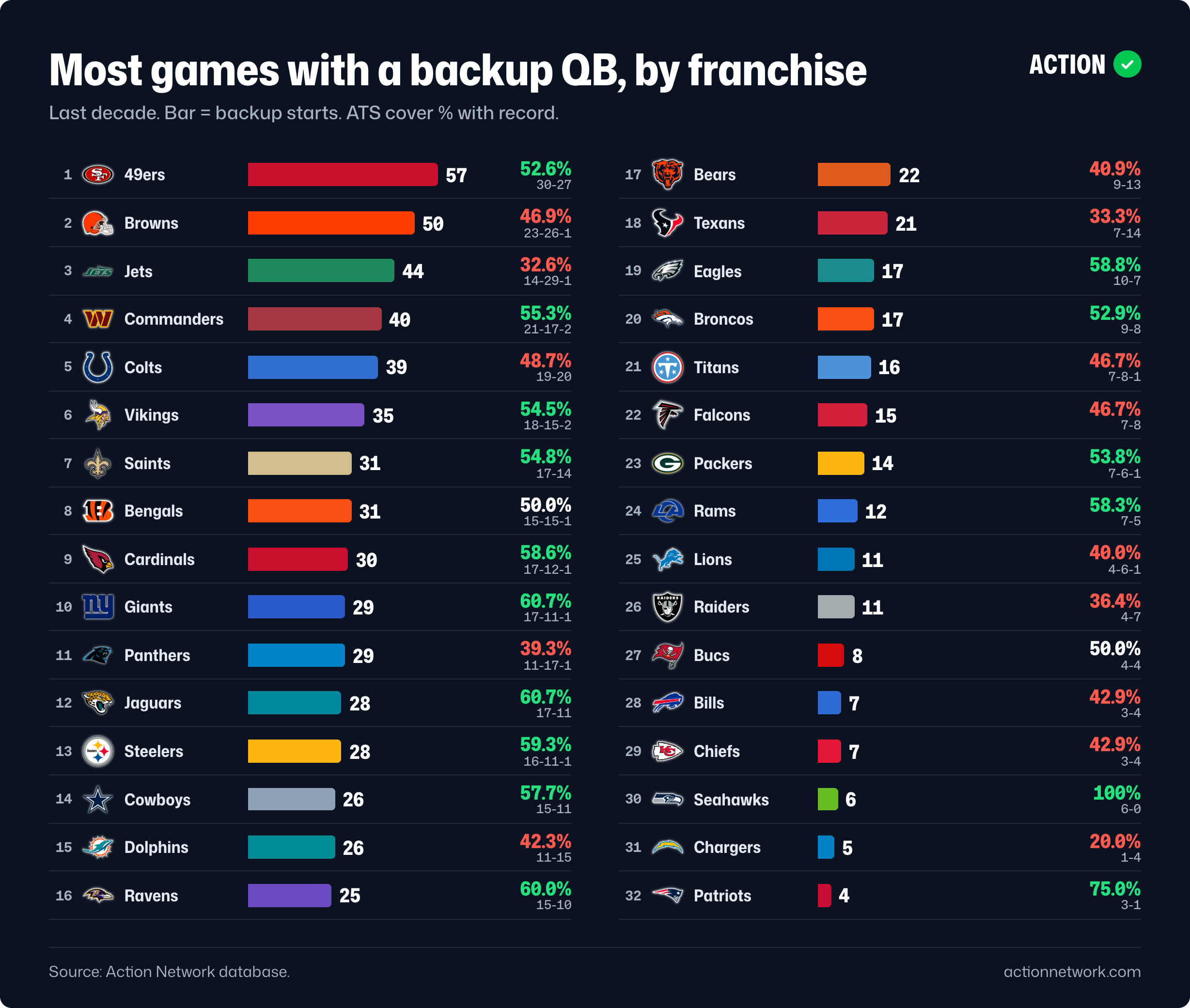
Here are the best of the best.
The Seahawks are a perfect 6-0 ATS with a backup QB, and minimum 10 games, title goes to the Jaguars at 17-11 ATS and the Giants at 17-11-1 ATS.
Only four teams are above .500 SU with a backup QB: Eagles, Steelers, 49ers, and Vikings.
The king of the backups has been Jacoby Brissett, with 34 such games (most of any QB) and a 19-14-1 ATS mark in them.
In the last decade, four QBs have made 10+ starts as a backup with a 60%+ ATS win percentage: Nick Foles, Jimmy Garoppolo, Tyler Huntley and Case Keenum.
The coach who got the most out of his backups? Of course, Riverboat Ron Rivera at 17-7-2 ATS (71%).
Now for the worst of the worst.
Not only are the Jets third in total backup QB games, but they are 14-29-1 ATS (33%), for the worst ATS mark in the NFL. The only franchise in my system without a win with a backup QB are the Lions at 0-11 SU in this range.
If you are betting on a backup QB to cover, you should hope not to see these fellas.
Here are the lowest ATS win percentages as a backup (min. 10 games): Nick Mullens, Zach Wilson, Jake Browning, Colt McCoy.
Only two head coaches (min. 10 games) are below 30% ATS win pct with a backup: Bill O'Brien and Robert Saleh.


