


Missouri casinos generated $171.4 million in adjusted gross revenue in August. That's down 3.5% from the same month last year, according to data from the Missouri Gaming Commission.
The statewide decline was driven largely by a sharp drop in table-game revenue. While slot machines remained relatively stable, revenue from games such as blackjack, craps, roulette, and poker fell at a much faster rate.
Missouri’s 13 commercial casinos produced $150.2 million from slots during the month, down about 1% year over year. Table games generated $21.1 million. That's a drop of nearly 18%d from August of last year.
That's the opposite of what we saw earlier this year. Lawmakers in "The Show Me State" are also considering whether or not to make casinos smoke-free.

Slots Remain the Foundation for Missouri Casinos
Slots continued to account for the overwhelming majority of gaming revenue at Missouri casinos.
The $150.2 million generated by slot machines represented nearly 88% of the state’s August adjusted gross revenue. That level of stability helped limit the overall decline, even as table games posted a much steeper drop.
Slot revenue is often more predictable than table-game revenue because casinos process a high volume of smaller wagers from a broad customer base. Players can use slot machines at almost any time, without needing a dealer, another player, or knowledge of game rules.
That consistency makes slots the financial backbone for most Missouri casinos, especially during months when live-table activity weakens.

Why Missouri Table-Game Revenue Fell
The 17.7% decline in table-game revenue does not necessarily mean Missouri casinos are facing a major collapse in demand. Table games are naturally more volatile than slots, and a relatively small change in high-limit play or player volume can have an outsized effect on a monthly report.
Table-game revenue depends on two main factors: how much customers wager and how much the casino retains after paying winning bets.
A few high-stakes blackjack, baccarat, roulette, or craps sessions can materially change a casino’s monthly results. If high-limit players win more often than usual, or if fewer large bettors visit a property, table revenue can drop quickly.
Slots operate differently. They involve a much larger number of lower-dollar wagers, which generally creates steadier results over time. That helps explain why slot revenue declined only about 1% while table-game revenue fell 17.7%.
Consumer Spending May Affect Live Tables More
Table games often attract customers who are willing to wager more per hand, remain at the casino longer, and spend more on food, drinks, hotel stays, and entertainment.
When consumers become more cautious about discretionary spending, higher-cost gambling activities may be among the first to feel pressure. Inflation, travel expenses, and general uncertainty about household budgets can all affect how much visitors are willing to risk at live tables.
By comparison, lower-denomination slot machines may remain appealing to customers looking for a less expensive form of casino entertainment.
Changing Player Preferences Could Matter
Slots are simple, fast, and accessible. Players do not need to understand betting systems, table etiquette, or game strategy before they begin.
Traditional table games can require more time and confidence, particularly for newer casino visitors. Some players may also prefer electronic gaming options over live dealer tables because machines allow for a more private and flexible experience.
Casinos also face higher operating costs for table games because live pits require dealers, supervisors, security staff, and support personnel. If demand softens, operators may reduce table hours or adjust the number of active games, which can further affect revenue.

Sports Betting Creates Another Entertainment Option
Missouri’s legal sports betting market launched on Dec. 1, 2025, giving residents another regulated wagering option. Major operators entered the market through casino and team relationships, expanding the number of gambling products available to customers statewide.
It is too early to state that sports betting directly caused the August table-game decline. However, sports wagering may compete for some of the same entertainment dollars, particularly from customers who previously spent more on blackjack, craps, roulette, or other live games.
The impact may be more noticeable among younger customers and bettors who are comfortable using mobile gambling products.

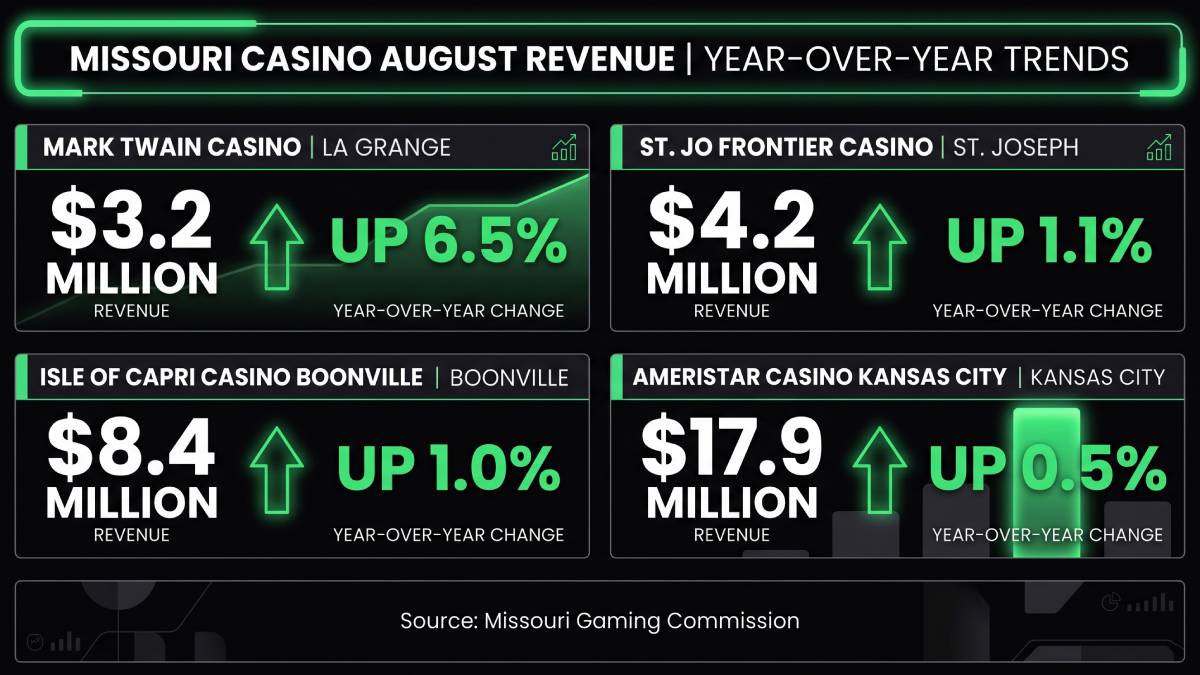
Four Missouri Casinos Posted Revenue Gains
Only four Missouri casinos reported year-over-year gains in August, showing that the statewide decline was not uniform across every market.
- Mark Twain Casino in La Grange generated $3.2 million – Up 6.5%
- St. Jo Frontier Casino in St. Joseph generated $4.2 million – Up 1.1%
- Isle of Capri Casino Boonville generated $8.4 million – Up 1.0%
- Ameristar Casino Kansas City generated $17.9 million – Up 0.5%
The rest of Missouri casinos reported year-over-year declines of different sizes.
Property-level results can vary because of local demand, tourism patterns, promotional activity, nearby competition, hotel and event traffic, and changes in high-limit play. August can also be an uneven month for casino visitation as summer travel winds down and families shift spending toward back-to-school needs.
What the August Results Mean
The August report shows that Missouri casinos remain a significant gaming market, even with a modest year-over-year revenue decline.
The more important takeaway is the difference between slots and table games. Slot revenue held relatively steady, confirming that electronic gaming remains the state’s most reliable casino revenue source. Table games, however, showed how quickly monthly results can change when high-stakes play, customer traffic, or casino hold percentages move in an unfavorable direction.
Missouri’s casinos generated $171.4 million in August adjusted gross revenue, and slots continued to deliver most of that total. Missouri’s 13 casinos pay a 21% gaming tax on adjusted gross revenue, according to the Missouri Gaming Commission’s annual report.
Future monthly reports will help show whether the table-game decline was a short-term fluctuation or part of a broader shift in player behavior, consumer spending, and competition within Missouri’s expanding gambling market.


